Domestic Food Assistance: Summary of Programs
Changes from August 27, 2019 to February 19, 2026
This page shows textual changes in the document between the two versions indicated in the dates above. Textual matter removed in the later version is indicated with red strikethrough and textual matter added in the later version is indicated with blue.
Domestic Food Assistance: Summary of of Programs
Contents
-
Contents
Background - Hunger and Food Insecurity
-
- Food Insecurity Rates in Recent Years
Program Variation -
USDA
-FNS Programs - Farm Bill
- WIC and Child Nutrition Programs
-
HHS
-ACL Programs- DHS FEMA Emergency Food and Shelter Program
Tables
- Table 1. Overview of Farm Bill Food Assistance Programs
ACL Programs
Tables
- Table 1. Overview of Farm Bill Programs
- Table 2. Overview of WIC and Child Nutrition Programs
- Table 3. Overview of Older Americans Act (OAA) Nutrition Programs
Summary
Over the years, Congress has authorized and
Summary
Since the 1930s, the federal government has administered programs to provide food to the hungry and to other vulnerable populations in this country. This report offers a brief overview of hunger and food insecurity along with the related network of programs. The report is structured around three main tables that contain information about each program, including its authorizing language, administering agency, eligibility criteria, services provided, participation data, and funding information. In between the tables, contextual information about this policy area and program administration is provided that may assist Congress in tracking developments in domestic food assistance. This report provides a bird's-eye view of domestic food assistance and can be used both to learn about the details of individual programs as well as compare and contrast features across programs.
This report includes overview information for the U.S. Department of Agriculture's Food and Nutrition Service (USDA-FNS) programs as well as nutrition programs administered by the Administration on Aging (AOA), within the U.S. Department of Health and Human Services' Administration for Community Living (HHS-ACL). USDA-FNS nutrition programs include those most recently reauthorized by the 2018 farm bill (the Agriculture Improvement Act of 2018; P.L. 115-334). Programs in the farm bill include the Supplemental Nutrition Assistance Program (SNAP), The Emergency Food Assistance Program (TEFAP), Commodity Supplemental Food Program (CSFP), Fresh Fruit and Vegetable Program (FFVP), and the Senior Farmers' Market Nutrition Program (SFMNP). USDA-FNS also administers programs not contained in the farm bill: the Special Supplemental Nutrition Program for Women, Infants, and Children (WIC) and Child Nutrition programs (School Breakfast Program [SBP], National School Lunch Program [NSLP], Summer Food Service Program [SFSP], Special Milk Program [SMP], and Child and Adult Care Food Program [CACFP]). HHS-ACL programs are the nutrition programs contained in the Older Americans Act (OAA)—Congregate Nutrition Program; Home Delivered Nutrition Program; Grants to Native Americans: Supportive and Nutrition Services; and the Nutrition Services Incentive Program (NSIP).
Background
This report gives an overview of the major federal programs that provide food assistance within the United States and the territories. The report begins by discussing common concepts and themes across the network of domestic food assistance programs. The report is split into two main parts: programs administered by the U.S. Department of Agriculture's Food and Nutrition Service (USDA-FNS), and programs administered by the Administration on Aging (AOA), within the U.S. Department of Health and Human Services' Administration for Community Living (HHS-ACL). Within the USDA-FNS section are two subsections of programs: Farm Bill programs (Table 1), and the Special Supplemental Nutrition Program for Women, Infants, and Children (WIC) and child nutrition programs (Table 2). Within the HHS-ACL section, Table 3 provides an overview of the Older Americans Act (OAA) nutrition programs.1 The tables within this report are intended to provide summary information, which can help illustrate the ways in which domestic food assistance programs are both similar and different.
Hunger and Food Insecurity
the United States. Such efforts date back to the Great Depression, when the government became involved in distributing agricultural surpluses to households and school lunch programs.
The relationship between food assistance and the farm economy has persisted over time, with many programs having the mutual goals of feeding people in need and supporting the agricultural sector. Most programs are administered by the U.S. Department of Agriculture's (USDA's) Food and Nutrition Service (FNS), including the largest—the Supplemental Nutrition Assistance Program (SNAP). SNAP and several other FNS programs have historically been reauthorized in the farm bill, an omnibus reauthorization and extension of dozens of farm, food, and nutrition laws. FNS also administers programs included in a separate child nutrition reauthorization process, including the Special Supplemental Nutrition Program for Women Infants and Children (WIC) and the National School Lunch Program. Other food assistance programs are administered by the U.S. Department of Health and Human Services' (HHS') Administration for Community Living (ACL) and the U.S. Department of Homeland Security's (DHS's) Federal Emergency Management Agency (FEMA). Those programs include ACL meal programs for seniors authorized under the Older Americans Act (OAA), and FEMA's Emergency Food and Shelter Program (EFSP), which includes a focus on individuals experiencing or at risk of experiencing homelessness. Although each of the programs discussed in this report provides for food in some way, the methods through which they accomplish this goal vary. For example, some programs provide food assistance to low-income households broadly, whereas others are targeted to specific populations (e.g., infants, children, seniors). The type of assistance can also differ. SNAP and certain other programs provide benefits redeemable for groceries, whereas others distribute foods or support prepared meals (e.g., the school lunch program). Some programs also support local feeding organizations' operating costs. All of the programs aim to reduce hunger in some way. Over the past 30 years, USDA has monitored trends in food insecurity—a related concept to hunger—in order to assess national progress toward reducing food-related hardship and collect data that is used in evaluating domestic feeding programs. For 2024, USDA estimated that 13.7% of U.S. households were food insecure at some point during the year, meaning that they could not afford or obtain adequate food due to a lack of resources. Such households included 49.7 million individuals. Approximately 5.4% of U.S. households experienced very low food insecurity, a more severe kind of food insecurity that reflects reduced food intake and disrupted eating patterns. USDA announced the discontinuation of its food insecurity reports in 2025. This report begins with a brief overview of hunger and food insecurity in the United States, and then describes the domestic food assistance programs in three sections: those administered by (1) USDA FNS, (2) HHS ACL, and (3) DHS FEMA. It includes information about each program, including its authorizing language, administering agency, eligibility criteria, services provided, and participation and funding levels. It also compares and contrasts features across programs. There are aspects of other federal programs that support nutrition in the general population, such as the U.S. Department of Health and Human Services' (HHS') Dietary Guidelines for Americans, coverage of medical foods and social determinants of health initiatives within Medicaid, and the Centers for Disease Control and Prevention's (CDC's) research on and promotion of nutrition interventions.1 Researchers have also linked certain non-food benefits, such as tax credits and cash assistance, with reductions in food insecurity.2 These other linkages between federal programs and nutrition are not discussed in this report.Background
This report gives an overview of the major federal programs that provide food assistance within the United States, including the territories. The report begins by discussing common concepts and themes across the network of domestic food assistance programs. It then breaks out discussions of programs by administering agency in the following report sections: (1) "USDA FNS Programs" (see Table 1 for farm bill programs and Table 2 for WIC and child nutrition programs), (2) "HHS ACL Programs" (Table 3), and (3) "DHS FEMA Emergency Food and Shelter Program" (Table 4). The tables within this report are intended to provide summary information, which can help illustrate the ways in which domestic food assistance programs are both similar and different.
2
Evaluating trends in hunger in our nation is crucial to understanding if the efforts to prevent hunger are working and in identifying vulnerable populations that need assistance. "Hunger,"3
Over time, government officials and researchers have developed ways to evaluate trends associated with hunger, with the goal of identifying vulnerable populations that need assistance and understanding if efforts to prevent hunger are working. Hunger, however, is a challenging concept to measure. For that reason, "Instead, food security" and "food insecurity," as opposed to "hunger," are the prevailing terms used to describe the ability to access adequate food.
"Food security" and "food insecurity," as defined by USDA, focus on economic and other access-related reasons associated with an individual's ability to purchase or otherwise obtain enough to eat. They are also terms that can be objectively measured. USDA's use of these terms came out of a decades-long collaboration between federal agencies and private-sector researchers to improve the measurement of hunger in the U.S. population.34 This consortium concluded that hunger, as an individual-level physiological condition, was difficult to measure through a household survey. They recommended food security and food insecurity as alternative concepts that captured the economic reasons for inadequate food and/or nutritional intake, rather than individual behaviors that may result in the physical condition of being hungry (for example, dieting or missing a meal due to illness). This newThe resulting food security measure was deployed in a multiquestionmulti-question "Food Security Supplement" to the Census's Current Population Survey (CPS) starting in 1995.5 In 2006, a National Academies panel convened at the request of USDA evaluated the measure, recommending its continued use with some refinements to the food security and insecurity definitions.4
Each year, USDA's Economic Research Service (USDA-ERS) conducts an analysis based on the Food Security Supplement data.5 Data from the USDA-ERS's 2017 study are included in this CRS report. 6
Since 2006, USDA-ERS has recognized a spectrum of four levels of food security, listed below from highest to lowest:
Food Security:
High food security—Households had no problems, or anxiety about, consistently accessing adequate food.
Marginal food security—Households had problems at times, or anxiety about, accessing adequate food, but the quality, variety, and quantity of their food intake were not substantially reduced.
Food Insecurity:
Low food security—Households reduced the quality, variety, and desirability of their diets due to a lack of money or resources, but the quantity of food intake and normal eating patterns were not substantially disrupted.
Very low food security—At times during the year, eating patterns of one or more household members were disrupted and food intake reduced because the household lacked money and other resources for food.6
Note that the National Commission on Hunger, a congressional commission that operated from 2014 to 2015, used "very low food security" as its working definition of "hunger" in its final report released in January 2016.7
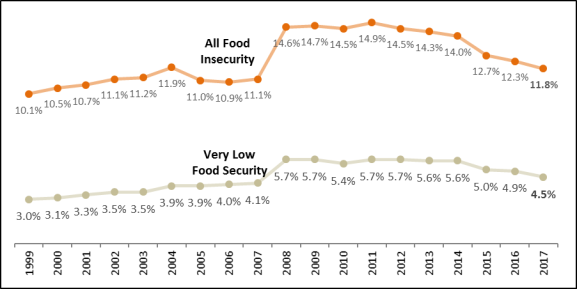
Figure 1.Trends in U.S. Food Insecurity, 2005-2024 (figure is interactive in HTML version of this report) Notes: "Low food security" and "very low food security" are subsets of all food insecurity. Low food security means that households reduced the quality, variety, and desirability of their diets due to a lack of financial resources, but the quantity of food intake and normal eating patterns were not substantially disrupted. Very low food security means that at times during the year, eating patterns of one or more household members were disrupted and food intake reduced because the household lacked money or other resources for food.In 2017, USDA-ERS found that 11.87
USDA's Economic Research Service (ERS) has historically funded the Food Security Supplement and published annual reports analyzing findings from the survey.8 In fall 2025, USDA announced that it would be discontinuing the survey and reports after the release of its 2024 findings.9 Findings from ERS's 2024 report are presented in the next section.
Food Insecurity Rates in Recent Years
In 2024, ERS found that 13.7% of U.S. households (where "household" includes one or more members) were food insecure.10 This was similar to the food insecurity rate in 2022 and 2023, but a statistically significant increase compared to rates in 2016 through 2021.11 As shown in Figure 1, the national household food insecurity rate reached recent highs of nearly 15% following the Great Recession, declined to a low of 10.5% in 2019 and 2020, then increased again following the COVID-19 pandemic.12 ' +
'● ' +
'{series.name}: {point.y:.1f}% % of U.S. households (where "household" includes one or more members) were food insecure—a statistically significant decline from 2016, when the rate was 12.3%, and recent highs of nearly 15% following the Great Recession.8 These rates, as well as the subset "very low food security," are shown in Figure 1.
In summary, in 2017
- 11.8% of U.S. households were food insecure (15.0 million households). This is a statistically significant decrease from 12.3% in 2016.
- 4.5% of U.S. households had very low food security (5.8 million households), a statistically significant decline from 4.9% in 2016. (Households with very low food security are a subset of food insecure households.)
- 58.4% of food insecure households reported that they participated in SNAP, WIC, or NSLP in the last month. However, this may be an underestimate because survey respondents often underreport participation in assistance programs.
USDA-ERS also analyzes food insecurity rates for different subpopulations and household types, finding subgroups above and below the national rates of food insecurity.17 Some examples of their 2017 findingsthese findings for 2024 include the following:
79.9% of households that included anelderly memberolder adult (aged 65 or older) (4.4 million households) were food insecure. This increase from 2016's rate (7.8%) is not statistically significant.15.7% of households that included children. This rate was higher (11.3%) among older adults living alone. 18.4% of households with children (6.7 million households) were food insecure. Food insecure households with children do not always include children who are themselves food insecure, as adults often shield children. Therefore, only 7.7% of households with children. However, not all members of the household are affected by food insecurity in the same way. Adults tend to shield children from food insecurity, and children often receive food benefits (such as free school meals) that are not accessible to adults. In 2024, ERS estimated that roughly half of food insecure households with children actually included a child experiencing food insecurity (representing 7.3 million children in 3.3 million households).- This included 751,000 children living in 318,000 households in which children experienced very low food security, meaning that they were hungry, skipped a meal, or did not eat for a whole day because there was not enough money for food.
24.4% of households headed by Black, non-Hispanic individuals; 10.1% of households headed by White, non-Hispanic individuals; and 20.2included food insecure children. These changes from 2016 findings (which were 16.5% and 8.0%, respectively) are not statistically significant.21.8% of households headed by black, non-Hispanic individuals; 8.8% of households headed by white, non-Hispanic individuals; and 18.0% of households headed by Hispanic individuals were food insecure.These were not statistically significant changes from 2016 rates (22.5%, 9.3%, and 18.5%, respectively).
Program Variation
Program Variation
There are a number of domestic food assistance programs.18 Although each of the 17 programs discussed in this report provides for food in some way, the ways in which each program accomplishesthey accomplish this goal vary. For example, programs vary with respect to the target population (e.g., pregnant women, children, older individuals), eligibility requirements, and types of assistance provided (e.g., grocery benefits, commodity foods, prepared meals), and settings (e.g., foods for consumption at home, meals served in institutional settings).
commodity foods, prepared meals). In an April 2010 report, the Government Accountability Office (GAO) listed 70 programs that pertain to food and nutrition but ultimately narrowed their study to a smaller subset of 18 programs that focus on food assistance or coordination of food assistance activities.9
One way to examine this variation is to compare the populations eligible for these domestic food assistance programs. For instance, the WIC program is available to children under the age of five, while the school meals programs (the NSLP and School Breakfast Program [SBP]) become available to school-age children. Another way to examine this variation is to compare the benefits that these programs provide. Within this constellation of programs, federal resources provide benefits redeemable for uncooked foods, cash assistance to support program operations, USDA-purchased commodity foods (discussed further in the next section), and prepared meals. While some programs provide specific foods (e.g., through the federal and state requirements for "food package" in the Commodity Supplemental Food Program [CSFP] and WIC), SNAP gives benefits that may be redeemed for a wide variety of foods at authorized retailers. OAA programs provide prepared meals that not only assist those who lack adequate resources to purchase food, but can also assist those who lack the functional capacity to prepare a meal on their own.
The following sections of the report and the accompanying tables provide more details about the services, eligibility, participation, and funding for each program. They help illustrate the similarities and differences between the programs, including the extent to which they provide similar or distinct forms of assistance to similar or distinct populations.
USDA- FNS Programs
USDA's Food and Nutrition Service (FNS) administers domestic food assistance programs authorized in the farm bill (Table 1),1019 as well as WIC and Child Nutrition Programs (Table 2). Table 1 and Table 2 provide details on the USDA-FNS programs, including services provided, eligibility, participation, and funding.
The USDA- (The tables in this report describe normal program operations, which may differ during disasters and emergencies.20)
The FNS national office works in concert with USDA-FNS's regional offices1121 and state agencies. With respect to SNAP (formerly known as the Food Stamp Program), state agencies and legislatures have a number of options and waivers that can affect SNAP program operations from state to state. USDA-FNS's "SNAP State Options" report illustrates how states are administering the program.12 With respect to school meals programs (National School Lunch Program and School Breakfast Program22 With respect to school meals programs (NSLP and SBP), state departments of education and school districts play a role in administering these programs. WIC and the Child and Adult Care Food Program (CACFP) are often coadministered by state and local health departments.
USDA Food Assistance Resources
|
As mentioned above, USDA commodity13 foods are foods purchased by the USDA for distribution to USDA nutrition programs. The programs in this report that include USDA commodity foods are
Several FNS programs distribute USDA-purchased foods as a primary or secondary means of assistance. Those programs include The Emergency Food Assistance Program (TEFAP), Commodity Supplemental Food Program (CSFP), National School Lunch Program (NSLP)NSLP, Summer Food Service Program (SFSP), and Child and Adult Care Food Program (CACFP). USDA commodity foods are also provided to the HHS-ACL's Nutrition Services Incentive Program (NSIP) (Table 3). These programs distribute "entitlement commodities" (an amount of USDA foods to which grantees are entitled by law) as well as "bonus commodities" (USDA food purchases based on the needs of the agricultural producers).14
23
These domestic food assistance programs have a historical, and in most respects, ongoing relationship with farming and agriculture. For example, the first Food Stamp Program, a pilot program in the late 1930s and early 1940s, sold orange and blue "food stamps" to program participants.1524 While $1 would provide a program participant with $1 in value of "orange stamps" that could be spent on any food, the program participant would also receive an additional 50 cents worth of "blue stamps," which could only be used to purchase agricultural products that were in surplus. Commodity donation programs that supported the post-Depression farm economy were precursors to the National School Lunch Program.1625 TEFAP and several of the child nutrition programs still benefit from USDA commodity foods as well as USDA's donation of bonus commodities, which USDA purchases based on agricultural producers' identification of surplus goods or need for price support. In more contemporary examples, the 2014 farm bill (P.L. 113-79), 2010 child nutrition reauthorization (P.L. 111-296), and USDA initiatives include efforts to promote "farm-to-school" endeavors, seeking, for example, to facilitate school cafeterias' purchasing from local and regional farms.17
Farm Bill
Table 1 lists those programs that were most recently reauthorized by the 2018 26
USDA Food Assistance Resources Farm Bill
Table 1 lists the FNS programs that are typically reauthorized by the farm bill. The "farm bill" is an omnibus reauthorization and extension of dozens of farm, food, and nutrition laws. Most recently, Congress passed the Agriculture Improvement Act of 2018 (P.L. 115-334), which is referred to as the "2018 farm bill." (hereinafter, the "2018 farm bill"), which made changes to the programs and extended their funding through FY2023 (subsequent laws have continued to provide annual funding for the programs27). The 2018 farm bill included 12 titles on topics ranging from conservation, rural development, and research to horticulture.1828 The nutrition title, Title IV, included all of the programs listed in Table 1.
Farm bill nutrition programs have their authorizing language primarily in the
- Food and Nutrition Act of 2008 (
originally P.L. 88-525, most recently amended by P.L. 115-334), - P.L. 88-525 as amended; codified at 7 U.S.C. §§2011 et seq.),
Emergency Food Assistance Act of 1983 (
originally P.L. 98-8, most recently amended by P.L. 115-334), and - P.L. 98-8 as amended; codified at 7 U.S.C. §§7501 et seq.), and
Agriculture Consumer and Protection Act of 1973 (
originally P.L. 93-86, most recently amended by P.L. 115-334P.L. 93-86 as amended; codified at 7 U.S.C. §612c note).
The primary food assistance program in the farm bill is SNAP. TheIn 2024, CRS estimated, primarily using the Congressional Budget Office's (CBO's) June 2024 baseline estimates, that approximately 81% of the (CBO), at the time of enactment, found that close to 76% of the forecasted 2018 farm bill spending was in the nutrition title, (Title IV).29.19 This is nearly all due to the mandatory spending associated with SNAP. Formerly referred to as the Food Stamp Program, the federal program name change to SNAP was included in the 2008 farm bill (P.L. 110-246). Further detail on SNAP, beyond Table 1, is available in CRS Report R42505, Supplemental Nutrition Assistance Program (SNAP): A Primer on Eligibility and Benefits.
Farm bill nutrition programs have generally been under the jurisdiction of the House Agriculture Committee and the Senate Committee on Agriculture, Nutrition and Forestry.30 CRS In Focus IF12255, and Forestry.20 The 2018 farm bill was enacted on December 20, 2018, and provides authorization (primarily authorizations of appropriations) through FY2023 (September 30, 2023) for most nutrition program activities. CRS In Focus IF11087, 2018 Farm Bill Primer: SNAP and Nutrition Title Programs, also summarizes these programs and policies.
WIC and Child Nutrition Programs
Table 2 lists the programs authorized by the Richard B. Russell National School Lunch Act (P.L. 79-396) and the Child Nutrition Act of 1966 (P.L. 89-642 as amended; codified at 42 U.S.C. §§1751 et seq.) and the Child Nutrition Act of 1966 (P.L. 89-642 as amended; codified at 42 U.S.C. §§1771 et seq.). Broadly, the programs contained in these laws are the Special Supplemental Nutrition Program for Women, Infants, and Children (WIC) as well as the "child nutrition programs." "Child nutrition programs" is a category used to describe the USDA-FNS programs that help to provide food for children in school or institutional settings.
The National School Lunch Program and School Breakfast Program provide a per-meal subsidy for each meal that is served for free, for a reduced price, or for a full price (called a "paid" meal). The Child and Adult Care Food Program (CACFP) and Summer Food Service Program (SFSP) will, under certain circumstances, provide free meals or snacks to all the children at a site, because it is often the site (not the child) that is subject to eligibility criteria. The Fresh Fruit and Vegetable Program (FFVP), or snack program (see Table 1), is sometimes referred to as a child nutrition program. In this report, it is included in farm bill programs because FFVP has been more often amended by omnibus farm bills than child nutrition reauthorization legislation.
Two programs—WIC and the Summer Electronic Benefits Transfer Program for Children (Summer EBT)—provide electronic benefits to eligible households that are redeemable for groceries at participating retailers. WIC is available to women during pregnancy and postpartum and to children from birth through age four, and includes nutrition and breastfeeding support services in addition to food benefits. Summer EBT is targeted toward households with school-age children who qualify for free or reduced-price school meals, and benefits are provided during the summer months when school is out.Historically, the WIC and child nutrition programs' authorizing statutes were reauthorized for a five-year period. The most recent reauthorization as of the child nutrition programs. These programs support food and nutrition starting during pregnancy and early infancy (in the case of WIC) and continuing through childhood.31
due to the provision of funding in FY2016, FY2017, FY2018, and FY2019 appropriations laws.21
under subsequent appropriations laws.32 Additional amendments were made to summer meals programs in the FY2023 Consolidated Appropriations Act (P.L. 117-328), which allowed meal delivery in rural areas and permanently authorized the Summer EBT program.33
WIC and the child nutrition programs have generally been under the jurisdiction of the House Committee on Education and LaborWorkforce and the Senate Committee on Agriculture, Nutrition and Forestry. For further details (beyond Table 2 information) on these programs and their reauthorizations, see
- CRS In Focus IF10266,
An Introduction to Child Nutrition Reauthorization CRS Report R43783,School Meals Programs and Other USDAChild Nutrition Reauthorization (CNR): An Overview CRS Report R46234, School Meals and Other Child Nutrition Programs:A Primer- Background and Funding CRS Report R44115, A Primer on WIC: The Special Supplemental Nutrition Program for Women, Infants, and Children
- CRS Report R44373, Tracking the Next Child Nutrition Reauthorization: An Overview
- CRS Report R41354, Child Nutrition and WIC Reauthorization: P.L. 111-296
Table 1. Overview of Farm Bill Food Assistance Programs
Authorizing Legislation/Federal Administrative Entity Program Information
FY2026 Funding (in millions)
Table 1. Overview of Farm Bill Programs
|
Authorizing Legislation/Federal Administrative Entity |
Program Information |
| ||||||
Supplemental Nutrition Assistance Program (SNAP, formerly the Food Stamp Program) | ||||||||
Food and Nutrition Act (7 U.S.C. §§2011 et seq.)/administered by USDA, FNS
| Description: Provides benefits (through the use of electronic benefit transfer cards) that supplement low-income recipients' food purchasing power. Benefits vary by household size, income, and expenses (like shelter and medical costs) and averaged nearly $
Data: In FY2018, SNAP had an average monthly participation of approximately 39.7 million individuals in 19.7 million households. Although this information is not yet available for FY2019, for FY2018, approximately 44% of participants were under age 18, 13% were age 60 or older, and 10% were disabled nonelderly adults. |
| ||||||
|
Food Distribution Program on Indian Reservations (FDPIR) |
||||||||
The state option of broad-based categorical eligibility also allows for the modification of some financial eligibility rules, including increasing the gross income limit to up to 200% of the federal poverty guidelines and increasing or eliminating the asset limit. The vast majority of SNAP state agencies have opted into broad-based categorical eligibility. Recipients of Temporary Assistance for Needy Families (TANF) cash assistance, Supplemental Security Income (SSI), or state-funded General Assistance are categorically eligible for SNAP. SNAP also has nonfinancial eligibility rules for households such as work requirements and citizenship-related rules.a
Data: In FY2025, SNAP served an average of 42.4 million individuals in 22.6 million households each month. In FY2023, the most recent year of available data, approximately 39% of participants were under age 18, 20% were age 60 or older, and 10% were disabled nonelderly adults.b
$106,766c
Food Distribution Program on Indian Reservations (FDPIR) Food and Nutrition Act, Section 4(b) (7 U.S.C. §2013(b))/administered by USDA, FNS | Description: Provides, in lieu of SNAP benefits, a food package of USDA commodities to low-income households on Indian reservations and to Native American families residing in Oklahoma or in designated areas near Oklahoma. In .
Eligibility: In addition to geographic eligibility requirements, FDPIR has income requirements similar but not identical to SNAP's.
Data: In |
| ||||||
on average, 58,000 participants per month.
$239 | ||||||||
The Food and Nutrition Act, Section 27 and The Emergency Food Assistance Act | (7 U.S.C. §§2036 & 7501 et seq.)/administered by USDA, FNS Description: Provides USDA-purchased food commodities (and cash support for distribution costs) through states to local emergency feeding organizations (e.g., food banks, food pantries, soup kitchens) serving the low-income population.
Eligibility: States grantees and set income thresholds for households picking up food within a federal range (states must set the threshold between 185% and 300% of the federal poverty guidelines, unless they receive an exemption from USDA to set a higher threshold). There are no income restrictions on individuals who receive prepared meals (e.g., at a soup kitchen).
Data: Information on the number of recipients or the average value of Community Food Projects |
| ||||||
|
Community Food Projects |
||||||||
Food and Nutrition Act, Section 25 (7 U.S.C. §2034) | , NIFA
Competitive grants to nonprofit organizations for programs that improve access to locally produced food for low-income households. Eligibility for grants will vary according to requests for applications. Grant program requires grantees' matching funds. In $5 Gus Schumacher Nutrition Incentive Program (GusNIP) Food Conservation and Energy Act of 2008, Section 4405 (7 U.S.C. §7517)/administered by USDA, NIFA Competitive grants for projects that increase low-income consumers' purchase of fruits and vegetables by providing incentives at SNAP points of purchase and (added by the 2018 farm bill) providing produce prescriptions to SNAP/Medicaid participants. In FY2024, USDA awarded grants to 26 projects in 18 states, DC, and two territories. |
$5 |
||||||
Commodity Supplemental Food Program (CSFP) | ||||||||
Agriculture and Consumer Protection Act of 1973, Section 4(a) (7 U.S.C. §612c note) | /administered by USDA, FNS Description: Provides supplemental monthly food packages to primarily low-income elderly persons.
Eligibility: Elderly persons (age 60+) who have access to a local CSFP project and household income below 130% of the federal poverty guidelines.
Data: In |
$223 |
||||||
across programs in 50 states, DC, and seven ITOs.
$460 | ||||||||
Russell National School Lunch Act, Section 19 (42 U.S.C. §1769a) (expanded in Section 4304 of the Food, Conservation, and Energy Act of 2008 (P.L. 110-246 | , FNS Description: Provides grants to elementary schools to purchase fresh fruit and vegetable snacks to be provided during the school day.
Eligibility: Program is nationwide in Data: Information on the number of FFVP recipients is not available. |
| ||||||
$243f
Senior Farmers' Market Nutrition Program | ||||||||
(SFMNP)
Food, Conservation, and Energy Act of 2008 (P.L. 110-246), Section 4231 (7 U.S.C. §3007) | /administered by USDA, FNS Description: Provides grants to participating states to offer vouchers/coupons to low-income seniors that may be used at farmers' markets, roadside stands, and other approved venues to purchase fresh produce. Eligibility: Income eligibility criteria are established by states, within a framework established by FNS (e.g., participants must be at least 60 years old, household income no greater than 185% of federal poverty).
Data: In |
| ||||||
FY2024, SFMNP was operated by 56 agencies, including states, DC, U.S. territories, and ITOs. In FY2022 (the latest year of available data), about 758,000 individuals received annual SFMNP vouchers/coupons worth an average of $39.
$21g
Source: Funding for SNAP, FDPIR, TEFAP, Community Food Projects, and CSFP are FY2026 appropriations from P.L. 119-37 and the accompanying explanatory statement. SNAP's and FDPIR's funding are largely based on the demand for program's benefits and services, so appropriations figures usually overestimate those programs' annual cost. Funding for GusNIP, FFVP, and SFMNP are based on the mandatory funds authorized by the programs' authorizing laws (explained further in the notes below). Participation data are from USDA, FNS, "September 2025 Keydata Report," December 23, 2025, https://www.fns.usda.gov/pd/overview/keydata-sept2025, unless otherwise noted. Data are preliminary for FY2025 and may be revised in future releases as reporting agencies finalize data.
a. See CRS Report R42505, Supplemental Nutrition Assistance Program (SNAP): A Primer on Eligibility and Benefits, for additional detail.
b. USDA, FNS, Characteristics of Supplemental Nutrition Assistance Program Households: Fiscal Year 2023, April 2025, https://www.fns.usda.gov/research/snap/characteristics-fy23.
c. SNAP funding figure displayed includes FY2026 appropriated amounts for NAP block grants (approximately $3 billion for Puerto Rico, $12 million for American Samoa, and an unspecified amount for the Commonwealth of the Northern Mariana Islands).
d. TEFAP appropriation for entitlement foods and administrative funds. Does not include the value of bonus foods distributed through TEFAP, which has ranged from $1 billion to $2 billion since FY2019. For more information, see CRS Report R45408, The Emergency Food Assistance Program (TEFAP): Background and Funding.
e. GusNIP's mandatory funding is provided by a transfer from the Commodity Credit Corporation; the transfer is authorized by the program's authorizing language. Amount shown is the authorized transfer amount for FY2026.
f. FFVP is funded by a mandatory transfer of funds from Section 32 of the Act of August 24, 1935. Amount shown is the authorized transfer amount for FY2026, from USDA, FNS, "Fresh Fruit and Vegetable Program: Allocation of Funds for Fiscal Year FY2026," SP 16-2025, June 4, 2025, https://www.fns.usda.gov/ffvp/allocation-funds-fy26.
g. SFMNP funding is provided by a transfer from the Commodity Credit Corporation; the transfer is authorized by the program's authorizing language. Amount shown is the authorized transfer amount for FY2026.
Table 2. Overview of WIC and Child Nutrition Programs
Authorizing Legislation/Federal Administrative Entity Program Information Special Supplemental Nutrition Program for Women, Infants, and Children (WIC) Child Nutrition Act, Section 17 (42 U.S.C. §1786)/administered by USDA, FNS
FY2026 Funding (in millions)
Description: Provides supplemental, nutrient-rich foods; nutrition education and counseling; and breastfeeding promotion and support to Prepared by CRS based on FY2019 appropriations information provided by P.L. 116-6 and the Appropriations Committees' accompanying joint explanatory statement; exceptions and further details are provided in the notes below. USDA-FNS FY2018 total program costs other program data are from USDA-FNS data sources found through http://www.fns.usda.gov/data-and-statistics (as of May 2019) or the FY2019 USDA-FNS Budget Explanatory Notes (http://www.obpa.usda.gov/32fns2019notes.pdf).
a. For a summary of the nonfinancial eligibility rules, see CRS Report R42505, Supplemental Nutrition Assistance Program (SNAP): A Primer on Eligibility and Benefits, by Randy Alison Aussenberg.
b. USDA-FNS FY2018 "Total Costs" data (not appropriations) are included here. Data as of August 2, 2019, available on USDA-FNS website, https://www.fns.usda.gov/sites/default/files/resource-files/annual.xls. As an open-ended appropriated mandatory program, SNAP's and FDPIR's funding is largely based on the demand for program's benefits and services.
c. Total displayed includes FY2019 appropriated mandatory funding for entitlement commodities ($294.5 million) and discretionary funding for administrative costs ($109.6 million, includes transfer of $30.0 million in CSFP prior-year funds); total does not include USDA's bonus commodity donations.
d. FFVP funding is permanently authorized to receive an annual transfer of $150 million (plus an annual adjustment for inflation) from the Section 32 account. $172 million is the inflation-adjusted amount of available funding for FY2019. See USDA-FNS, "Fresh Fruit and Vegetable Program: Allocation of Funds for Fiscal Year 2019," SP 16-2018, May 25, 2018, https://fns-prod.azureedge.net/sites/default/files/cn/SP16-2018os.pdf.
e. Senior Farmers' Market Nutrition Program (SFMNP) funding is provided by a transfer from the Commodity Credit Corporation; the transfer is authorized by the program's authorizing language. SFMNP is not funded by appropriations. Amount shown is authorized transfer amount for FY2019.
|
Authorizing Legislation / Federal Administrative Entity |
Program Information |
| |||||||||||||||
|
Special Supplemental Nutrition Program for Women, Infants, and Children (WIC) |
|||||||||||||||||
|
Child Nutrition Act, Section 17 (42 U.S.C. §1786) / Administered by USDA-FNS |
Eligibility: Pregnant, postpartum, and breastfeeding women, infants, and children up to age five with household income at or below 185% of the federal poverty guidelines may be WIC eligible. Applicants must be individually determined to be at "nutritional risk" by a health professional and must meet state residency requirements. Applicants may
Data: In $8,200 |
| |||||||||||||||
WIC Farmers Market Nutrition Program | |||||||||||||||||
(FMNP)
Child Nutrition Act, Section 17(m) (42 U.S.C. §1786(m)) | /administered by USDA, FNS Description: Provides grants to participating states to offer vouchers/coupons/EBT to WIC participants that may be used in farmers' markets, roadside stands, and other approved venues to purchase fresh produce. Eligibility: Women, infants over four months old, and children who are certified to receive WIC Program benefits or who are on a waiting list for WIC certification are eligible to participate in the FMNP.
Data: In |
$18.5 |
|||||||||||||||
|
School Breakfast Program (SBP) |
|||||||||||||||||
ITOs.
$10 School Breakfast Program (SBP) | /administered by USDA, FNS
Description: Provides federal cash assistance for elementary and secondary schools that provide breakfast to school children. Federal subsidies currently range from about
Eligibility: Children are eligible to receive free school breakfasts if their family income is below 130% of federal poverty guidelines, or if they receive TANF or SNAP benefits Data: In FY2018, an average of 14.7 million students participated each school day; 11.8 million received a free breakfast, 770,000 received a breakfast at reduced price, and 2.2 million received a full-price (paid) meal. |
| |||||||||||||||
|
National School Lunch Program (NSLP) |
|||||||||||||||||
|
Russell National School Lunch Act (42 U.S.C. §1751 et seq.) / Administered by USDA-FNS |
Children in states operating universal free meal policies, or in schools operating federal options such as the Community Eligibility Provision (CEP), receive meals for free.
Data: In FY2025, an average of 16.0 million students in approximately 91,000 schools participated in SBP each school day. $6,590 National School Lunch Program (NSLP) Russell National School Lunch Act (42 U.S.C. §§1751 et seq.)/administered by USDA, FNS There are also options for schools to provide summer meals through NSLP's Seamless Summer Option and afterschool snacks through the NSLP Afterschool Snack component.
Eligibility: Children are eligible to receive free school lunches if their household income is below 130% of federal poverty guidelines, or if they receive TANF or SNAP benefits Data: In FY2018, an average of 29.7 million students participated each school day, 20.2 million received a free lunch, 1.8 million received a lunch at reduced price, and 7.7 million received a full-price (paid) lunch. |
| |||||||||||||||
|
Summer Food Service Program (SFSP) |
|||||||||||||||||
Children in states operating universal free meal policies, or in schools operating federal options such as CEP, receive meals for free.
Data: In FY2025, an average of 29.9 million students in approximately 94,000 schools participated in NSLP each school day. $18,692 Summer Food Service Program (SFSP) | , FNS
Description: Provides federal cash assistance and some commodity foods to local public and private nonprofit "service institutions" running summer youth programs, camps, or other recreation sites that serve low-income children during their summer break or during lengthy school-year breaks. Sites may be schools, camps, community centers, and other
Eligibility: Children age 18 or younger and certain individuals with disabilities over the age of 18, who either live in low-income areas or meet program eligibility rules similar to the eligibility rules for the school lunch program.
Data: In June 2025, summer meals were served at about 35,000 sites to 2.4 million children and youth each summer day.a
$905 Summer Electronic Benefits Transfer for Children Program (Summer EBT) Russell National School Lunch Act, Section 13A (42 U.S.C. §1762)/administered by USDA, FNS Description: Summer EBT provides electronic benefits that can be redeemed for groceries to households with eligible children over the summer months. Eligible households in participating jurisdictions receive a $40 per child, per month grocery benefit (adjusted annually for inflation) that they can redeem at SNAP-authorized retailers. Special program rules exist for certain Indian tribal organizations, certain territories, and children attending year-round schools. Eligibility: Children who receive free or reduced-price meals during the school year are automatically enrolled in Summer EBT (though families may opt out). States participating in the program must also establish an application process—using the same eligibility criteria as free and reduced-price school meals—for other children. Data: In summer 2025, 37 states, DC, four territories, and five ITOs operated Summer EBT, with a peak of 8.5 million children receiving benefits in June 2025. $4,357 Special Milk Program Child Nutrition Act, Section 3 (42 U.S.C. §1772)/administered by USDA, FNS Data: In FY2018, based on July 2018 data, summer meals were served at about 49,800 sites to 2.7 million children and youth each summer day. |
| |||||||||||||||
|
Special Milk Program |
|||||||||||||||||
|
Child Nutrition Act, Section 3 (42 U.S.C. §1772) / Administered by the USDA-FNS |
Description: Provides public or nonprofit schools or child care institutions that do not participate in other federal meal programs with a per-half pint reimbursement for part of the cost of milk served to children/students. Eligibility: Any child at a participating school or half-day prekindergarten program can receive milk through the Special Milk Program. Children may either buy milk or receive it free, depending on the school's choice of program options.
Data: In |
| |||||||||||||||
b
$5 | |||||||||||||||||
Russell National School Lunch Act, Section 17 (42 U.S.C. §1766)) / Administered by the USDA | , FNS
Description: Provides cash subsidies to participating child care centers, family day care homes, after-school programs, and nonresidential adult-care centers for the meals and snacks they serve to children, the elderly, and chronically disabled persons. In child care centers and nonresidential adult-care settings, per-meal/snack subsidy payments are the same as those for school meals and child care centers. Family day care homes are reimbursed according to a tiered system. Federal subsidies currently range from about , Hawaii, and specified U.S. territories).
Eligibility: Data: In |
| |||||||||||||||
$4,521
Source: Funding data are FY2026 appropriations from P.L. 119-37 and the accompanying explanatory statement unless otherwise noted. Appropriations for child nutrition programs may not match final expenditures for the fiscal year because spending fluctuates with the number of meals served in the programs and because funds are available for two fiscal years. Participation data are from USDA, FNS, "September 2025 Keydata Report," December 23, 2025, https://www.fns.usda.gov/pd/overview/keydata-sept2025, unless otherwise noted below. Participation data are preliminary for FY2025 and may be revised in future releases as reporting agencies finalize data.
a. USDA, FNS, "October 2025 Keydata Report," January 23, 2026, https://www.fns.usda.gov/pd/overview/keydata-oct25.
b. Daily average half-pints served in the Special Milk Program were estimated by CRS based on the average number of half pints served per month divided by an estimated 20 operating days per month.
HHS ACL Programs
Prepared by CRS based on FY2019 appropriations information provided by P.L. 116-6 and the Appropriations Committees' accompanying joint explanatory statement; exceptions and further details are provided in the notes below. USDA-FNS FY2018 total program costs other program data are from USDA-FNS data sources found through http://www.fns.usda.gov/data-and-statistics (as of November 2018) or the FY2019 USDA-FNS Budget Explanatory Notes (https://www.obpa.usda.gov/32fns2019notes.pdf).
a. P.L. 116-6 (§723) also rescinded $500 million in WIC carryover funds.
b. USDA-FNS FY2018 "Total Costs" data (not appropriations) are included here. Data as of August 5, 2019, available on USDA-FNS website, https://www.fns.usda.gov/pd/child-nutrition-tables. As an open-ended appropriated mandatory program, these child nutrition programs' funding is largely based on the demand for the programs' benefits and services.
HHS-ACL Programs
The Administration on Aging (AOA) within the U.S. Department of Health and Human Services (HHS), Administration for Community Living (ACL) administers domestic food assistance programs authorized under the Older Americans Act (OAA). These programs provide formula grants to states, U.S. territories, and Indian tribal organizations to support congregate meals in group settings (i.ee.g., senior centers, community centers, schools, and houses of worship) and home-delivered meals to older Americans.22individuals.34 AOA also administers the Nutrition Services Incentive Program (NSIP), which provides funds to the same entities to purchase food for these programs. While OAA's nutrition services programs provide food assistance in the form of a prepared meal to older individuals living in the community, the stated purpose of the program is not only to reduce hunger and, food insecurity, and malnutrition, but also to promote socialization, as well as the health and well-being of older individuals.2335 Table 3 provides details on the HHS- ACL programs, including eligibility, services provided, and funding.
Older individuals who meet certain income and other requirements may also be eligible for other domestic food assistance programs administered by USDA, such as the Supplemental Nutrition Assistance Program (SNAP), the Senior Farmers' Market Nutrition Program (SFMNP), and the Commodity Supplemental Food Program (CSFP)SNAP, SFMNP, CSFP, and CACFP. Moreover, other services funded under OAA provide outreach, education, and referral to assist eligible older individuals in accessing these USDA benefits and programs. While senior nutrition programs are administered by AOA, there continues to be program coordination between HHS- ACL and USDA- FNS. At the federal level, states and other entities may choose to receive all or part of their NSIP allotments in the form of USDA commodities.2436 Obligations for NSIP commodity procurement are funded under an agreement between HHS-ACL and USDA-FNS.25
37
At the state level, HHS- ACL and USDA- FNS nutrition services programs that target seniors may be jointly administered under state aging and disability agencies, who are primarily responsible at the state level for administering OAA-funded programs. According to findings from an evaluation of the OAA nutrition services programs, 8 in 10 State Units on Aging (SUAs)—designated state-level agencies2638—had a nutrition program administrator (NPA) who plans, develops, administers, implements, and evaluates OAA nutrition services. In 40% of SUAs with an NPA, the NPA has program responsibilities for OAA nutrition services as well as USDA programs such as SNAP and SFMNP.2739 Whether a state agency has some responsibility for administering HHS- ACL and USDA- FNS programs and services may depend on whether the agency functions as an independent administrative agency or part of an umbrella agency that also has responsibility for other health and human services.
SUAs may also collaborate with USDA-FNS programs. Most SUAs reported that they also collaborate with SNAP (56%) and SFMNP (62%), but collaborate less so with other USDA-FNS programs, such as CSFP, Child and Adult Care Food Program (CACFP)CACFP, and The Emergency Food Assistance Program (TEFAP).2840 Collaboration activities with SNAP and SFMNP included promoting older-adult access to these programs, participating in committees and workshops as well as training and assistance programs, and policy planning activities.41 Also, older adults participating in SNAP can use their benefits as a voluntary contribution toward the OAA meal if the nutrition service provider is authorized by USDA to accept SNAP benefits for this purpose and the older adults choose to do so.29
Congress has reauthorized and amended the OAA numerous times since it was first enacted in 1965. The last OAA reauthorization occurred in 20162020, when the 114116th Congress enacted the Supporting Older Americans Act Amendments of 2016of 2020 (P.L. 114-144116-131), which extended the act's authorization of appropriations for most programs, including senior nutrition, through FY2019. The 2016 OAA reauthorization made two changes to the nutrition services programs. First, it required states to "utilize" the expertise of a dietician or other individuals with equivalent education and training in nutrition science, or an individual with comparable expertise (rather than "solicit"). Second, where feasible, it added language for states to ensure that the nutrition project encourages the use of locally grown foods in meals programs and identifies potential partnerships and contracts with local producers and providers of locally grown foods.30
|
Authorizing Legislation / Federal Administrative Entity |
Program Information |
| ||||||
|
Congregate Nutrition Program |
||||||||
|
Older Americans Act, Title III, Part C, Subpart 1 (42 U.S.C. §3030e) / Administered by HHS-ACL |
The 2020 OAA reauthorization made several changes to the nutrition services programs. First, it added reducing malnutrition as a purpose of the nutrition services programs and similarly included screening for malnutrition in the definition of disease prevention and health promotion services under the act. It clarified that the officer or employee responsible for federal administration of the nutrition services programs be a registered dietician or registered dietician nutritionist, and that nutrition programs specify that meals adjusted to meet special dietary needs include those adjusted for cultural considerations and preferences and "medically tailored meals." It further required states to decrease administrative burdens and direct services to the greatest need when transferring funds between the congregate and home-delivered nutrition programs. Finally, it required the Assistant Secretary to conduct a Nutrition Services Impact Study to assess how to measure and evaluate the discrepancy between available nutrition services and the demand for such services.42 Authorizing Legislation/Federal Administrative Entity Program Information Congregate Nutrition Program Older Americans Act, Title III, Part C, Subpart 1 (42 U.S.C. §3030e) / Administered by HHS, ACL
Eligibility:
|
$495 |
||||||
|
Home Delivered Nutrition Program |
||||||||
$565 Home Delivered Nutrition Program | , ACL
Description: Provides meals to
Eligibility:
|
$251 |
||||||
1.2 million participants.
$381 | ||||||||
Older Americans Act, Title VI, (42 U.S.C. §3057c) / Administered by HHS | , ACL Description: Provides for the delivery of supportive and nutrition services comparable to services provided under Title III (i.e., congregate and home-delivered meals) to older Native Americans. Eligibility: Older individuals who are Indians, Alaskan Natives, and Native Hawaiians. Data: In 2017, 2.4 million congregate meals were served to about 58,000 participants and 2.6 million home-delivered meals were served to almost 21,000 participants. |
$34 |
||||||
|
Nutrition Services Incentive Program (NSIP) |
||||||||
Eligibility: Same program eligibility criteria as Congregate and Home Delivered Nutrition Program (see above rows). A tribal organization or Hawaiian Native grantee may develop further eligibility requirements for implementation of services for older Native Americans consistent with the OAA and applicable federal requirements. Data: In 2023 (the most recent data available), 2.8 million congregate meals were served to about 56,000 participants and 3.8 million home-delivered meals were served to almost 45,000 participants. $40 Nutrition Services Incentive Program (NSIP) | , ACL Description: Provides funds to states, territories, and Indian Tribal Organizations to purchase food or to cover the costs of food commodities provided by USDA for the congregate and home-delivered nutrition programs. Funds are allotted to states and other entities based on each state's share of total meals served during the prior year. Most states choose to receive their share of funds in cash, rather than commodities.a |
$160 |
||||||
$112
Source: Prepared by CRS based on FY2019FY2026 Labor-Health and Human Services (HHS)-Education Appropriations acts and accompanying report and explanatory statement language available at the CRS appropriations status table. Eligibility rules are under 45 C.F.R. §§1321.81, 1321.87, 1322.21, 1322.27. Program data are from the Administration on Aging, AGing Integrated Database (AGID), https://agid.acl.gov/.
Notes: For more information on programs and funding under the OAA, see CRS Report R43414, Older Americans Act: Overview and Funding.
a. In The Federal Emergency Management Agency (FEMA)—a component of the U.S. Department of Homeland Security (DHS)—administers the Emergency Food and Shelter Program (EFSP).43 The EFSP was established through the Temporary Emergency Food Assistance Act of 1983 (Title I of P.L. 98-8) and later authorized under the Stewart B. McKinney Homeless Assistance Act of 1987 (Title III of P.L. 100-77).44 Unlike some forms of FEMA assistance, the provision of EFSP funding does not require a presidential emergency or major disaster declaration.45 The EFSP provides grants to local government and nonprofit organizations to support and expand existing programs that aid individuals and families who are, or are at risk of, experiencing hunger or homelessness. As established in statute, the EFSP provides funding for food, shelter, and supportive services.46 The guidance for each funding phase lists the eligible costs that program-funded organizations may cover with EFSP resources, such as the following: The EFSP is governed by a National Board composed of representatives from private nonprofit organizations and chaired by the FEMA Administrator.48 The National Board is responsible for establishing program guidance,49 determining qualifying jurisdictions and funding allocations,50 and disbursing awards to subrecipients (referred to as Local Recipient Organizations [LROs]—local government and nonprofit organizations).51 The National Board identifies and selects the jurisdictions with the highest need for food and shelter assistance (i.e., qualifying jurisdictions) using a formula that considers population data, poverty data from the U.S. Bureau of the Census's American Community Survey, and unemployment data from the U.S. Department of Labor, Bureau of Labor Statistics, and determines the amount to be distributed to each.52 Each locality designated for funding must establish a Local Board, the composition of which mirrors the National Board—with a local government representative and representatives of the same private nonprofit organizations as the National Board—to the extent practicable.53 Local Boards are responsible for determining community needs and distribution strategies for the locality's funding allocation. Local Boards also select LROs for funding awards.54 Authorizing Legislation/Federal Administrative Entity Program Information (in millions) McKinney-Vento Homeless Assistance Act (42 U.S.C. §§11331-11352) /administered by DHS, FEMA Data: In FY2022 (the most recent year of data), the EFSP funded an estimated 73.1 million meals, 2.8 million nights of lodging, 32,449 rent/mortgage payments, and 32,297 utility payments. $117 Notes: For more information on EFSP and funding under Title III of the McKinney-Vento Homeless Assistance Act, see CRS In Focus IF12026, FEMA's Emergency Food and Shelter Program (EFSP). Other examples include Head Start, which provides funds that go, in part, to providing meals, and emergency disaster relief programs administered by the Department of Homeland Security such as the Stafford Act Public Assistance Program, which provides sustenance as part of disaster recovery. For example, see Paul R. Shafer et al., "Association of the Implementation of Child Tax Credit Advance Payments With Food Insufficiency in US Households," JAMA Network Open, vol. 5, no. 1 (2022). For a brief history of anti-hunger policies in the past 50 years, see Tufts University, Report of the 50th Anniversary of the White House Conference on Food, Nutrition, and Health: Honoring the Past, Taking Actions for our Future, Boston, MA, March 2020, pp. 8-12.FY2018, sevenFY2024, four states chose to receive a portion of their share of the nutrition services incentive funds in commodities: Delaware, Idaho, Kansas, Massachusetts, Montana, Nevada, and Oklahoma. The FY2018and Montana. The FY2024 total value for these commodities was $3.72.3 million (USDA, FNS, 20192026 Explanatory Notes, pp. 34-100 and 34-114).
DHS FEMA Emergency Food and Shelter Program
Table 4 provides details on the EFSP, including eligibility, services provided, and funding.
FY2025a Funding
Description: Provides grant funding to local government and nonprofit organizations to supplement and expand efforts to provide food, shelter, and supportive services to individuals and families experiencing, or at risk of experiencing, hunger or homelessness.
Eligibility: Local Recipient Organizations—EFSP subrecipients—include private nonprofit organizations and public organizations of the local government within the United States and the U.S. territories. The EFSP is needs-based and clients (i.e., beneficiaries) must be permanent residents of or "transients" within that jurisdiction.b
Source: Prepared by CRS based on statute, program guidance, funding opportunities, and federal grants resources, including the National Board, Phase 35 Responsibilities and Requirements Manual, https://www.efsp.unitedway.org/efsp/website/websiteContents/PDFs/EFSPManual/Phase_35_Manual.pdf; Department of Homeland Security (DHS), Notice of Funding Opportunity (NOFO): Fiscal Year 2025 Emergency Food and Shelter National Board Program, https://files.simpler.grants.gov/opportunities/baf1e52b-2fe8-49c8-912b-c7552b1c74d6/attachments/7b75447d-ae95-4634-8209-5f17d10f689d/Fiscal_Year_2025_Emergency_Food_and_Shelter_National_Board_Program_508.pdf; and Federal Program Inventory, "Emergency Food and Shelter National Board Program," last accessed January 9, 2026, https://fpi.omb.gov/program/97.024 (see "Program Results").
Footnotes
1.
2.
3.
4.
Explanatory Notes, pp. 32-161 and 32-162).
Author Contact Information
Footnotes
| 1. |
There are additional federal programs that may provide food or meal assistance but these programs fall outside of what is typically considered to be the domestic food assistance programs. For example, while the early childhood education program, Head Start, may provide funds that go, in part, to providing meals, Head Start is not considered a food assistance program and is not included in this discussion. Similarly, emergency disaster relief programs administered by the Department of Homeland Security may in part provide sustenance as part of disaster recovery, but those programs are also not included in this overview. |
||||||||||||||||||||||||||||||||
| 2. |
See, for example, USDA-FNS website, "About FNS," https://www.fns.usda.gov/about-fns. |
||||||||||||||||||||||||||||||||
| 3. | For further background, see National Research Council, Food Insecurity and Hunger in the United States: An Assessment of the Measure, Washington, DC, 2006, pp. 23-51, https://www.nap.edu/catalog/11578/food-insecurity-and-hunger-in-the-united-states-an-assessment. | ||||||||||||||||||||||||||||||||
| 4. |
Ibid. |
||||||||||||||||||||||||||||||||
| 5. |
| ||||||||||||||||||||||||||||||||
| 6. |
USDA-ERS website, http://www.ers.usda.gov/topics/food-nutrition-assistance/food-security-in-the-us/measurement.aspx. |
||||||||||||||||||||||||||||||||
| 7. |
National Commission on Hunger, Freedom from Hunger: An Achievable Goal for the United States of America, 2015, p. iv. |
||||||||||||||||||||||||||||||||
| 8. | The CPS is a monthly survey of about 60,000 U.S. households conducted by the U.S. Census Bureau, primarily used to report monthly labor force statistics such as the labor force participation and unemployment rates. For some months, the basic questions of the CPS are supplemented with special topical questions, such as the Food Security Supplement or the Annual Social and Economic Supplement, which produces annual poverty statistics. USDA, ERS, "Food Security in the U.S. - CNSTAT Assessment," January 8, 2025, https://www.ers.usda.gov/topics/food-nutrition-assistance/food-security-in-the-us/definitions-of-food-security/cnstat-assessment (accessed February 2, 2026). USDA, ERS, "Food Security in the U.S. – Measurement," January 8, 2025, http://www.ers.usda.gov/topics/food-nutrition-assistance/food-security-in-the-us/measurement.aspx (accessed February 2, 2026). USDA, Economic Research Service, "Food Security in the U.S. - History & Background," January 8, 2025, https://www.ers.usda.gov/topics/food-nutrition-assistance/food-security-in-the-us/history-background (accessed February 2, 2026). USDA, "USDA Terminates Redundant Food Insecurity Survey," September 20, 2025, https://www.usda.gov/about-usda/news/press-releases/2025/09/20/usda-terminates-redundant-food-insecurity-survey. Matthew P. Rabbitt et al., Household Food Security in the United States in 2024, USDA, ERS, Report No. ERR-358, December 2025 (hereinafter, "USDA, ERS 2024"). These may be underestimates, as the CPS uses address-based sampling and therefore does not capture individuals who are homeless and does not fully capture those in temporary housing arrangements, as discussed in Matthew P. Rabbitt et al., Statistical Supplement to Household Food Security in the United States in 2024, USDA, ERS, Report No. AP-126, December 2025. | ||||||||||||||||||||||||||||||||
| 9. | USDA, ERS 2024, p. 17. Further discussion of the duration of food insecurity can be found on page 16 of USDA, ERS 2024. Households' receipt of food assistance is measured separately on the survey. Their receipt of such assistance is not taken into account in the food insecurity questions. However, in some cases, households may interpret benefits such as SNAP to be a monetary resource, which could affect their responses to the food insecurity questions and whether they get classified as "food insecure." This is likely an underestimate because survey respondents tend to underreport participation in assistance programs. For example, see Travis A. Smith and Christian A. Gregory, "Food Insecurity in the United States: Measurement, Economic Modeling, and Food Assistance Effectiveness," Annual Review of Resource Economics, vol. 15, no. 1 (2023), pp. 279-303. Refer to the 2024 report for additional measures of food security (e.g., regions, states, populations of interest). | ||||||||||||||||||||||||||||||||
The Community Food Projects | |||||||||||||||||||||||||||||||||
| 11. |
See also USDA-FNS website, "FNS Regional Offices," http://www.fns.usda.gov/fns-regional-offices. |
||||||||||||||||||||||||||||||||
| 12. |
USDA-FNS, State Options Report: Supplemental Nutrition Assistance Program: February 6, 2018 (Options as of October 1, 2016), https://fns-prod.azureedge.net/sites/default/files/snap/13-State_Options-revised.pdf. |
||||||||||||||||||||||||||||||||
| 13. |
"Commodity" or "commodities" in the context of food assistance is broader and distinct from the term used to describe corn, wheat, soybeans, etc. in the context of commodity support programs such as described in CRS Report R43448, Farm Commodity Provisions in the 2014 Farm Bill (P.L. 113-79). |
||||||||||||||||||||||||||||||||
| 14. |
For more on the procurement of USDA foods, see CRS Report RL34081, Farm and Food Support Under USDA's Section 32 Program. For more information on FNS's distribution of commodities, please see USDA-FNS website, Food Distribution Programs and Services, http://www.fns.usda.gov/fdd/food-distribution-programs. |
||||||||||||||||||||||||||||||||
| 15. |
USDA-FNS website, "A Short History of SNAP," https://www.fns.usda.gov/snap/short-history-snap. |
||||||||||||||||||||||||||||||||
| 16. |
Gordon W. Gunderson, USDA-FNS website, "The National School Lunch Program: Background and Development," https://www.fns.usda.gov/nslp/history. |
||||||||||||||||||||||||||||||||
| 17. |
See, for example, USDA-FNS's Office of Community Food Systems: https://www.fns.usda.gov/farmtoschool/farm-school. |
||||||||||||||||||||||||||||||||
| 18. |
For more information on the Omnibus Farm Bill, please consult CRS In Focus IF10187, Farm Bill Primer: What Is the Farm Bill?. |
||||||||||||||||||||||||||||||||
| 19. |
See CRS Report R45425, Budget Issues That Shaped the 2018 Farm Bill; compiled using the CBO Baseline by Title (unpublished; April 2018), and the CBO cost estimate of the conference agreement for H.R. 2 (December 11, 2018). |
||||||||||||||||||||||||||||||||
| 20. |
For more information on FNS program operations during disasters and emergencies, see USDA, FNS, "Disaster Assistance," https://www.fns.usda.gov/disaster. See also the USDA, FNS, "FNS Regional Offices," http://www.fns.usda.gov/fns-regional-offices. USDA, FNS, Supplemental Nutrition Assistance Program: State Options Report 17th Edition, August 2025, https://www.fns.usda.gov/snap/waivers/state-options-report. For more on the procurement of USDA foods, see CRS Report R48141, Trends in USDA Procurement of U.S. Food and Agricultural Products. For more information on FNS's distribution of commodities, see USDA, FNS website, "Food Distribution & Emergency Assistance," https://www.fns.usda.gov/usda-foods. USDA, FNS, "A Short History of SNAP," https://www.fns.usda.gov/snap/short-history-snap. Gordon W. Gunderson, "The National School Lunch Program: Background and Development," USDA, FNS, https://www.fns.usda.gov/nslp/program-history. See, for example, USDA, FNS, "The Patrick Leahy Farm to School Program," https://www.fns.usda.gov/f2s/farm-to-school. See P.L. 118-22, P.L. 118-58, and P.L. 119-37. For more information on the farm bill, see CRS Report RS22131, What Is the Farm Bill? | ||||||||||||||||||||||||||||||||
| 21. |
Exceptions include individuals with disabilities over the age of 18 attending K-12 schools participating in the lunch or breakfast programs, and older adults who attend CACFP adult day care centers. | ||||||||||||||||||||||||||||||||
| 22. | Child Nutrition Reauthorization (CNR): An Overview.
For more information, see CRS In Focus IF11633, Summer Food for Children: An Overview of Federal Aid. | ||||||||||||||||||||||||||||||||
42 U.S.C. §3030d-21. | |||||||||||||||||||||||||||||||||
| 24. | The Nutrition Services Incentive Program (NSIP) was originally established by the OAA in 1974 as the Nutrition Program for the Elderly and administered by USDA. Congress transferred the administration of NSIP from USDA to HHS | ||||||||||||||||||||||||||||||||
Most entities choose to receive their share of NSIP funds in cash, rather than commodities. In | |||||||||||||||||||||||||||||||||
At the state-level, a State Unit on Aging (SUA) may be referred to as a Department, Office, Bureau, Commission, Council, or Board for older adults, seniors, aging, the elderly, and/or adults with physical disabilities. | |||||||||||||||||||||||||||||||||
James Mabli | |||||||||||||||||||||||||||||||||
| 28. |
Ibid. pp. 43-44. |
||||||||||||||||||||||||||||||||
| 29. |
Administration for Community Living, "The Older Americans Act Nutrition Program Did You Know…?" May 2015, at https://www.acl.gov/sites/default/files/programs/2016-11/OAA-Nutrition-Program-FAQ.pdf. |
||||||||||||||||||||||||||||||||
| 30. | Mabli et al., "Process Evaluation of Older Americans Act," pp. 43-44. For more information, see the National Aging and Nutrition Resource Center, "Partnerships with Foodbanks and Other United States Department of Agriculture (USDA) Programs," https://acl.gov/sites/default/files/nutrition/Partnerships-with-Foodbanks-and-Other-United-States-Department-of-Agriculture-non-COVID_508.pdf. For more information about the OAA 2020 Reauthorization see CRS Report R46439, Older Americans Act: 2020 Reauthorization. 42 U.S.C. §§11331-11352. The act has also been amended and reauthorized, including through the Stewart B. McKinney Homeless Assistance Amendments Act of 1988 (P.L. 100-628). P.L. 106-400 renamed the Stewart B. McKinney Homeless Assistance Act the McKinney-Vento Homeless Assistance Act in 2000.). The Robert T. Stafford Disaster Relief and Emergency Assistance Act (Stafford Act; P.L. 93-288, as amended; 42 U.S.C. §§5121 et seq.) authorizes the President to declare an incident an "emergency" or a "major disaster." An emergency or major disaster is required in order for FEMA to provide many forms of assistance. 42 U.S.C. §11343(a). The National Board, which governs the EFSP, issues guidance for each phase (i.e., a grant cycle aligning with a tranche of appropriated funding). For examples of eligible costs as detailed in the program guidance, see the National Board, Emergency Food and Shelter National Board Program Phase 35 Responsibilities and Requirements Manual, pp. 65-76, https://www.efsp.unitedway.org/efsp/website/websiteContents/PDFs/EFSPManual/Phase_35_Manual.pdf (hereinafter, "National Board, Phase 35 Manual"). The National Board has produced addendums to the Phase 35 Manual or published tables reflecting updates to the guidance for subsequent phases. See, for example, the National Board, Emergency Food and Shelter National Board Program Phase 36 Addendum, https://www.efsp.unitedway.org/efsp/website/websiteContents/PDFs/AddendumtoProgramManual/AddendumP36Manual.pdf and National Board, "Emergency Food And Shelter Program Changes / New Guidance: Implementation Beginning with Phases 39 and ARPA-R Awards," https://www.efsp.unitedway.org/efsp/website/websiteContents/pdfs/EFSP%20Program%20Changes.pdf. 42 U.S.C. §11331(a)-(c). By statute, the National Board includes representatives from six private nonprofit organizations: (1) the American Red Cross, (2) Catholic Charities U.S.A., (3) the Council of Jewish Federations, Inc., (4) the National Council of Churches of Christ in the U.S.A., (5) the Salvation Army, and (6) the United Way of America (also referred to as United Way Worldwide), and the FEMA Administrator is the Director (the Director is the Chairperson of the National Board). 42 U.S.C. §11346(a). 42 U.S.C. §11346(a)(1)-(2). The National Board publishes allocation information (see, for example, the Emergency Food and Shelter National Board Program, Phase 42: Fiscal Year 2024 Allocations, https://www.efsp.unitedway.org/efsp/website/websiteContents/pdfs/Phase%2042%20(FY2024)%20Allocations.pdf). 42 U.S.C. §11345. The National Board uses a formula to determine whether a jurisdiction is eligible for funding (e.g., a jurisdiction could qualify for Phase 40 funding [FY2022 annual appropriations] if it met one of the following criteria: number of unemployed: 300 or more with a 3.9% rate of unemployment; or number of unemployed: 300 or more with a 12.8% rate of poverty"). EFSP grant award amounts to formula-qualified jurisdictions are based on a per capita rate, which is determined by dividing the available funds by the number of unemployed persons within each qualifying jurisdiction. In addition, there is a "State Set-Aside" process that allows any jurisdiction—formula-qualified or not—to receive EFSP funding. The National Board allocates a portion of the appropriated funds for such purposes based on the unemployment rates in the jurisdictions that do not qualify under the formula. These grants can be used to address pockets of homelessness and poverty or immediate needs. See National Board, Phase 35 Manual, pp. 16, pp. 20-21; and National Board, "How Areas Qualify," https://www.efsp.unitedway.org/efsp/website/websiteContents/index.cfm?template=qualify.cfm (accessed January 12, 2026). 42 U.S.C. §11332(a). 42 U.S.C. §11332. National Board, "About the Emergency Food and Shelter Program" web page, https://www.efsp.unitedway.org/efsp/website/websiteContents/about.cfm#ssac (accessed January 12, 2026). The "Your Community" web page tab provides information on the amount spent and the assistance provided related to served meals, other food, mass shelter, other shelter, supplies and equipment, rehabilitation of facilities, rent or mortgage assistance, utility assistance, and administrative costs at the county level by fiscal year and EFSP funding phase (filtered by state and county), available at https://www.efsp.unitedway.org/efsp/website/websiteContents/index.cfm?template=qualify.cfm. |