Export-Import Bank of the United States: Overview and Reauthorization Issues
Changes from August 9, 2019 to May 7, 2026
This page shows textual changes in the document between the two versions indicated in the dates above. Textual matter removed in the later version is indicated with red strikethrough and textual matter added in the later version is indicated with blue.
Export-Import Bank: Overview and Reauthorization Issues
Export-Import Bank of the United States: Overview and Reauthorization Issues
Updated May 7, 2026 (R43581) Jump to Main Text of ReportContents
- Introduction
- Background
- Trade Finance Context
- Historical Origins of Ex-Im Bank
- Leadership
- Programs
- General Products
- Targeted Initiatives and Techniques
- Select Statutory and Policy Parameters
- Funding
- Risk Management
- Activity
- International ECA Landscape
- Select Issues for Congress
- Renewal of Charter
- CTEP, Nuclear Energy Support, and Default Rate Cap
- Competitiveness of Policies and Jobs Considerations
- Oversight and Codification of Project Vault and Other Initiatives
- Staffing and Compensation
- Prioritization and Support for Specific Exports
- Defense Exports Financing
- International ECA Rules and Enforcement
Figures
Tables
Summary
The Export-Import Bank of the United States (Ex-Im Bank, EXIM, or the Bank), a wholly U.S. government-owned corporation, aims to support U.S. jobs by financing and facilitating U.S. exports when: (1) the private sector is unwilling or unable to provide financing at acceptable rates; and/or (2) U.S. exports are competing against exports from foreign countries that receive financial backing from their national governments. Ex-Im Bank also is one of approximately 117 export credit agencies (ECAs) operated by more than 90 governments globally. ECAs commonly are defined as public or semi-public institutions that governments use generally to support national exporters competing to sell their goods and services in foreign markets.
Ex-Im Bank is headed by a Board of Directors with five voting positions that are subject to presidential appointment and Senate advice and consent. A quorum of the Board (three members) is required for the Board to conduct business, including to make policy and approve transactions; transactions below $20 million can be approved at below-Board levels under delegated authority.
The Bank provides direct loans to foreign buyers of U.S. exports, guarantees of loans by financial institutions to foreign buyers, and export credit insurance for U.S. exporters and financial institutions. In addition to providing financing for U.S. exports, the Bank provides financing for domestic export-oriented projects and has a new initiative called Project Vault to establish a domestic critical minerals reserve. A major program highlighted by Ex-Im Bank is its China and Transformational Exports Program (CTEP), which provides financing to counter export financing and subsidies by the People's Republic of China (PRC, or China) and/or advance U.S. comparative leadership in certain high-technology export areas. Bank transactions are demand-driven, fee-based, backed by the full faith and credit of the U.S. government, and subject to statutory and policy requirements. Ex-Im Bank also abides by international rules for ECAs under the Organization for Economic Cooperation and Development (OECD).
Congress has various responsibilities with respect to Ex-Im Bank. Congress established Ex-Im Bank in its current form in 1945 under a general statutory charter, the Export-Import Bank Act of 1945, as amended (12 U.S.C. §§635 et seq.). Congress periodically has debated and reauthorized the agency's charter. The most recent reauthorization took place in December 2019, when Congress extended the Bank's charter for seven years until December 31, 2026 (P.L. 116-94, Div. I, Title IV). If Congress does not reauthorize the Bank or does not take other action to waive the sunset, the Bank would be unable to approve new transactions, but could manage its existing financial obligations and perform certain other functions for "an orderly liquidation" of its assets (12 U.S.C. §635f).
Congress does not approve individual Ex-Im Bank transactions, but has set general statutory parameters for the Bank's support in the charter. Ex-Im Bank financing is subject to statutory requirements such as to: support, not compete with private sector financing; have a "reasonable assurance of repayment"; and be "fully competitive" with the rates, terms, and conditions of foreign ECAs. Congress also has set notification requirements for certain transactions, including those that are above $100 million, before final approval by the Board. Congress also provides appropriations for the Bank and conducts oversight of its activities. Additionally, the Senate has responsibility to provide advice and consent for presidential appointments to Ex-Im Bank Board and certain other positions.
Ex-Im Bank's financing authority has been constrained at times. In 2015, the Bank's charter lapsed for five months when Congress did not take action to renew it amid debate over rationales for and against the Bank's existence. This period overlapped with a lapse in a quorum of the Board for nearly four years during 2015 to 2019, during which the time Ex-Im Bank could not approve larger, long-term deals that required Board approval.
The 119th Congress faces a number of issues on Ex-Im Bank, chief of which is whether or not to renew Ex-Im Bank's charter. Should Congress decide to reauthorize the Bank, it would need to consider for how long to renew the Bank's charter. It also could consider other issues, such as whether or not to change its lending limit; whether or not to modify the scope or aims of its authorities and risk management requirements; and whether or not to codify and/or set parameters for Bank initiatives established by the Administration, such as the critical minerals-focused Project Vault or Make More in America (MMIA) domestic financing initiative. Congress also faces issues such as consideration of Ex-Im Bank's FY2027 budget request and FY2027 appropriations, and the Senate faces consideration of potential Ex-Im Bank Board nominees.
Introduction
Congress established the Export-Import Bank of the United States (Ex-Im Bank, EXIM, or the Bank) in its current form in 1945 under a general statutory charter (12 U.S.C. §§635 et seq.).1 Since then, Congress has debated and periodically renewed and modified Ex-Im Bank's charter to shape the direction and activities of the Bank (see Appendix).A wholly U.S. government-owned corporation, Ex-Im Bank aims to support U.S. jobs by financing and facilitating U.S. exports of goods and services when: (1) the private sector is unwilling or unable to provide financing at acceptable rates; and/or (2) U.S. exports are competing against exports from foreign countries that receive financial backing from their national governments. The Bank provides direct loans to foreign buyers of U.S. exporters, loan guarantees to financial institutions to support export transactions, and export credit insurance to U.S. exporters and financial institutions.
In December 2019, Congress extended the Bank's charter for seven years until December 31, 2026 (P.L. 116-94, Div. I, Title IV). If Congress does not reauthorize Ex-Im Bank or does not take other action to waive the charter expiration date (i.e., the sunset date), the Bank would be unable to approve new transactions, but could manage its existing financial obligations and perform certain other functions tied to "an orderly liquidation" of its assets (12 U.S.C. §635f).
A key issue facing the 119th Congress is whether or not to renew the Bank's charter and, if so, for how long and under what terms. Should Congress decide to reauthorize the Bank, it would need to consider the length of reauthorization. Congress also could consider whether to extend sunsets for specific components of the Bank that Congress has set in statute. For example, the Bank's China and Transformational Exports Program (CTEP) also is scheduled to sunset on December 31, 2026, and the $135 billion limit on the Bank's financing (sometimes called its "exposure cap") is set by statute to apply through FY2027.
As part of potential reauthorization consideration, Congress could consider other issues, such as whether to: maintain, decrease, or expand the Bank's current $135 billion exposure cap; modify the scope or objectives of the Bank's authorities and risk management requirements; and codify and/or set parameters for Bank initiatives established by the executive branch. Debate could intersect with questions over U.S. policy to bolster U.S. economic security, exports, and jobs; secure U.S. supply chains; and enhance competitiveness vis-à-vis China and other U.S. competitors. Ex-Im Bank presents other issues for Congress, including consideration of FY2027 appropriations and consideration by the Senate of potential nominees to Ex-Im Bank's Board of Directors.
Background Trade Finance ContextBusinesses can face challenges in certain markets or sectors when exporting overseas.2 Firms might face commercial risks, such as buyer insolvency, or political risks, such as violence or war, which may hinder the ability of foreign buyers to pay for purchases of goods and services. Raising sufficient capital for purchases also can be a challenge for buyers, particularly for small businesses with limited collateral or for businesses involved in high-cost infrastructure projects. To mitigate the risks of exporting (for sellers) and increase access to capital (for buyers), businesses on both sides of a transaction may seek financing. By some estimates, the majority of world trade depends on trade financing.3
Businesses may seek financing through commercial banks and other private financial institutions or through national governments. Many national governments have established export credit agencies (ECAs), which generally are public or semi-public institutions, to support their national exporters competing to sell goods and services in foreign markets. An ECA may provide support, for instance, in situations where foreign buyers cannot access commercial or private credit to purchase goods and services from the country, or when domestic sellers face state-supported competition in foreign markets or a heightened risk of a foreign party defaulting for political or other reasons.
The historical role of ECAs has been to operate as "lenders of last resort," but many have become more proactive, with national governments using them to advance various national interest objectives, including aims not connected to specific exports, climate policy, supply chain security, energy security, and emerging technologies.4
Ex-Im Bank is sometimes referred to as the U.S. government's official ECA. It is among at least 117 ECAs operated by more than 90 governments globally.5 ECAs vary in their missions, programs, authorities, priorities, and activity levels. There are international rules to guide ECA activity (see "International ECA Landscape").
Historical Origins of Ex-Im BankEx-Im Bank's origins date to two predecessor banks established in 1934 as part of the Franklin D. Roosevelt Administration's New Deal to stimulate U.S. international trade amid the Great Depression and to facilitate U.S. bilateral relations.6 One predecessor, the Export-Import Bank of Washington, was established to lend to the Soviet Union. The other predecessor, the Second Export-Import Bank of Washington, was established to lend to Cuba; its authority subsequently was broadened to lend globally except for exports to Russia. Following reorganizations of the predecessor banks, Congress in 1945 established the present-day Ex-Im Bank, responding to President Harry Truman's proposal to use the first Bank to support emergency reconstruction assistance in Europe after World War II.
In the immediate post-war period, Ex-Im Bank supported reconstruction efforts in Europe, Asia, and Africa, and played a role in U.S. aid efforts. In the 1950s, the Bank shifted away from aid-related activities toward offering export credit financing for U.S. exports of goods. It also sought to confront competition faced by U.S. exporters in overseas markets from foreign firms backed by other countries'Contents
- Introduction
- Select Developments on Reauthorization
- Background
- Historical Overview
- Authorization Status
- Board of Directors Leadership
- Ex-Im Bank in Context
- Requirements for Ex-Im Bank Financing and Insurance Support
- Financial Products
- Direct Loans
- Medium- and Long-Term Loan Guarantees
- Working Capital and Supply Chain Guarantee Programs
- Export Credit Insurance
- Specialized Finance Products
- Activity and Portfolio Exposure
- Appropriations and Budget
- Risk Management
- International Context
- Debate Over Ex-Im Bank
- Economic Issues
- International Competition Issues
- Potential Issues for Congress
Figures
- Figure 1. Ex-Im Bank Direct Loan Structure
- Figure 2. Ex-Im Bank Loan Guarantee Structure
- Figure 3. Ex-Im Bank Exporter Insurance Structure
- Figure 4. Ex-Im Bank Authorizations, FY1997-FY2018
- Figure 5. Ex-Im Bank Exposure Levels and Exposure Cap, FY1997-FY2018
- Figure 6. Ex-Im Bank Exposure Level by Product, Region, and Sector, FY2018
- Figure 7. Export Financing by Selected ECAs in 2018
Summary
The Export-Import Bank of the United States (Ex-Im Bank or the Bank)—commonly referred to as the official export credit agency (ECA) of the United States—provides financing and insurance to facilitate the export of U.S. goods and services to support U.S. jobs. Ex-Im Bank, a wholly owned U.S. government corporation, operates pursuant to a renewable statutory charter (Export-Import Bank Act of 1945, as amended; 12 U.S.C. §635 et seq.), and also abides by international rules on ECA financing under the Organization for Economic Cooperation for Development (OECD). The Bank aims to provide support in two circumstances:
- to fill gaps in the market—when the private sector is unwilling or unable to provide financing for U.S. exports; or
- to counter foreign ECA competition—when U.S. exporters face competition from foreign businesses backed by foreign ECAs.
The activities of the Bank are "demand-driven," meaning they depend on private sector demand and interest for such government support. Ex-Im Bank charges interest, premia, and other fees for its services. Ex-Im Bank's rationales and activities are subject to legislative and policy debate.
In the 116th Congress, Senate confirmations to positions on the Board of Directors of the Bank restored a quorum of the Board and reinstated the Board's full authority, including to approve financing transactions above $10 million with repayment terms of seven years or longer, generally for the first time in nearly four years.
Ex-Im Bank's charter is scheduled to sunset on September 30, 2019, unless Congress takes action. Potential issues for the 116th Congress include whether to reauthorize Ex-Im Bank and, if so, under what terms, as well as Senate consideration of additional Board nominations and congressional consideration of reauthorizing Ex-Im Bank.
In deliberating on Ex-Im Bank's authorization status, potential options for Congress include a "clean" extension of Ex-Im Bank's sunset date (12 U.S.C. §635f), an extension with limited or significant changes to the charter, or other options, such as allowing the charter to lapse, terminating the Bank and setting specific parameters for a wind-down of Ex-Im Bank's functions, or reorganizing its functions in the context of overall U.S. export promotion and financing activities of the federal government.
Potential issues for Congress include:
- What should be the purpose of Ex-Im Bank? What are the economic, foreign competition, and other policy justifications for and against Ex-Im Bank?
- What length of time is desirable for an extension of Ex-Im Bank's charter?
- What should be Ex-Im Bank's exposure cap?
- Are modifications needed to the Board of Director terms, succession rules, or quorum?
- Should the scope of policy criteria for Ex-Im Bank be revisited?
- Should Ex-Im Bank programs, policies, and/or risk management practices be modified?
- Is Ex-Im Bank competitive with foreign ECAs? Do current international rules on export credit financing support U.S. policy goals, or are changes needed?
Introduction
The Export-Import Bank of the United States (Ex-Im Bank or the Bank)—commonly referred to as the official export credit agency (ECA) of the United States—provides financing and insurance to facilitate the export of U.S. goods and services to support U.S. jobs. Ex-Im Bank, a wholly owned U.S. government corporation, operates pursuant to a renewable, statutory charter (Export-Import Bank Act of 1945, as amended; 12 U.S.C. §635 et seq.), and also abides by international rules on ECA financing under the Organization for Economic Cooperation for Development (OECD). The Bank aims to provide support in two circumstances:
- to fill in gaps in the market—when the private sector is unwilling or unable to provide financing for U.S. exports; or
- to counter foreign ECA competition—when U.S. exporters face competition from foreign businesses backed by foreign ECAs.
The activities of the Bank are "demand-driven," meaning they depend on private sector demand and interest for such government support. Ex-Im Bank charges interest, premia, and other fees for its services. Ex-Im Bank's rationales and activities are subject to legislative and policy debate.
|
Ex-Im Bank: Key Dates July 1, 2015. The Bank's charter lapsed. July 20, 2015. Ex-Im Bank Board of Directors lost a quorum, rendering the Board unable to conduct policy, approve longer-term transactions above $10 million (with few exceptions), and do other business. December 4, 2015. Congress reauthorized Ex-Im Bank through September 30, 2019 (P.L. 114-94 ). May 8, 2019. Senate confirmations of Board members restored a quorum of the Board, and thus, restored Ex-Im Bank to full operational status. September 30, 2019. The Bank's charter is scheduled to lapse, unless Congress takes action. |
In the 116th Congress, Senate confirmations to positions on the Board of Directors of the Bank restored a quorum of the Board and reinstated the Board's full authority, including to approve financing transactions above $10 million with repayment terms of seven years or longer, generally for the first time in nearly four years (see text box).
Unless Congress takes action, Ex-Im Bank's charter is scheduled to sunset on September 30, 2019 and Ex-Im Bank will no longer have authority to authorize new transactions, but will be permitted to continue to serve its existing loan, guarantee, and insurance obligations and other functions "for purposes of an orderly liquidation."1
Potential issues for the 116th Congress include whether to reauthorize Ex-Im Bank and, if so, under what terms, as well as Senate consideration of additional Board nomination.
Select Developments on Reauthorization
In the 116th Congress, legislative and oversight developments include the following.
- The House Financial Services and Senate Banking Committee held hearings on reauthorization of the agency—on June 4, 2019 and June 27, 2019, respectively.
- H.R. 3407, the United States Export Finance Agency Act of 2019, was introduced on June 21, 2019 by House Financial Services Committee Chairwoman Waters and co-sponsored by Ranking Member McHenry. This bill would renew Ex-Im Bank's authority for seven years, raise its exposure cap to $175 billion by FY2026, and allow the Board of Directors to continue to operate and approve larger deals in the absence of a quorum through the creation of a temporary Board. The bill would also make a number of other changes to Ex-Im Bank's charter, including a controversial provision to restrict Ex-Im Bank's ability to finance and insure exports to Chinese state-owned enterprises (SOEs). The House Financial Services Committee scheduled a mark-up on June 26, 2019, but did not hold a vote due to opposition by some Members to some of the proposed changes in Chairwoman's bill. Some Members argued that proposed restrictions on Ex-Im Bank support for exports to Chinese SOEs would result in lost U.S. export opportunities and jobs, while others argued that they were important to address U.S. policy concerns with respect to China.
- S. 2293, the Export-Import Bank Reauthorization Act of 2019, which was introduced on July 25, 2019 by Senator Cramer, with nine original co-sponsors, would renew Ex-Im Bank for ten years, raise its statutory exposure cap to $175 billion, allow for the creation of a temporary Board of Directors to lead Ex-Im Bank if the Board of Directors loses a quorum of members necessary to approve larger deals. This bill has been referred to the Senate Banking Committee.
- H.R. 1910, the Export-Import Bank Termination Act, which was introduced on March 27, 2019 by Representative Amash, with five original co-sponsors, would terminate Ex-Im Bank. This bill has been referred to the House Financial Services Committee.
Background
Historical Overview
Ex-Im Bank's statutory basis is the Export-Import Bank Act of 1945, as amended, commonly referred to as the agency's "charter."2 The origins of Ex-Im Bank, however, date further back to two predecessor banks, established in 1934 as part of the Franklin D. Roosevelt Administration's New Deal response to the Great Depression.3 These origins are rooted in a combination of U.S. trade, economic, and foreign policy rationales.
In comparison to Ex-Im Bank's worldwide focus, the initial orientation of its predecessor banks was narrower; the Export-Import Bank of Washington ("first Bank") focused on supporting U.S. trade with the Soviet Union, while the Second Export-Import Bank of Washington (Second Bank) focused on supporting U.S. trade with Cuba. In both cases, the United States sought to stimulate U.S. international trade amid the Great Depression and to facilitate U.S. bilateral relations. The Second Bank's operations expanded to include supporting U.S. trade with all countries, save the Soviet Union. In 1936, the Second Bank's charter lapsed and its functions transferred to the first Bank. Congress extended the first Bank's charter several times, and in 1945, established the present-day Ex-Im Bank to supersede the first Bank—acting upon President Truman's proposal to use the first Bank to support post-war emergency reconstruction assistance in Europe.
In the immediate post-war period, Ex-Im Bank participated in reconstruction efforts through financial cooperation and physical rebuilding. Policymakers viewed Ex-Im Bank as a growing part of U.S. aid efforts. In the 1950s, Ex-Im Bank responded to requests from U.S. exporters by shifting away from aid-related activities to offering export credit financing for U.S. exports of goods and by confronting the competition that U.S. exporters faced in the form of officially-financed export credits. In the early 1960s, Ex-Im Bank further attempted to meet the needs of U.S. exporters by offering export credit guarantees to insure against political and exchange rate risk officially-financed export credits.
In the early 1960s, the Bank sought to expand its support for U.S. exporters by offering export credit insurance. In the 1970s, Ex-Im Bank funded large-scale infrastructure projects in numerous developing countries. By7 In the early 1980s, small projects and capital goods and services constitutedreceived an increasingly larger share of Ex-Im Bank's business.4
8 In recent decades, confronting competition by foreign ECAs, including those of the People's Republic of China (PRC, or China) has been an increasing focus of Ex-Im Bank activity.
Ex-Im Bank's name includes the word "import" and its A quorum of the Board is three members. The Board needs a quorum of three members to conduct business, such as to approve transactions, make policy, establish new initiatives, and delegate authority to Ex-Im Bank employees below the Board level. The Board has delegated authority for staff to approve transactions below $25 million.10 Ex-Im Bank has alternative procedures for Board operations in the event of a lapse of the quorum (see text box). The Board presently is comprised of: Ex-Im Bank Temporary Board Provisions After a lapse of a quorum of the Bank's Board of Directors for nearly four years during 2015-2019, Congress added "temporary Board" provisions to the Bank's charter in the 2019 reauthorization law (P.L. 116-94, Division I, Title IV, Section 409; 12 U.S.C. §635a(c)(6)(B)). These provisions mandate that if a quorum lapses for 120 consecutive days during a President's term, a "temporary Board" composed of three Cabinet-level individuals (the Secretaries of Commerce and the Treasury, and the USTR) and Board members "shall act in the stead of the Board." Congress has barred the temporary Board from changing Bank policies or procedures, and set standards for its approval of transactions (e.g., congressional notifications). By statute, the Bank has an Advisory Committee, which advises the Bank on policies and programs to support the Bank's mission, U.S. industry, and U.S. competitiveness.13 The Bank also has a statutorily-mandated Sub-Saharan African Advisory Committee, which advises on policies and programs for the region.14 The Bank is headquartered in Washington, DC, and it has 12 other domestic regional offices to support business-development efforts. It also can co-locate staff at U.S. export assistance centers and U.S. overseas missions. Ex-Im Bank provides financing to support U.S. exports based on user demand. Commitments and repayment periods range from short-term (one year or less) to medium-term (one to seven years) to long-term (seven or more years). The Bank charges interest on loans, risk premia, and other fees for its services. Its support is backed by the full faith and credit of the U.S. government. Congress has authorized Ex-Im Bank to provide direct loans, loan guarantees, and insurance to finance and facilitate U.S. exports. These products are summarized below. Direct Loans. The Bank offers direct loans to foreign buyers of U.S. exports of goods and services, usually for capital equipment. Direct loans have no minimum or maximum amount. They carry fixed interest rates and generally are made at terms that are the most attractive allowed under international rules.15 The Bank can cover up to 85% of the total amount of the contract for goods and services, with a cash payment of at least 15% of the contract price from the buyer. Demand for direct loans can rise during times of financial crisis when commercial banks face challenges originating export finance transactions at competitive rates (e.g., the 2008-2009 financial crisis and global economic downturn). Medium- and Long-Term Loan Guarantees. The Bank provides guarantees for loans made by lenders (e.g., commercial banks) to foreign buyers of U.S. exports by committing to pay the lender the outstanding principal and interest on the loan if the buyer defaults. Lenders typically use such guarantees when financing purchases of U.S. capital equipment and services. Loan guarantees can cover up to 85% of the total contract amount, with a minimum 15% down payment required from the buyer. Working capital guarantees. The Bank offers working capital guarantees to facilitate finance for U.S. businesses that have exporting potential but need working capital funds to fulfill export orders. Working capital guarantees provide short-term financing and can cover up to 90% of the principal and interest on a loan for export-related inventory and accounts receivables, with the lender bearing at least 10% of the risk. Export Credit Insurance. The Bank also offers export credit insurance, which aims to protect U.S. exporters or financial institutions from political or commercial risks that may result in a foreign buyer or foreign debtor defaulting on payments for purchases of U.S. goods and services. Bank payment of insurance claims is conditional on the fulfillment of requirements.16 Small businesses are a top user of Ex-Im Bank export credit insurance. Ex-Im Bank has targeted initiatives that may make use of its general financing tools. Congress has mandated some initiatives, and the Board also has established other initiatives citing to its authorities. Key initiatives currently include the following. China and Transformational Exports Program (CTEP). Congress mandated the establishment of CTEP at Ex-Im Bank under the agency's 2019 reauthorization.17 CTEP aims to counter export subsidies and financing by China and advance U.S. leadership in high-technology areas. Congress has specified 10 statutory "transformational export areas," which include artificial intelligence (AI), 5G, semiconductors, and renewable energy. For support in these export areas, applicants do not need to demonstrate evidence of competition with China.18 For support under CTEP outside of these areas, applicants must demonstrate such evidence, which may be difficult, given the perceived opacity of China's ECA financing.19 CTEP support offers users certain flexibilities, such as extended repayment terms and a more flexible content policy (see "Select Statutory and Policy Parameters"), compared to "traditional" Bank financing.20 Congress mandated that the Bank reserve no less than 20% of its total financing authority (i.e., $27 billion out of $135 billion) for CTEP. Congress also provided for CTEP to sunset on December 31, 2026.21 As a result, CTEP's status could feature in broader Ex-Im Bank reauthorization debate (see "Renewal of Charter"). Ex-Im Bank CEO and Chairman Jovanovic has emphasized that since the start of his tenure, he has transformed CTEP "from being an appendage of the Bank to placing it at the nucleus of everything that the Bank does ... , with one out of every four transactions we do at the Bank look[ing] to the CTEP program."22 He also noted that the head of CTEP now "runs all of our origination and business development efforts around the globe."23 Make More in America (MMIA) Initiative. Approved by the Board in 2022, MMIA provides financing for domestic manufacturing projects (e.g., expansion of a manufacturing facility located in the United States). MMIA makes use of the Bank's existing financing and insurance authorities. Projects under MMIA must have an "export nexus," with requirements for a percentage of product or shipments expected to be tied to exports (e.g., for small businesses, 15%, for other businesses, 25%). Many of the transactions that the Bank has approved under MMIA have been focused on expanding domestic capabilities, such as refining and processing of minerals, and reducing U.S. commercial dependence on foreign-led supply chains for critical minerals (see below). Supply Chain Resiliency Initiative (SCRI). Approved by the Board on January 8, 2025 in the final weeks of the Biden Administration, SCRI aims to strengthen U.S. critical minerals supply chains. SCRI provides financing for international projects with long-term off-take contracts (commitments for the purchase of future goods stemming from project production at certain prices and quantities). These contracts enable U.S. companies to gain access to critical minerals from partner countries. Per Ex-Im Bank, SCRI "is tied to... [the Bank's] import authority," and the financed amount based on off-take contract amount.24 Project Vault. On February 2, 2026, the Trump Administration announced the launch of "Project Vault," an effort by the Administration to strengthen U.S. critical minerals supply chains. Project Vault aims to establish a U.S. Strategic Critical Minerals Reserve as an "independently governed public-private partnership that will store essential raw materials in facilities across the United States" and make them available to eligible U.S. buyers.25 The Ex-Im Bank Board in February 2026 approved a long-term direct loan of up to $10 billion to back Project Vault, with the private sector to provide another $2 billion in capital. Per Ex-Im Bank, potential participation could include original equipment manufacturers (OEMs) such as Clarios, GE Vernova, Western Digital, and Boeing; and suppliers such as Hartree Partners, Mercuria Americas, and Traxys. In remarks at a conference in April 2026, Ex-Im Bank's Chief Banking Officer Brian Greeley stated "Vault itself is a private, independent company" that is to operate "at the behest of manufacturers with an independent board to manage risk," such as in terms of OEM or mineral concentration, and that Ex-Im Bank has a "Board observer role."26 Greely stated that OEMs would be able to participate in Vault by paying a "small upfront fee" to stockpile inventory.27 He also stated that participants would be able to withdraw "a portion of their minerals any given year with the caveat that they have to replenish dollar for dollar ... either the mineral that they pulled out or a different critical mineral if they want to rebalance or whatever they so choose."28 Greeley further stated that "the replenishments will be sourced domestically where ... possible, then in allied nations where possible."29 To date, Ex-Im Bank has not announced publicly any project approvals under the initiative. Ex-Im Bank Chairman Jovanovic reportedly aims to operationalize Project Vault in 2026.30 Per its charter, Ex-Im Bank is permitted to extend financing only if it has a "reasonable assurance of repayment";31 the Bank accordingly limits its coverage based on assessments of risk in the buyer's country, among other factors. The Bank also must supplement, not compete with, private capital and be "fully competitive" with foreign ECA rates, terms, and conditions.32 The Bank must take into account the economic and environmental impact of proposed projects, among other factors. It must determine whether financing would adversely affect U.S. industry, the availability of materials in short supply, and U.S. employment. The Bank also must establish procedures to "take into account the potential beneficial and adverse environmental effects" of proposed projects and publicly disclose environmental assessments and other reports for projects meeting certain criteria.33 These environmental procedures must permit the Board to withhold or approve financing based on potential environmental effects. The Bank has developed procedures to implement its statutory requirements on economic and environmental impact.34 The Bank has statutorily-prescribed sectoral mandates. Annually, the Bank must: The Bank has developed policies and processes to guide its activities, including Ex-Im Bank collects revenues from interest, risk premia, and other fees charged for its support. Revenues acquired in excess of forecasted losses are recorded as offsetting collections. The Bank uses such revenues to offset or pay back appropriations.42 From FY1992 through FY2025, the Bank reported sending a net of $9.8 billion to the Treasury, after covering expenses, loan loss reserves, and administrative costs. Offsetting collections did not fully cover costs from FY2018 through FY2025, which the Bank attributed to lower activity during the 2015-2019 lack of a Board quorum. The Bank is funded under Title VI of annual appropriations for the Department of State and related assistance programs (e.g., for FY2026, the National Security, Department of State, and Related Programs Appropriations Act, 2026, Division F of P.L. 119-75). Congress provides direct appropriations for the Bank's OIG and sets a limit on the Bank's administrative expenses. It also provides appropriations in some years for certain program costs.43 Annual appropriations from FY2018 through FY2026 have designated that the fiscal year amount appropriated from the General Fund is to be reduced "on a dollar-for-dollar basis" by offsetting collections, to "result in a final fiscal year appropriation from the General Fund estimated at $0" (e.g., as in P.L. 119-75). Per Ex-Im Bank, the administrative resources and program budget authority would "enable the Bank to offer competitive export financing while maintaining appropriate reserve levels," allowing Ex-Im Bank to support "key strategic sectors, including infrastructure, critical minerals, and supply chain resilience."47 Regarding its program budget request, which is a significant ask compared to the FY2026 enacted level, Ex-Im Bank states that its ability to support transactions in critical minerals and transformational export sectors requires reserve levels that surpass what it charges users on a competitive basis, and that by using program budget resources, the Bank can be more competitive, "particularly in strategic industries... where [ECAs]—especially those backed by the PRC—offer below-market rates."48 Ex-Im Bank's FY2027 congressional budget justification (CBJ) makes specific mention of the China and Transformational Exports Program and SCRI, but not Project Vault. Millions of U.S. Dollars Fiscal Year 2018 2019 2020 2021 2022 2023 2024 2025 2026 Office of the Inspector General 5.7 5.7 5.7 6.5 6.5 7.5 8.86 8.86 8.86 7.90 Administrative Expenses 110.0 110.0 110.0 110.0 114.0 125.0 125.0 125.0 125.0 149.7 Program Budget — — — — 5.0 15.0 15.0 15.0 20.0 200.0 Source: CRS, using annual appropriations measures. Note: Req. = Requested. Fiscal Year 2018 2019 2020 2021 2022 2023 2024 2025 2026 2027 IG 24 19 19 21 21 19 33 33 27* 27* Programming 399 365 374 375 376 350 379 324 390* 413* Source: CRS, based on data from Office of Management, Budget of the United States Government, Appendix, various years. Note: *Estimated. Ex-Im Bank monitors its overall credit and other risks and it holds reserves against potential losses. As part of the Bank's 2015 reauthorization, Congress mandated a default rate cap on the Bank.49 If the Bank's default rate reaches 2%, it cannot approve new financing until it lowers the rate. Congress also mandated that Ex-Im Bank report quarterly on its default rate. As of September 30, 2025, the Bank had $2.2 billion in reserves (6.4% of exposure) and a default rate of 1.023%. The default rate represented an increase from a rate of 0.862% the year before, which Ex-Im Bank attributed to a "decline in total financing outstanding rather than a material increase in defaults."50
Source: CRS, based on data from Ex-Im Bank annual reports. Notes: Not adjusted for inflation. In FY2025, support for U.S. small business exports, one of Ex-Im Bank's statutory mandates, was 19.4% of its total authorizations by amount and 87.7% by number of transactions. In addition to direct support, U.S. small businesses may benefit indirectly by participation in supply chains of larger users of Bank financing. In terms of certain other statutory mandates, by amount, CTEP exports were 23.5% of the Bank's total authorizations by value, while exports to sub-Saharan Africa comprised 8.4% and renewable energy exports 4.1%. The Bank may classify one transaction under multiple mandates (e.g., an energy transaction in Africa that helps a U.S. exporter compete against a PRC-backed supplier simultaneously could fulfill CTEP, renewable energy, and Africa mandates).
Source: CRS, based on Ex-Im Bank, FY2025 Annual Report. During the current Trump Administration, Ex-Im Bank approvals have included guarantees of U.S. exports for a data center in Côte d'Ivoire ($66 million), Kazakhstan's national railway ($448 million), an oil and gas project in Bahrain ($500 million), and a power generation plant upgrade in Iraq ($292 million). It also moved on a $4.7 billion loan for an energy project in Mozambique that stalled for four years amid political strife in-country. Under MMIA, in FY2025, Ex-Im Bank approved financing for an expansion project in Pennsylvania to construct new buildings and buy equipment to refine titanium, nickel, and alloy powders ($27 million); a press release stated that this was the Bank's first deal "conducted in coordination with the U.S. Department of War's Defense Production Act (DPA) Title III program."53 Other MMIA transactions included approval of financing for zinc mining equipment purchases ($16 million) and facility expansion and equipment procurement to produce satellite equipment for communications systems ($185 million). The Bank signed a credit agreement to support development of a nuclear power plant in Poland using U.S. technology. It also announced, "in close coordination" with the Office of Science and Technology (OSTP) and the U.S. Departments of Commerce and State, the launch of the American AI Exports Program, which aims to advance U.S. leadership in "full-stack" AI technologies, per an executive order by President Trump.54 Ex-Im Bank has been flagged in discussions about potential financing for U.S. energy companies in Venezuela, following the shift in U.S. relations with Venezuela.55 For example, in a news interview, Secretary of Energy Chris Wright stated that Ex-Im Bank may be used as "credit support for large projects" in Venezuela.56 As of February 3, 2026, Ex-Im Bank did not permit financing in Venezuela based on the assessed level of country risk.57 Export credit practices that conform with the Arrangement are deemed not to be prohibited export subsidies, i.e., export subsidies that are prohibited by World Trade Organization (WTO) rules.58 Unregulated ECA financing stems from both non-OECD countries operating ECAs and OECD members offering support outside of the Arrangement. China's ECA activity has raised concerns for some stakeholders, in particular due to its purported size, scope, tactics, opacity, and operation outside of the OECD framework.59
Billions of U.S. Dollars The OECD Arrangement has been updated periodically through negotiations among the participants. For example, in 2023, Arrangement participants updated the framework to incentivize more climate-friendly transactions, such as to expand maximum repayment terms from 18 years to 22 years.60 Ex-Im Bank, which adopted the longer repayment terms and other flexibilities, stated that the updates also aim to make financing for projects under the Arrangement more competitive against financing from non-OECD countries such as China.61 As part of the Bank's 2012 reauthorization, Congress directed the President of the United States to negotiate with other key export countries, including OECD members and non-members, to "substantially reduce, with the possible goal of eliminating" before December 4, 2025 global export financing subsidies and other export subsidies.62 Congress also directed the President to negotiate with non-OECD members to "bring those countries into a multilateral agreement establishing rules and limitations on officially supported export credits."63 An effort by the United States, China, and others to form new ECA rules outside of the OECD halted in 2020 over differences on transparency and other issues.64 Congress has periodically extended the Bank's charter for varying lengths of time, including through amendments to the Bank's sunset date in its charter and extensions of authority in appropriations acts (see Appendix). Absent congressional action to extend or waive the sunset, the Bank would not be able to make new commitments; it could continue to fulfill existing obligations while implementing an "orderly liquidation" of its assets. The Bank's charter has expired at times, for example, for six months in 2015 when Congress did not take action to renew it. During this time, the Board could not approve new financing commitments or make policy changes. This charter lapse overlapped with the longer-running lapse of the Board's quorum during 2015-2019, which prevented the Board from approving larger, longer-term deals. The lapses led to a reduction in Ex-Im Bank's activity. Ex-Im Bank's OIG has identified the two lapses as diminishing the Bank's reputation among users over concerns about the Bank's status, affecting the Bank's ability to develop business relationships and a deal pipeline, and constraining Ex-Im Bank's competitiveness relative to foreign ECAs.65 Congress has several options regarding Ex-Im Bank reauthorization, including the following. Reauthorize the Bank's general statutory charter, possibly accompanied by other changes. Some prior Bank reauthorizations have been contested in Congress and among stakeholders.66 Supporters have argued that the Bank fills gaps in private-sector financing and helps counter ECA-backed financing by competitors.67 Critics have argued that it distorts private markets, represents "corporate welfare," and poses taxpayer risks.68 Congress could consider whether and, if so, for how long to reauthorize the Bank. A shorter-term renewal could give Congress more structured opportunities to oversee Bank activities; a longer-term or permanent renewal could give more assurances to users of the Bank about its durability. Congress also could consider whether to extend and/or modify Ex-Im Bank's $135 billion exposure cap, which currently applies through FY2027. An expanded cap could give the Bank more flexibility to take on new commitments, yet potentially increase taxpayer liability. With the Bank's portfolio currently represents one-quarter of its total available exposure, supporters of the Bank may see a need for the Bank to increase the pace and scope of its activity. Additionally, Congress could consider whether to extend other sunsets in the charter, such as for CTEP. Should it do so, Congress could examine the effectiveness of CTEP in countering PRC export financing and advancing U.S. comparative leadership in high-technology areas. It could require another report from the Bank about CTEP utility and/or direct the U.S. Government Accountability Office (GAO) to conduct a review of CTEP, which could help inform congressional decision-making on CTEP.69 Reauthorization also is an opportunity for Congress to modify or set additional parameters on the Bank, such as adjusting requirements for and limitations on Ex-Im Bank support, prioritizing export areas, and other features. Doing so could enable Congress to ensure that Bank is appropriately designed to advance congressional aims. Additional congressional mandates, however, potentially could constrain the Bank's ability to respond flexibly to any future changes in U.S. commercial interests, global economic dynamics, and executive branch priorities. Additional or modified requirements could pose greater administrative burdens on Ex-Im Bank, with possible implications for application review and processing times and complexity. In the 119th Congress, S. 3772 would extend, by 10 years, Ex-Im Bank's overall sunset date and CTEP sunset date (to September 31, 2036) and the applicability of Ex-Im Bank's lending cap level ($135 billion through September 31, 2037). A 10-year extension would be the longest in the Bank's history. During a Senate Banking Committee hearing on Ex-Im Bank, one Senator asked whether Congress should consider a permanent reauthorization.70 A discussion draft text of a bill shared at the March 2026 House Financial Services Committee hearing on Ex-Im Bank reauthorization proposes extending, by five years, the Bank's overall and CTEP sunset dates, and, by four years, the applicability of the $135 billion lending cap—each through September 31, 2031.71 It also proposes other changes to Ex-Im Bank's authorities, including to add nuclear energy to statutorily specified sectoral areas under CTEP and to impose directives about international negotiations on export subsidies (see below). Take no action, allowing the Bank to sunset, or set parameters on Bank termination. Some Members have supported allowing the Bank to sunset and have sought to specify further how the Bank's sunset would proceed. For example, some Members have proposed to set a timeline for the Bank's termination and transfer its functions to the U.S. Department of the Treasury until the Bank is terminated (e.g., H.R. 2263/S. 1102, 113th Congress). Stakeholders and commentators disagree on the economic implications of a lapse in Ex-Im Bank's authority. Some argue that the Bank's inability to extend new commitments in such a scenario could adversely affect U.S. firms reliant on its support when facing difficulty accessing private sector financing at prevailing commercial rates or competition from foreign ECA-backed businesses, including firms of U.S. strategic interest. They also argue that such a lapse could affect the supply chains of U.S. firms. Other argue that a sunset could boost export financing by the private sector, based on the view that the Bank's activities use capital and labor resources that otherwise would be available for alternative uses absent government intervention. In a 2023 report, Ex-Im Bank's OIG stated that the limitations on the Bank's full financing authority during the quorum lapse led to a "significant decline in lending activity [by Ex-Im Bank] compared to its OECD ECA peers, from which [the Bank] has yet to fully recover."72 Per the OIG, the limitations also affected the Bank's ability to develop new business over the long-term. Some analysts have tried to quantify the economic impact of the 2015-2019 lapse in the Bank's full financing authority. For example, one study estimated that a $1 reduction in Ex-Im Bank financing reduced U.S. exports by $4.50; it also identified a downturn in total revenues, investment, and employment of Bank users during this period.73 A second study found that during the quorum lapse, sales of Boeing (historically the Bank's largest user) fell "only modestly," driven by airlines facing financial limitations or operating in countries with underdeveloped financial systems, and that airlines in developed countries could obtain private sector financing easily.74 Another study found that during 2015-2019 quorum lapse, U.S. export levels generally were not affected; the authors of this study used these data to justify arguments that Ex-Im Bank is not needed as a U.S. government tool.75 A range of macroeconomic factors affect the overall level of trade and it may be difficult to determine the precise long-term economic impact of Ex-Im Bank's presence or absence.76 Reorganize Ex-Im Bank within the U.S. government's trade organizational structure. At times, policymakers have proposed reorganizing Ex-Im Bank as part of broader trade reorganization, such as by consolidating its functions with other trade-related agencies.77 In addition to Ex-Im Bank, other agencies are involved in export financing, albeit in many cases focused on specific constituencies.78 For example, the U.S. Department of Agriculture's Foreign Agricultural Service (FAS) has provided agriculturally-focused export financing; and the U.S Small Business Administration (SBA) has provided trade financing for U.S. small businesses. Meanwhile, the U.S. International Development Finance Corporation (DFC) uses financial tools similar to those used by Ex-Im Bank, though its policy goals differ; DFC aims to support private sector investments overseas to advance U.S. development goals, foreign policy, and economic interests. Supporters of an Ex-Im Bank reorganization may argue that it would eliminate duplication of functions or streamline overlapping functions across U.S. trade agencies, better define U.S. goals and priorities, and reduce costs to the federal government of providing trade financing services. Critics may argue that moving Ex-Im Bank's functions to other agencies could make its particular programs less effective by diluting its currently mandated policy focuses or limiting available resources. They also may argue that it could shift the Bank's focus away from supporting a broad array of U.S. exporters to a focus on more targeted constituencies. Debate over CTEP has intersected with debate over Ex-Im Bank's nuclear energy support and default rate cap. One issue is whether or not to add nuclear energy to the statutorily prescribed list of transformational export areas under CTEP. Doing so could expand Ex-Im Bank's ability to provide support for nuclear energy projects and make it easier to do so. Currently, projects in statutory CTEP export areas can receive support under CTEP without having to demonstrate competition with China, which can be difficult to prove at times, given opacity in PRC financing.79 Doing so, however, could dilute CTEP financing for the other currently specified 10 statutory export areas. Another issue is whether or not to modify the calculation of Ex-Im Bank's default rate, including to make more effective use of programs such as CTEP. Options include raising the default rate cap and/or exempting certain sectors from default rate calculations. Easing default rate cap rules could allow the Bank to take on more risk and support higher impact transactions, yet could pose increased risks for taxpayers should any defaults affect the Bank's overall risk profile. Ex-Im Bank's OIG has observed that the Bank is the only ECA with a default rate cap and lending freeze.80 The Bank's annual competitiveness report flags the default rate cap as a constraint on its risk appetite and competitiveness.81 Some bills in the 119th Congress would ease the Bank's default rate rules for CTEP to address China competition; and exclude nuclear-related transactions from the default rate calculation (e.g., H.R. 1615/S. 753, S. 4228).82 In its FY2027 CBJ, Ex-Im Bank renewed its request from prior years for a "targeted exemption" of CTEP and civil nuclear energy projects from default rate calculations, noting that with the size of nuclear energy commitments, a single default could push the default rate above 2%.83 Surveys by Ex-Im Bank of exporters and lenders have identified certain policies of the Bank as key constraints to its competitiveness.84 These policies have been subject to stakeholder debate, at times pitting industry interests against labor interests. For example, some seek a more flexible Ex-Im Bank approach to treatment of U.S. and foreign content in export contracts to reflect more accurately the realities of global supply chains and be more competitive against foreign ECAs; others argue doing so would lower Bank support for U.S. jobs and could incentivize firms to locate their manufacturing facilities overseas.85 In a survey by Ex-Im Bank of exporters and lenders, a majority identified domestic content requirements as the main constraint to Bank competitiveness.86 The OIG also found that Ex-Im Bank's 85% U.S. content threshold for full financing is "more stringent" than those of other OECD ECAs, many of which have lower or no domestic content thresholds.87 The Bank's U.S.-flag shipping requirements for exporters raise similar issues. In the aforementioned survey, a majority of exporters and lenders rated shipping requirements as "negative" or "slightly negative" for Ex-Im Bank competitiveness, such as by raising exporting costs and time.88 In contrast, USA Maritime, a coalition of carriers and maritime unions, has opposed attempts to adjust U.S.-flag requirements, holding that it would weaken the U.S.-flag merchant marine, cost jobs, and "destroy the ability of the U.S.-flag industry to provide the commercial sealift readiness capability relied upon by the Department of Defense."89 Debate over these issues could intensify amid the Trump Administration's increased prioritization of shipbuilding activities.90 The Biden and Trump Administrations have sought to use Ex-Im Bank's import-related authorities to support domestic manufacturing financing and critical minerals-focused activities. Congress could consider whether or not to conduct specific oversight of Project Vault and other executive-established initiatives, such as MMIA and SCRI. It could conduct hearings focused on their activities, mandate reviews by GAO, require reporting by Ex-Im Bank, and/or direct Ex-Im Bank to solicit views from industry, civil society, and other representatives. Congress also could consider whether to codify these initiatives. Some of these initiatives have been contested. For example, when the Board approved MMIA in 2022, the Bank asserted that its charter allows it to go beyond financing U.S. exports directly, also empowering it to "facilitate" them.91 The then-Senate Banking Committee chair welcomed MMIA, asserting that it was consistent with the Bank's 2019 reauthorization to help U.S. exporters compete with China and other countries.92 In contrast, the then-Ranking Member argued that MMIA "subverts Congressional intent by straining the interpretation of EXIM's charter to such an extent as to make it meaningless."93 Congress could review MMIA and other initiatives in the context of current global economic dynamics and any shifts in U.S. national security and economic interests. Should it decide to codify these initiatives, Congress could consider whether to set certain parameters around them, such as on transparency, reporting requirements, relative prioritization of certain types of businesses and sectors, and requirements for support (e.g., additional environmental and social-related due diligence requirements). Codification could allow Congress to set priorities for these initiatives and clarify the authorities underpinning them, yet could reduce the Bank's flexibility to make operational changes to the initiatives. As with CTEP, Congress could examine the effectiveness of these initiatives in the context of other U.S. policies, such as critical minerals policy.94 Ex-Im Bank's Project Vault has elicited both support and concern. Per the Bank, participating original equipment manufacturers and suppliers "welcomed" Project Vault and stated it would bolster U.S manufacturing and supply chain security.95 During March 2026 hearings of the House Financial Services and Senate Banking committees with Ex-Im Bank CEO and Chairman Jovanovic, Members raised concerns about Project Vault, including questions such as: In response, Chairman Jovanovic sought to assure Members that Ex-Im Bank is "going to continue to work with [Congress] to make sure you get all the information you need within the process"; noted that "participation of blue chip companies actually creates the credit profile ... that will actually allow small and medium-sized companies to participate"; and vowed the Project Vault would "adhere with all the highest ethical standards and the best industry practices across the board."96 Debate over Project Vault continues and is likely to be a key part of any future reauthorization debate in the 119th Congress. The Ex-Im Bank OIG has identified staffing issues affecting Ex-Im Bank operations and staff recruitment and retention. It has noted vacancies in key positions, such as in the Bank's Engineering and Environment Division, which affects Bank "ability to conduct required technical reviews of transactions" and, in turn, affects "overall processing timelines and competitiveness."97 The OIG also has identified the Bank's compensation levels as a constraint on staffing, noting that it may limit the agency's attractiveness vis-à-vis financial regulatory agencies.98 Congress included a provision for Ex-Im Bank in the Export Enhancement Act of 1992 (P.L. 102-429, Sec. 117) that allowed, for two years, Ex-Im Bank to provide higher pay for certain employees. This provision authorized the Board to compensate no more than 35 employees of Ex-Im Bank "without regard to the provisions of chapter 51 or subchapter III or VIII of chapter 53 of title 5" of the U.S. Code, and had a reporting requirement. Congress has extended the compensation provision (but not the reporting requirement) through appropriations law, most recently for FY2026. Some stakeholders have called for Congress to codify and expand the number of employees eligible to have administratively determined compensation.99 Such changes could require the Bank to have additional resources. A bill in the 119th Congress, S. 4228, would increase the number of employees eligible for special compensation from 35 to 100. A press release on the bill stated that it would "expand EXIM's ability to offer market-competitive pay for specialized staff, helping the agency attract and retain the expertise needed to compete globally."100 It also cited comparisons with "peer institutions" like DFC101; in the December 2025 reauthorization of DFC, Congress raised the number of DFC employees eligible for special compensation from 50 to 100.102 Ex-Im Bank's statutory directives to prioritize certain exports (e.g., exports by small businesses, renewable energy exports) may be an issue for some Members, including in the context of the Bank's demand-driven nature. Matters at issue may include In the 118th Congress, S. 458, and S. 2226 as engrossed, would have mandated Bank prioritization of critical minerals supply chains and related energy technology. In the March 2026 Senate Banking Committee hearing on Ex-Im Bank reauthorization, various Senators expressed interest in ensuring that Ex-Im Bank continues to support small businesses.104 Ex-Im Bank Fossil Fuel Financing Ex-Im Bank has provided financing for fossil fuel, renewable energy, and nuclear energy exports. Congress may consider whether or not to modify the mix of energy exports that the Bank supports, an issue that has been contested by some particularly in terms of Ex-Im Bank support for fossil fuels-related exports. Proponents of fossil fuel financing argue that it supports U.S. jobs and fosters U.S. strategic competitiveness; reduces dependencies on Russian energy supplies; and promotes energy transitions.105 Critics argue that fossil fuel financing is detrimental to U.S. efforts to address climate change and may constrain U.S. international leadership on climate policy.106 Some Members and stakeholders disagree on the statutory basis for the Bank's fossil fuel support. Proponents point to the non-discrimination requirement in the charter to justify fossil fuel financing; critics emphasize other authorities. In a letter to the Biden Administration, some Members argued that the "nondiscrimination provisions do not supersede the charter's environmental policies and procedures," and that they instead preclude Ex-Im Bank from limiting decisions based "solely on the industry, sector, or business."107 If Congress supports fossil fuel financing by the Bank, it could explicitly direct the Bank to promote fossil fuel financing, add specific requirements for the Bank to undertake such financing. If Congress opposes or seek to limit fossil fuel financing, it could prohibit the Bank from conducting such activity, add specific requirements for the Bank to conduct fossil fuel financing, or set a cap on the carbon emissions associated with the Bank's portfolio. Congress also could clarify how the nondiscrimination requirement relates to environmental requirements. Starting in 1968, Ex-Im Bank was barred from financing defense exports in less-developed countries, and since 1992, from doing so in all countries, subject to certain exceptions for dual-use exports and anti-narcotics purposes. In 1991, the-then U.S. General Accounting Office analyzed a Bank proposal to finance military exports, concluding it did "not believe a case has been made to demonstrate the need" for such a change.108 It identified concerns such as potential overlap with existing programs under the Department of Defense, potential heightened competition between U.S. civilian and military exporters, and constraints on Bank resources. Review of Ex-Im Bank's military financing restrictions could emerge as a reauthorization issue amid any debate over competitiveness of the Bank. For example, one commentator has called for the Bank to be able to finance defense-related exports, holding that it would align with President Trump's interest in foreign countries purchasing U.S. defense systems and arguing that it would help level the playing field for U.S. firms competing against foreign defense suppliers that may receive financial backing from their governments.109 Defense is a top sector of medium- and long-term export credit financing activity among major ECAs, apart from Ex-Im Bank.110 ECA governance, including whether continued U.S. participation in the OECD Arrangement and/or negotiation of new ECA rules would align with U.S. interests, is another potential area of congressional oversight. This issue may be particularly salient in the context of the Trump Administration's review of U.S. support for international organizations and departure from some international agreements and organizations.111 Participation in the OECD Arrangement offers the United States an opportunity to shape international standards on export credit financing and participate in a rules-based framework. While the OECD Arrangement is not binding (it has been referred to as a "Gentlemen's Agreement"), participation could be viewed as a constraint on Ex-Im Bank flexibility to pursue potentially more competitive policies vis-à-vis countries that conduct ECA financing outside of the OECD Arrangement (e.g., China). Whether to direct the Administration to seek WTO enforcement against countries not complying with international rules on export subsidies may be an additional matter of interest for some Members. Pursuing WTO enforcement could signal U.S. concern about ECA non-compliance with international trade rules. However, acting on such concerns could have limited practical effect, given that the WTO dispute settlement mechanism currently is constrained due to ongoing vacancies on the appellate body.112 Such an approach also could potentially open the United States up to scrutiny over its own practices. In the 119th Congress, a discussion draft text of a bill shared at a March 2026 House Financial Services Committee hearing on Ex-Im Bank reauthorization would, among other things, direct the Secretary of the Treasury to report to Ex-Im Bank's authorizing committees on a strategy for the U.S. government to work, in cooperation with allies, to ensure that China complies with the OECD Arrangement, as well as to advance the statutory goal for the U.S. government to work to reduce and potentially eliminate subsidized export financing and other export subsidies.113 The discussion draft also would transfer the responsibility for the conduct of these negotiations from the President of the United States to the Secretary of the Treasury. Since Ex-Im Bank's establishment, Congress has reauthorized Ex-Im Bank periodically for varying lengths of time. Some extensions have occurred through amendments to the Bank's charter, revising the sunset date specified in 12 U.S.C. §635f. Some other extensions, such as in appropriations law, have allowed Ex-Im Bank to continue its functions "notwithstanding" the date specified in 12 U.S.C. §635f. The table below provides information on extensions of Ex-Im Bank's authority, relying on the editorial notes to 12 U.S.C. §635f in U.S. Code, as prepared by the Office of the Law Revision Counsel of the House of Representatives. The longest reauthorization that CRS identified was Ex-Im Bank's most recent reauthorization of seven years (P.L. 116-94), which extended the sunset date to December 31, 2026. In a few instances, Ex-Im Bank's charter has lapsed, such as for a five-month period in 2015. In some cases, Congress "retroactively" extended the Bank's authority by providing an earlier "effective date" for the new sunset. In addition to its overall sunset provision, Ex-Im Bank has other sunsets, such as for its Sub-Saharan Advisory Committee and its China and Transformational Exports Program (CTEP). Those sunset provisions are beyond the scope of this table. Legislation Enactment Date Sunset Date (with relevant language from law excerpted) July 31, 1945 CRS did not identify a sunset date in Section 8 of Ex-Im Bank's original charter. Sec. 8. The provisions of the existing charter of the Bank relating to the term of its existence, to the management of its affairs, and to its capital stock are superseded by the provisions of this Act and the Bank shall be exempt from compliance with any provisions of law relating to the amendment of certificates of incorporation or to the retirement or increase of stock of District of Columbia corporations and from the payment of any fee or tax to the Recorder of Deeds of the District of Columbia determined upon the value or amount of capital stock of the Bank or any increase thereof. June 9, 1947 June 30, 1953 October 3, 1951 June 30, 1958 (c) By deleting from section 8 the date "June 30, 1953" and substituting in lieu thereof the date "June 30,1958". June 15, 1957 June 30, 1963 That section 8 of the Export-Import Bank Act of 1945, as amended (12 U.S.C. 635f), is amended by striking out "June 30, 1958" and inserting in lieu thereof "June 30, 1963". An Act to increase the lending authority of the Export-Import Bank of Washington, to extend the period within which the Export-Import Bank of Washington may exercise its functions, and for other purposes (P.L. 88-101) August 20, 1963 June 30, 1968 SEC. 2. Section 8 of the Export-Import Bank Act of 1945 is amended by striking out "June 30,1963" and inserting in lieu thereof "June 30,1968". March 13, 1968 June 30, 1973 (f) By changing, in section 8 of that Act, "June 30, 1968" to read "June 30,1973". Export Expansion Finance Act of 1971 (P.L. 92-126) August 17, 1971 June 30, 1974 (4) Section 8 of such Act is amended by striking out "June 30,1973" and inserting in lieu thereof "June 30,1974", and by inserting immediately following the words "Secretary of the Treasury" "or any other purchasers". Joint resolution to extend by thirty days the expiration of the Export-Import Bank Act of 1945 (P.L. 93-331) July 4, 1974 July 30, 1974 That section 8 of the Export-Import Bank Act of 1945 is amended by striking out "June 30" and inserting in lieu thereof "July 30". Joint resolution to amend the Export-Import Bank Act of 1945 (P.L. 93-374) August 14, 1974 September 30, 1974 That section 8 of the Export-Import Bank Act of 1945 is amended by striking out "July 30" and inserting in lieu thereof "September 30". Joint resolution to extend termination date of Export-Import Bank (P.L. 93-425) September 30, 1974 October 15, 1974 That section 8 of the Export-Import Bank Act of 1945 (12 U.S.C. 635f) is amended by striking "September 30, 1974" and inserting in lieu thereof "October 15,1974". October 18, 1974 November 30, 1974 That section 8 of the Export-Import Bank Act of 1945 is amended by striking out "October 15, 1974" and inserting in lieu thereof "November 30, 1974". Provided, however, That the Bank shall not authorize any financial assistance to the Union of Soviet Socialist Republics during the life of this resolution. January 4, 1975 June 30, 1978 October 26, 1977 September 30, 1978 SEC. 4. Section 8 of the Export-Import Bank Act of 1945 is amended Extension, by striking out "June 30" and inserting in lieu thereof "September 30". Joint resolution to amend section 8 of the Export-Import Bank Act of 1945 (P.L. 95-407) September 30, 1978 December 31, 1978 November 10, 1978 September 30, 1983 Joint resolution to provide for the temporary extension of certain insurance programs... (P.L. 98-109) October 1, 1983 October 31, 1983 November 1, 1983 November 18, 1983 That section 8 of the Export-Import Bank Act of 1945 is amended by striking out "October 31, 1983" and inserting in lieu thereof "November 18, 1983". Export-Import Bank Act Amendments of 1983 (Title VI of P.L. 98-181, An act making supplemental appropriations for the fiscal year ending September 30, 1984, and for other purposes) November 30, 1983 September 30, 1986 October 15, 1986 September 30, 1992 October 21, 1992 September 30, 1997 September 30, 1997 October 23, 1997* SEC. 122. Section 7 of the Export-Import Bank Act of 1945 (12 U.S.C.635f) is amended by striking "1997" and inserting "October 23, 1997". *A series of joint resolutions on continuing appropriations for FY1998 extended Ex-Im Bank's sunset date by applying Section 122 of P.L. 105-46 as if a new sunset date was substituted for October 23, 1997: P.L. 105-64 (enacted October 23, 1997) until November 7, 1997; P.L. 105-68 (enacted November 7, 1997) until November 9, 1997; P.L. 105-69 (enacted November 9, 1997) until November 10, 1997; P.L. 105-71 (enacted November 10, 1997) until November 14, 1997; and P.L. 105-84 (enacted November 14, 1997) until November 26, 1997. Export-Import Bank Reauthorization Act of 1997 (P.L. 105-121) November 26, 1997 (effective date of September 30, 1997) September 30, 2001* *A series of joint resolutions making continuing appropriations for FY2002 and other laws permitted Ex-Im Bank to continue to exercise its functions on a short-term basis: Export-Import Bank Reauthorization Act of 2002 (P.L. 107-189) June 14, 2002 September 30, 2006 Export-Import Bank Reauthorization Act of 2006 (P.L. 109-438) December 20, 2006 September 30, 2011* *The Consolidated Appropriations Act, 2012 (Div. I, Title VI of P.L. 112-74), enacted on December 23, 2011, subsequently allowed Ex-Im Bank to continue to exercise its functions through May 31, 2012, "notwithstanding" the date specified in Section 7 of the Export-Import Bank of 1945. Export-Import Bank Reauthorization Act of 2012 (P.L. 112-122) May 5, 2012 September 30, 2014* *Section 147 of P.L. 113-164 subsequently extended Ex-Im Bank's authority through June 30, 2015: The Export-Import Bank Act of 1945 (12 U.S.C. 635 et seq.) shall be applied through June 30, 2015, by substituting such date for ''September 30, 2014'' in section 7 of such Act. Export-Import Bank Reform and Reauthorization Act of 2015 (Division E of P.L. 114-94, Fixing America's Surface Transportation Act) December 4, 2015 September 30, 2019* *This provision had an effective date of June 30, 2015, covering the five-month period of a lapse in Ex-Im Bank's general statutory charter (June 30, 2015 – December 4, 2015). Export-Import Bank Extension (Division I, Title IV of P.L. 116-94, Further Consolidated Appropriations Act, 2020) December 20, 2019 December 31, 2026 Source: CRS, relying on editorial notes to 12 U.S.C. §635f in the U.S. Code, as prepared by the Office of the Law Revision Counsel of the House of Representatives, and relevant public laws and statutes. Notes: The primary entries in the table focus on provisions in law that extended Ex-Im Bank's sunset date (12 U.S.C. §635f), with details provided on certain laws that allowed Ex-Im Bank to continue to exercise its functions without making changes to its sunset date. Export-Import Bank Act of 1945 (59 Stat. 526), as amended. The charter is available at https://img.exim.gov/s3fs-public/21-01-19-exim-bank-2019-charter-as-amended-final.pdf. U.S. Department of Commerce, International Trade Administration (ITA), Trade Finance Guide: A Quick Reference for U.S. Exporters. United Nations Conference on Trade and Development (UNCTAD), "Over 90% of Global Trade Now Depends on Finance, Reshaping Opportunities and Deepening Vulnerabilities," December 2, 2025; and World Trade Organization (WTO), "Trade Finance," https://www.wto.org/english/thewto_e/coher_e/tr_finance_e.htm. Ex-Im Bank, Report to the U.S. Congress on Global Export Credit Competition, June 2024, p. 4. Ex-Im Bank, Report to the U.S. Congress on Global Export Credit Competition, June 2025, pp. 53-54. National Archives, "Records of the Export-Import Bank of the United States," http://www.archives.gov/research/guide-fed-records/groups/275.html; U.S. Congress, Senate Committee on Banking and Currency, Legislative History of the Export-Import Bank of Washington, committee print, 83rd Cong., 1st sess., 1953, p. 2; and Ex-Im Bank, "Historical Timeline," https://www.exim.gov/about/history-exim/historical-timeline. In 1978, Ex-Im Bank began offering tied aid financing, defined as "concessional financing support provided by a donor government that finances the procurement of goods or services from the donor country." See Ex-Im Bank, Report to the U.S. Congress on Global Export Credit Competition, June 2025, p. 36. Jordan Jay Hillman, The Export-Import Bank at Work: Promotional Financing in the Public Sector (Westport 1982); and Ex-Im Bank, http://archive.exim.gov/about/whoweare/anniversary/History/1930s.cfm. Jordan Jay Hillman, The Export-Import Bank at Work, Westport: Quorum Books, 1982, pp. 31-32. This threshold previously was $10 million. Upon reinstatement of the quorum in 2019, the new Board voted to increase the threshold to $25 million. Ex-Im Bank, "Newly Sworn-in EXIM Board of Directors Holds First Board Meeting Since July 2015," May 30, 2019. Ex-Im Bank, "President Trump Strengthens Export-Import Bank of the United States, Supports U.S. Jobs by Establishing Board Quorum Through Acting Appointments," February 28, 2025. See also U.S. Government Accountability Office (GAO), "Federal Vacancies for Current Administration," Vacancy 24241, https://www.gao.gov/fedvacancy/24241. An Ex-Im Bank press release describes Bachus as a Republican who served on the Board during May 9, 2019 – July 20, 2023, following his nomination by President Trump in his first term. In September 2023, President Biden nominated Bachus to be a Board member again. Ex-Im Bank, "President Biden Nominates Former U.S. Congress Spencer Bachus to be a Member of EXIM's Board of Directors," September 26, 2023. 12 U.S.C. §635a(d). 12 U.S.C. §635(b)(9). GAO, Export-Import Bank: Recent Growth Underscores Need for Continued Improvements in Risk Management, GAO-13-303, March 2013, p. 41. 12 U.S.C. §635(l). Ex-Im Bank, "Comparing CTEP," https://www.exim.gov/about/special-initiatives/ctep/chart. Ex-Im Bank, Report to the U.S. Congress on Global Export Credit Competition, June 2023, p. 34. Ex-Im Bank, "Comparing CTEP to Traditional Financing," https://www.exim.gov/about/special-initiatives/ctep/chart; and Ex-Im Bank, "EXIM Board Unanimously Approves Historic Policy to Support U.S. Exporters Competing with the People's Republic of China," December 18, 2020. 12 U.S.C. §635(l). Congressional Quarterly, "House Financial Services Subcommittee on National Security, Illicit Finance and International Financial Institutions Holds Hearing on Export-Import Bank," transcript, March 18, 2026. Congressional Quarterly, "House Financial Services Subcommittee on National Security, Illicit Finance and International Financial Institutions Holds Hearing on Export-Import Bank," transcript, March 18, 2026. Ex-Im Bank, "Supply Chain Resiliency Initiative," https://www.exim.gov/about/special-initiatives/supply-chain-resiliency-initiative. Ex-Im Bank, "EXIM Approves Project Vault Loan to Launch America's Strategic Critical Minerals Reserve and Support Manufacturing Jobs," February 2, 2026. SAFE Summit 2026, "Fill the Vault: Stockpiling and Mineral Security," April 28, 2026, recording around 4:15 mark, https://www.youtube.com/watch?v=Z1fM9uyseDM&list=PLDNBadbiCAErZX1_evt8DPQtG37jom6L6&index=8. SAFE Summit 2026, "Fill the Vault: Stockpiling and Mineral Security," April 28, 2026, recording around 2:30 mark. SAFE Summit 2026, "Fill the Vault: Stockpiling and Mineral Security," April 28, 2026, recording around 3:15 mark. SAFE Summit 2026, "Fill the Vault: Stockpiling and Mineral Security," April 28, 2026, recording around 3:30 mark. James Atwood, "U.S. Minerals Stockpile to Be Open to All Traders, Ex-Im Bank Says," Bloomberg, April 17, 2026. 12 U.S.C. §635(a). 12 U.S.C. §635(b). For example, one criterion pertains to "significant environmental effects upon the global commons." See Ex-Im Bank, "Economic Impact," https://www.exim.gov/policies/economic-impact; and Ex-Im Bank, "Environmental and Social Due Diligence Procedures and Guidelines (June 27, 2013, revised December 12, 2013 and revised April 8, 2015)," https://www.exim.gov/policies/exim-bank-and-environment/procedures-and-guidelines. The Bank states that its aim "is to increase small business authorizations consistent with all applicable statutory and policy requirements. In FY2025, EXIM had sufficient financing authority for all qualified small business applications." Ex-Im Bank, FY2025 Annual Report, p. 32. 12 U.S.C. §635(b)(1)(B).This authority was delegated to the Secretary of State in 1979. 12 U.S.C. §635(d). Congress established this prohibition in 2015 (P.L. 114-94, Division E, Title LIV, Section 55001), amid restrictions pursued by the Obama Administration on coal-related financing. Ex-Im Bank, "Medium- and Long-Term Content Policy," https://www.exim.gov/policies/content/medium-and-long-term. Ex-Im Bank, "EXIM Board Unanimously Approves Historic Policy to Support U.S. Exporters Competing with the People's Republic of China," December 18, 2020. Transactions include direct loans of any amount and loan guarantees valued over $20 million and more than 7 years. Ex-Im Bank, "U.S. Flag Shipping Requirements," https://www.exim.gov/policies/us-flag-shipping-requirements. Ex-Im Bank, FY2025 Annual Management Report. Ex-Im Bank also borrows from the Treasury when it provides financing for direct loans and issues payments on obligations. It repays the Treasury primarily with repayments of its loans. See Ex-Im Bank, FY2025 Annual Management Report, p. 63. For more information, see CRS In Focus IF10457, Export-Import Bank (Ex-Im Bank) and the Federal Budget, by Grant A. Driessen. Office of Management and Budget (OMB), Budget of the U.S. Government Appendix, Fiscal Year 2027, pp. 1189-1194; and Ex-Im Bank, FY2027 Congressional Budget Justification (FY2027 CBJ), p. 1, 4. Ex-Im Bank, FY2027 CBJ, p. 5. Ex-Im Bank, FY2027 CBJ, p. 5. Ex-Im Bank, FY2027 CBJ, pp. 2, 4. Ex-Im Bank, FY2027 CBJ, p. 6. P.L. 114-94, Division E, Title LIV, Section 51001; 12 U.S.C. §635e(a). Ex-Im Bank, FY2025 Annual Report, p. 36. Ex-Im Bank, FY2025 Annual Report, p. 5. Based on CRS calculation of monthly U.S. goods exports data for October 2024 – September 2025, from U.S. Bureau of Economic Analysis. Ex-Im Bank, "Jovanovic's First EXIM Board Action: Critical Minerals Expansion in Pennsylvania with Department of War," November 20, 2025. The Department of Defense is going by a secondary Department of War designation. See Executive Order 14347 of September 5, 2025, "Restoring the United States Department of War," 90 Federal Register 43893, September 10, 2025. For background, see CRS Report R43767, The Defense Production Act of 1950: History, Authorities, and Considerations for Congress, by Alexandra G. Neenan. Ex-Im Bank, "EXIM Powers American AI Exports Program, Backing President Trump's Push for Global U.S. Leadership in Artificial Intelligence," October 22, 2025; and Executive Order 14320 of July 23, 2025, "Promoting the Export of the American AI Technology Stack," 90 Federal Register 35393, July 28, 2025. For background, see CRS Insight IN12618, U.S. Capture of Venezuela's Nicolás Maduro: Considerations for Congress, by Clare Ribando Seelke; and CRS Insight IN12637, Venezuela Oil Sector: Context for Recent Developments, by Brent D. Yacobucci. U.S. Department of Energy, Facebook post and video of interview of Secretary Wright with Fox News, January 9, 2026, https://www.facebook.com/energy/videos/secretary-chris-wright-i-have-been-deluged-with-companies-interested-to-go-to-ve/1143971557811131/. See Ex-Im Bank, Country Limitation Schedule, https://www.exim.gov/resources/country-limitation-schedule#tblV; and Doug Palmer, "U.S. Ex-Im Bank Loans for Venezuela Would Face Creditworthiness Hurdle," PoliticoPro, January 6, 2026. WTO "Agreement on Subsidies and Countervailing Measures," Annex I(k). See, for example, Ex-Im Bank, Report to the U.S. Congress on Global Export Credit Competition, June 2025. OECD, Evolution of the Arrangement on Officially Supported Export Credits, February 24, 2026, https://one.oecd.org/document/TAD/PG(2026)2/en/pdf. Ex-Im Bank, "EXIM Helps U.S. Sign onto Major OECD Reform for Export Credit Agencies," April 4, 2023; and Ex-Im Bank, "EXIM Announces Longer Repayment Terms, Flexibilities for Climate Projects," July 12, 2023. P.L. 114-94, Division E, Section 11; 12 U.S.C. §635a-5. P.L. 114-94, Division E, Section 11; 12 U.S.C. §635a-5. U.S. Department of the Treasury, "Joint Statement on the Temporary Suspension of the Technical Negotiations in the International Working Group on Export Credits," November 19, 2020. Ex-Im Bank OIG, Comparative Analysis of U.S. and OECD Arrangement Export Credit Agencies, September 29, 2023. Andrea Durkin, "Keeping EXIM Open: The Pros and Cons," Global Trade, May 1, 2017. House Committee on Financial Services (Democrats), "The Ex-Im Bank: Back in Business," section on "Outpouring of Support for the Ex-Im Bank" around the 2015 reauthorization debate, https://democrats-financialservices.house.gov/issues/extending-import-export-bank-charter.htm#Outpouring; and National Association of Manufacturers (NAM), "Senators Introduce Reauthorization Bill for Ex-Im Bank," February 6, 2026; Daniel Runde, "Why Donald Trump Should Renew the ExIm Bank," National Interest, February 17, 2026. Veronique de Rugy, "Shut Down the Export-Import Bank," Mercatus Center, George Mason University, June 30, 2025; Americans for Prosperity, "Our Economy Doesn't Need the Export-Import Bank," May 10, 2019; Ryan Young, "How the Ex-Im Bank Enables Cronyism and Wastes Taxpayer Money," Competitive Enterprise Institute, September 9, 2019; and Chris Edwards, "Corporate Welfare in the Federal Budget," CATO Institute, March 4, 2025. In assessing CTEP, Congress may opt to take a holistic view, i.e., to consider the role Ex-Im Bank plays relative to other U.S. government levers and tools for pursuing U.S. policy goals in the context of U.S.-China trade and economic relations. See, for example, CRS In Focus IF11284, U.S.-China Trade Relations, by Karen M. Sutter. See Senator Bernie Moreno in Congressional Quarterly, "Senate Banking, Housing and Urban Affairs Committee Holds Hearing on Export-Import Bank Reauthorization," March 26, 2026, transcript. Ex-Im Bank OIG, Comparative Analysis of U.S. and OECD Arrangement Export Credit Agencies, September 29, 2023. Adrien Matray, "EXIM's Exit: The Real Effects of Trade Financing by Export Credit Agencies," National Bureau of Economic Research (NBER), Working Paper 32019, 2024. Efraim Benmelech, "Who Benefits from the Export-Import Bank Aid?," NBER, Working Paper 31562, August 2023. Veronique de Rugy and Justin Leventhal, Ex-Im Bank: A Comparative Analysis of Pre- and Post-Quorum Lending, Mercatus Center, April 23, 2019. For background, see CRS In Focus IF13047, Introduction to U.S. Economy: Trade Deficit, by Marc Labonte and Lida R. Weinstock. See, for example, The White House (archives), "President Obama Announces Proposal to Reform, Reorganize, and Consolidate Government," January 13, 2012. CRS In Focus IF11016, U.S. Trade Policy: Trade Functions of Key Federal Agencies, by Shayerah I. Akhtar. Ex-Im Bank, "Comparing CTEP," https://www.exim.gov/about/special-initiatives/ctep/chart. Ex-Im Bank OIG, Comparative Analysis of U.S. and OECD Arrangement Export Credit Agencies, September 29, 2023, p. 12. Ex-Im Bank, Report to the U.S. Congress on Global Export Credit Competition, June 2025. In the 118th Congress, Members sought to expand CTEP to include civil nuclear reactors, raise the default rate cap to 4%, and exclude CTEP transactions subject to certain requirements (H.R. 10323, S. 1928). Ex-Im Bank, FY2027 CBJ, p. 7. Ex-Im Bank, Report to the U.S. Congress on Global Export Credit Competition, June 2025. Ex-Im Bank surveyed stakeholders who had an authorized transaction in 2024 or had responded to the survey in the last two years. Ex-Im Bank OIG, Comparative Analysis of U.S. and OECD Arrangement Export Credit Agencies, September 29, 2023, p. 23. Ex-Im Bank, 2024 Competitiveness Report, June 2025, p. 28. Ex-Im Bank OIG, Comparative Analysis of U.S. and OECD Arrangement Export Credit Agencies, September 29, 2023, pp. 20-21. Ex-Im Bank, 2024 Competitiveness Report, June 2025, p. 29. Seafarers International Union, "USA Maritime: Keep 'Ship American' Rules," June 1, 2022. The White House, America's Maritime Action Plan, February 2026. Letter from Reta Jo Lewis, Then-Ex-Im Bank President and Chair, to Senator Patrick J. Toomey, March 23, 2022, https://www.banking.senate.gov/imo/media/doc/exim_response_on_domestic_financing_program.pdf. U.S. Senate Committee on Banking, Housing, and Urban Affairs, "Brown Applauds EXIM Bank for Its Continued Commitment to Domestic Manufacturers," April 14, 2022, https://www.banking.senate.gov/imo/media/doc/exim_response_on_domestic_financing_program.pdf. U.S. Senate Committee on Banking, Housing, and Urban Affairs, "Toomey on EXIM's Domestic Finance Initiative: This is Worse Than Mission Creep," April 14, 2022, https://www.banking.senate.gov/newsroom/minority/toomey-on-exims-domestic-finance-initiative-this-is-worse-than-mission-creep. See, for example, CRS In Focus IF11284, U.S.-China Trade Relations, by Karen M. Sutter; and CRS Report R48149, Critical Minerals and Materials for Selected Energy Technologies, by Emma Kaboli. Ex-Im Bank, "EXIM Approves Project Vault Loan to Launch America's Strategic Critical Minerals Reserve and Support Manufacturing Jobs," February 2, 2026. CQ, "Senate Banking, Housing and Urban Affairs Committee Holds Hearing on Export-Import Bank Reauthorization," March 26, 2026. See also CQ, "House Financial Services Subcommittee on National Security, Illicit Finance and International Financial Institutions Holds Hearing on Export-Import Bank," March 18, 2026. Ex-Im Bank OIG, "Evaluation of EXIM's Environmental Effects Consideration," September 29, 2025. See also Ex-Im Bank OIG, Fiscal Year 2025 Major Management Challenges, September 30, 2025. Ex-Im Bank OIG, Evaluation of EXIM's Human Capital Function, August 14, 2024. See, for example, Dan Giamo, Unlocking EXIM: Priorities for Reform, Climate Leadership Council, March 12, 2026. Senator Dave McCormick, "Senators McCormick, Kim Introduce Bill to Strengthen U.S. Global Nuclear Exports," March 27, 2026. Senator Dave McCormick, "Senators McCormick, Kim Introduce Bill to Strengthen U.S. Global Nuclear Exports," March 27, 2026. P.L. 119-60, Title LXXXVII, Sec. 8727. CRS In Focus IF12819, Export-Import Bank Financing of Fossil Fuel Projects, by Shayerah I. Akhtar. See, for example, questioning by Senators Elizabeth Warren, Mike Rounds, and Lisa Blunt Rochester in Congressional Quarterly, "Senate Banking, Housing and Urban Affairs Committee Holds Hearing on Export-Import Bank Reauthorization," March 26, 2026, transcript. Martin Durbin, "EXIM Bank's Environmental Critics Miss the Mark," U.S. Chamber of Commerce, April 18, 2024. Letter from Center for American Progress et al. to then-Treasury Secretary Janet Yellen and then-Ex-Im Bank President and Chair Reta Jo Lewis, September 12, 2024, https://www.nrdc.org/sites/default/files/2024-09/ex-im-ngo-letter-sept-2024.pdf. Senator Jeff Merkley, "Merkley, Huffman, Colleagues Urge EXIM Bank to Not Fund Expansion of Oil and Gas Drilling in Bahrain," March 14, 2024. U.S. General Accounting Office (now U.S. Government Accountability Office), The U.S. Export-Import Bank: Review of a Proposal to Finance Military Exports, May 2, 1991. Daniel F. Runde, "Why Donald Trump Should Renew the ExIm Bank," National Interest, February 17, 2026. Ex-Im Bank, 2024 Competitiveness Report, June 2025, p. 18. Executive Order 14199 of February 4, 2025, "Withdrawing the United States From and Ending Funding to Certain United Nations Organizations and Reviewing United States Support to All International Organizations," 90 Federal Register 9275, February 10, 2025. CRS In Focus IF10002, World Trade Organization, by Cathleen D. Cimino-Isaacs. See https://www.govinfo.gov/app/details/STATUTE-59/STATUTE-59-Pg526. Based on the reauthorization law references, it used to be in Section 8 of the charter until the 1990s; CRS could not identify the source of change in numbering. See Ex-Im Bank charter, https://img.exim.gov/s3fs-public/21-01-19-exim-bank-2019-charter-as-amended-final.pdf. formal statutory mission provides for facilitating both U.S. exports and imports.5 Historically, Ex-Im (12 U.S.C. §635(a)). However, for most of its existence, the Bank's role in financing U.S. imports directly was " was negligible," as the financing of imports did not present the same challenges, by one historical account.9 At the same time, exports financed by Ex-Im Bank may include inputs that are imported. Additionally, the Biden and Trump Administrations have sought to expand use of the agency's import-related authorities to support domestic manufacturing and ensure U.S. access to strategic goods or technologies, particularly critical minerals (see "Targeted Initiatives and Techniques").
Leadership
By statute, Ex-Im Bank is led by a Board of Directors ("Board") with five voting members who are presidentially appointed and Senate confirmed. No more than three Directors can be of the same political party. The Bank President and First Vice President (VP) serve as Board Chair and Board Vice Chair, respectively. Additionally, the Secretary of Commerce and the U.S. Trade Representative (USTR) are ex officio, non-voting members of the Board.
2027Req.
Export-Import Bank Act of 1945 (P.L. 79-173; 59 Stat. 526)
Footnotes
1.
2.
3.
4.
5.
6.
7.
8.
9.
10.
11.
12.
13.
14.
15.
See https://www.exim.gov/resources/commercial-interest-reference-rates/about-cirr-rates.
16.
17.
18.
19.
20.
21.
22.
23.
24.
25.
26.
27.
28.
29.
30.
31.
32.
33.
34.
35.
36.
37.
38.
39.
40.
41.
42.
43.
44.
45.
46.
47.
48.
49.
50.
51.
52.
53.
54.
55.
56.
57.
58.
59.
60.
61.
62.
63.
64.
65.
66.
67.
68.
69.
70.
71.
72.
73.
74.
75.
76.
77.
78.
79.
80.
81.
82.
83.
84.
85.
86.
87.
88.
89.
90.
91.
92.
93.
94.
95.
96.
97.
98.
99.
100.
101.
102.
103.
104.
105.
106.
107.
108.
109.
110.
111.
112.
113.
114.
115.
as the financing of imports did not present the same challenges as financing U.S. exports linked to overseas credit.6 The agency does not support U.S. imports presently, focusing exclusively on support U.S. exports.
Authorization Status
Ex-Im Bank's full statutory authority is scheduled to sunset on September 30, 2019, unless Congress takes action. The primary method of continuing Ex-Im Bank's authority has been through the enactment of provisions extending the sunset date in the charter (12 U.S.C. §635f), most typically in authorizing laws (see Table 1). The average length of extension has been between four and five years.
Provisions in other laws, most typically appropriations acts, have also been used to provide for a continuation of functions during periods when the sunset date had lapsed and not yet been extended. The most recent extension of Ex-Im Bank authority through a provision in an appropriations act allowed Ex-Im Bank to exercise its functions for a little over eight months through June 30, 2015 (P.L. 114-164).
The agency's current authorization status follows years of active debate. After allowing Ex-Im Bank's full statutory authority to expire from July 1, 2015, until December 4, 2015, Congress reauthorized the agency through September 30, 2019 (P.L. 114-94). Congress also lowered Ex-Im Bank's portfolio "exposure cap" (total authorized outstanding and undisbursed financing and insurance) to $135 billion for FY2015-FY2019, subject to conditions, and made reforms in areas such as risk management, fraud controls, ethics, and the U.S. approach to international negotiations on ECA disciplines.
Board of Directors Leadership
By statute, a five-member Board of Directors, representing both political parties, leads the Bank. The Ex-Im Bank President and First Vice President serve as the Board Chairman and Vice Chairman, respectively. The Board needs a quorum (at least three members) to conduct business, including approving financing over $10 million with a repayment term of seven years or longer (with few exceptions), making policies, and delegating authority. The $10 million threshold is not a statutory parameter; rather, it arose through Board resolutions. Advisory and other committees provide support to the Board.
On May 8, 2019, the Senate confirmed three nominations to the Board: the President/Chairman, for a term expiring January 20, 2021 (79-17 vote); a member, for a term expiring January 20, 2023 (72-22); and another member, for a term expiring January 20, 2021 (77-19). The Senate action followed renewed calls by the Trump Administration for the Senate to restore the Bank to full capacity and subsequent cloture votes that limited debate. The nominations to the two other positions—one for First Vice President/Vice Chairman, for a term expiring January 20, 2021, and the other for a Board member, for a term expiring January 20, 2023—are available for action by the full Senate.
Previously, for nearly four years, starting on July 20, 2015, the Board lacked a quorum, as terms expired and no Board nominations were confirmed. No action was taken on Board nominations submitted during the 114th Congress. During the 115th Congress, some nominations were reported from committee, but none were confirmed.
With a restoration of a quorum, the Board of Directors has implemented outstanding requirements of the 2015 reauthorization act which required Board action. The Board appointed a chief ethics officer and a chief risk officer, raised the medium-term loan program cap from $10 million to $25 million, and increased staff authority to approve small business export financing from $10 million to $25 million. On July 30, 2019, the Board of Directors met for the first time since 2015 to consider transactions for approval.7
Ex-Im Bank in Context
Export financing and insurance are means of facilitating international trade to cover risks associated with the time between an export order being placed and payment being made. Exporters require due payment for goods and services, while importers need a guarantee they will be satisfied with delivery and status of purchased goods and services. Financing operations to bridge the time lag between product shipment and arrival by minimizing the risk of non-payment and other issues. There are many forms of trade finance, and usually, it is intermediaries such as banks or financing institutions that provide the financing.
Trade finance has been growing with international trade flows. No comprehensive source exists for measuring the magnitude and composition of the trade finance market globally, but general characterizations may be obtained by combining the statistics provided by certain national governments (whose coverage can vary) and other data sources.8 The global market for trade finance, when defined broadly, may be well above $12 trillion annual of $18 trillion of global exports.9 According to one industry report, about 80% of trade is financed by some form of credit, guarantee, or insurance.10 Globally, unmet demand for trade finance to support buyers and sellers of goods across countries could have been as high as $1.6 trillion in 2015—most related to proposals by smaller businesses and for transactions in low-income and emerging economies.11
Export financing is available through both the private sector and public sector. Commercial banks and insurance companies have been estimated to account for 80% of the trade finance market. Private lenders and insurers conduct the majority of short-term export financing, though ECAs may play a role in supporting certain sectors, such as taking on risks of financing small business exports. With respect to longer-term financing, the market can play an active role, but in certain cases, ECA support may help make transactions more commercially attractive by mitigating risks of financing or by providing an additional source of funding to diversify risks. Other sources of export financing are capital markets and manufacturer self-financing.
Ex-Im Bank is one of several federal government agencies involved in promoting U.S. exports of goods and services.12 It provides financing for U.S. exports of goods and services for companies of all sizes. Other U.S. government agencies also offer financing for exports, among other activities, including the U.S. Department of Agriculture (USDA), which finances U.S. agricultural exports, and the Small Business Administration (SBA), which provides export promotion-focused guarantee programs for small businesses.13 While Ex-Im Bank focuses on supporting exports in support of U.S. commercial interests, the Overseas Private Investment Corporation (OPIC) uses similar tools, but to support U.S. investment in developing and emerging economies to support U.S. foreign policy objectives.14 At the same time, Ex-Im Bank's activities can have U.S. foreign policy implications.
Requirements for Ex-Im Bank Financing and Insurance Support
Congress does not approve individual Ex-Im Bank transactions, and rather, has set statutory requirements for and prohibitions on the agency's activity in its charter and other laws. These statutory provisions serve as the basis of Ex-Im Bank policies and procedures.15
Ex-Im Bank's primary mission is to support U.S. exports of goods and services to support U.S. jobs.16 Under its charter, Ex-Im Bank-supported transactions must have a "reasonable assurance of repayment,"17 and Ex-Im Bank must charge fees and premiums "commensurate…with risks covered in connection with the contractual liability that the Bank incurs" for its support.18 The charter also directs Ex-Im Bank to provide exporters with financing terms and conditions that are "fully competitive" with those financing terms and conditions that foreign governments provide to their exporters.19 Under the charter, Ex-Im Bank financing must "supplement and encourage, and not compete with, private capital" (i.e., be "additional" to the private sector).20
What follows is an overview of select other provisions in Ex-Im Bank's statutory framework.21
Nonfinancial/Noncommercial Considerations. Ex-Im Bank is permitted to deny applications for credit on the basis of "nonfinancial and noncommercial considerations" only "in cases where the President, after consultation with the Committee on Financial Services of the House and the Committee on Banking, Housing and Urban Affairs of the Senate, determines" that the denial of such applications would be in the national interest in terms of advancing U.S. policy in areas such as international terrorism, nuclear proliferation, environmental protection, and human rights.22 The power to make a national interest determination has been delegated to the Secretary of State.
Economic Impact. Ex-Im Bank must determine whether the extension of its financing support would adversely affect the U.S. economy. 23 The charter also prohibits Ex-Im Bank from offering financial support for U.S. exports whose likely impact would prove negative on U.S. industries and employment.24 Ex-Im Bank has developed economic impact procedures and methodological guidelines to implement its statutory requirements and prohibitions.
Environment. Ex-Im Bank must consider the potential beneficial or adverse environmental effects of proposed transactions.25 The Board of Directors is authorized to grant or withhold financing support after taking into account the environmental impact of the proposed transaction.26 Ex-Im Bank has environmental and social due diligence procedures and guidelines.
- Coal. Ex-Im Bank environmental policies restrict support for coal-based power projects, but appropriations legislation prohibitions since FY2014 have resulted in Ex-Im Bank suspending these coal restrictions in lower-income countries—if doing so would prohibit Ex-Im Bank from supporting coal-fired or other power generation projects to provide affordable electricity in these countries.27
- Nuclear. Ex-Im Bank is prohibited from supporting "the purchase of any liquid metal fast breeder nuclear reactor or any nuclear fuel reprocessing facility."28 In most instances, the Board cannot give final approval for nuclear energy-related transactions unless Ex-Im Bank submits a detailed notification to Congress. For many years, appropriations laws have included a provision restricting the use of Ex-Im Bank program account funds for certain nuclear-related support.29
- Energy Source Nondiscrimination. Since 2015, Ex-Im Bank has been subject to a non-discrimination provision with respect to energy, prohibiting Ex-Im Bank from denying financing on the sole basis of industry, sector, or business, "for projects concerning the exploration, development, production, or export of energy sources and the generation or transmission of electrical power, or combined heat and power, regardless of the energy source involved."30
Content. In pursuit of its mandate to support U.S. jobs, Ex-Im Bank uses domestic "content"—the costs associated with the production of a U.S. export—as a proxy for U.S. jobs. Under its content policy, for all medium- and long-term transactions, Ex-Im Bank limits its support to the lesser of (1) 85% of the value of all goods and services contained within a U.S. supply contract; or (2) 100% of the U.S. content of an export contract. If the foreign content exceeds 15%, the Bank's support is lowered proportionally.31 For short-term export contracts, the minimum U.S. content for full Ex-Im Bank financing is generally 50%.32
Focus Areas. Congress directs Ex-Im Bank to support certain types of exports. Ex-Im Bank must make available not less than 25% of its total authority to finance small business exports, and to have a goal to increase the amount made available to finance exports by minority- and women-owned small businesses.33 The charter also directs Ex-Im Bank to promote renewable energy-related exports34 and exports to sub-Saharan Africa.35 While the Bank seeks to support these export goals, it is demand-driven and its activity depends on alignment with commercial opportunities.
Country, Sectoral, and Other Limitations. Congress prohibits Ex-Im Bank from supporting certain types of transactions subject to exceptions. Ex-Im Bank is prohibited from extending its support to countries that are in armed conflict with the United States,36 those subject to U.S. sanctions, those with balance of payment problems,37 those under the charter's "Marxist-Leninist" prohibition,38 or those for which a presidential determination has been issued.39 Ex-Im Bank also is prohibited from financing defense articles and defense services with certain limited exceptions, such as a national interest determination by the President.40
Notifications. Ex-Im Bank must submit proposed transactions of $100 million or more or transactions related to nuclear power and heavy water production facilities through a congressional notification process.41 Other notification and reporting requirements also apply.
- U.S. Flag Vessel. Under Ex-Im Bank's shipping policy, certain products supported by the Ex-Im Bank must be transported exclusively on U.S. vessels (e.g., generally direct loans of any amount, guarantees above $20 million, and products with repayment periods of more than seven years). Certain exceptions apply to this policy. This policy is based on Public Resolution 17 (PR-17, approved March 26, 1934, by the 73rd Congress).42
Financial Products
Ex-Im Bank provides direct loans, loan guarantees, and export credit insurance.43 Commitments and repayment periods can range from short-term (less than one year); to medium-term (one to seven years); to long-term (more than seven years). The Bank may determine repayment terms based on variables such as buyer, industry, and country conditions; common repayment terms that the market gives such products; terms of international rules on export credit activity; and the matching of terms offered by foreign ECAs. Ex-Im Bank, a demand-driven agency, charges interest, risk premia, and other fees for its services.
Direct Loans
Ex-Im Bank provides direct loans to foreign buyers of U.S. goods and services, usually for U.S. capital equipment and services (see Figure 1). Direct loans have no minimum or maximum size. The Bank extends to the U.S. company's foreign customer a loan covering 100% of U.S. content, up to 85% of the total contract amount. Direct loans are available for lengths up to 12 years generally and up to 18 years for renewable energy projects. The direct loans carry fixed interest rates and generally are made at terms that are the most attractive allowed under the provisions of the OECD Arrangement. The specific rates charged by Ex-Im Bank are based on the Commercial Interest Reference Rates (CIRR).44
|
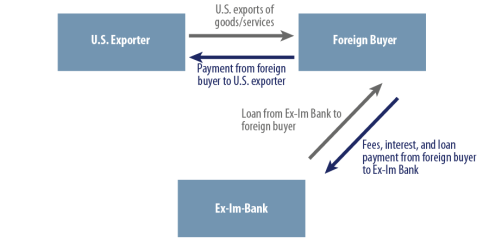 |
|
Source: CRS, based on Ex-Im Bank information. Notes: This diagram is a general representation of Ex-Im Bank direct loans. Specifics vary by transaction. |
Prior to 1980, Ex-Im Bank's direct lending program was its chief financing vehicle. Both the budget authority requested by the Administration and the level approved by Congress for direct lending dropped sharply during the 1980s, reportedly as a target of budget cuts.45 In the past decade, demand for Ex-Im Bank direct loans has been limited due to low commercial interest rates.46 Demand for direct loans increased significantly with the international financial crisis of 2008-2009, as banking problems limited the ability of commercial banks to originate export finance transactions at competitive rates.
Medium- and Long-Term Loan Guarantees
Ex-Im Bank provides medium- and long-term guarantees of loans made by a lender to a foreign buyer of U.S. goods and services, promising to pay the lender, if the buyer defaults, the outstanding principal and accrued interest on the loan (see Figure 2).
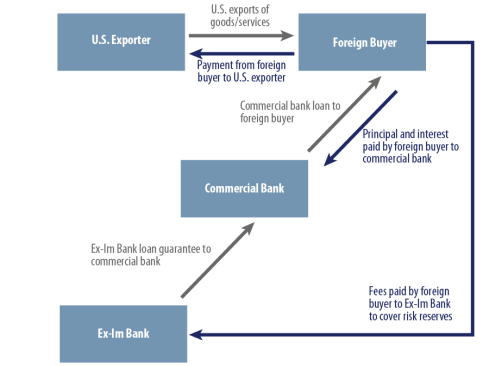
Loan guarantees are intended to cover repayment risk. Medium- and long-term loan guarantees are typically used to finance purchases of U.S. capital equipment and services. Unlike insurance (discussed below), loan guarantees are unconditional—representing Ex-Im Bank's commitment to a commercial bank for full repayment in the event of a default. The transaction size for a loan guarantee has no limit. Loan guarantees are up to 10 years generally, with exceptions up to 18 years for renewable energy projects. The guarantee covers 100% of the U.S. contact up to 85% of the total contract amount, with a minimum 15% down payment required from the buyer. The interest rate is negotiated between the commercial lender and the borrower.
Working Capital and Supply Chain Guarantee Programs
Ex-Im Bank also has specific loan guarantee programs for working capital guarantees and supply chain finance guarantees. These programs aim to make funds available for U.S. businesses to fulfill international sales orders.
The working capital guarantee program guarantees up to 90% of the principal and interest on a loan made to a participating lender for export-related inventory and accounts receivables. Ex-Im Bank's working capital program is intended to facilitate finance for businesses that have exporting potential but need working capital funds to produce or market their goods or services for export. A U.S. small business may have a cash flow shortage to fulfill an export order, and may seek a working capital loan to finance, for instance, its purchase of materials or supplies for the export order, the product of the good, or the collection of payment from the foreign buyer. However, the small business may face challenges obtaining this financing from the private sector, as the small business's inventory may not be a source of sufficient collateral for the loan and commercial banks are often unwilling to lend against export-related receivables. The Ex-Im Bank working capital guarantee may help the exporter expand its borrowing base by enabling the exporter to use these export-related assets as collateral for loans.
The supply chain finance guarantee program guarantees up to 90% to a participating lender that purchases accounts receivable from suppliers of an approved exporter. The program aims to allow U.S. suppliers to sell their accounts receivables to a private lender at a discounted rate to obtain early payment of their invoices and increase liquidity to fulfill export orders.
For both programs, the loan guarantee can be approved for a single loan or a revolving line of credit, and is a short-term guarantee of less than one year. Generally, each product must have more than 50% U.S. content based on all direct and indirect costs for eligibility. The interest rates for working capital loans guaranteed by Ex-Im Bank are set by the commercial lender.
Export Credit Insurance
Export credit insurance (see Figure 3) accounts for the majority of Ex-Im Bank's small business support, both by number and value of authorizations. Ex-Im Bank aims to support U.S. exporters by protecting their businesses against the risk of a foreign buyer (or other foreign debtor) defaulting on payment for political or commercial reasons.47 Export credit insurance could allow the exporter to extend more competitive terms of credit to foreign buyers, and/or allow the exporter to expand its borrowing base from a commercial lender, such as potentially by using Ex-Im Bank-insured receivables as additional collateral for financing.
Like loan guarantees, insurance is intended to reduce the risks involved in exporting by protecting against commercial or political uncertainty. However, in contrast, insurance is conditional on the fulfillment of various requirements for Ex-Im Bank to pay a claim (e.g., compliance with underwriting policies, deadlines for filing claims, payment of premiums and fees, and submission of proper documentation).48
For a qualified transaction, the small business may receive export credit insurance from Ex-Im Bank to cover 95% of the political and commercial losses of exporting. Export credit insurance can cover single buyers or multiple buyers in multiple countries. Ex-Im Bank charges insurance premia and other fees.
The Bank issues short-term insurance policies of less than one year to U.S. exporters to reduce their risk of nonpayment by the foreign buyer. Coverage is generally up to 95% of nonpayment losses due to commercial and political risks. Short-term exporter insurance is available for products shipped from the United States and with at least 50% U.S. content (excluding mark-up). Ex-Im Bank offers a renewable one-year policy that generally covers up to 180-day terms, but can be extended up to 360 days for qualifying transactions. Ex-Im Bank also maintains short-term insurance policies for lenders.
Ex-Im Bank can extend medium-term insurance policies generally for one to seven years and for amounts up to $25 million, to both exporters and lenders, covering one or a series of shipments. Coverage is for 100% of the U.S. content, up to 85% of the contract price. Ex-Im Bank requires the buyer to make cash payment to the exporter equal to 15% of the U.S. contract value.
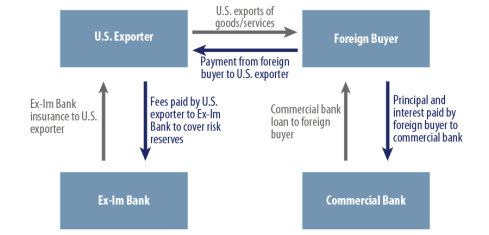
Specialized Finance Products
Ex-Im Bank's programs include specialized finance products,49 such as:
- project finance, which is limited recourse finance to newly created companies, usually in amounts greater than $10 million. Project finance typically covers large, long-term infrastructure and industrial projects (e.g., airport construction, oil and gas power sector projects, wind turbines), involving multiple contracts for completion and operation. Sponsor support during construction, combined with the project's future cash flows, form the basis for the Bank's analysis of the creditworthiness of the project, as well as its source of repayment (rather than repayments by foreign governments, financial institutions, or established corporations). Repayment terms are generally up to 14 years, but can be up to 18 years for renewable energy projects.
- structured finance, which is finance to existing companies located overseas, based on their balance sheets and other sources of collateral or security enhancements. Through structured finance, Ex-Im Bank has financed fiber-optic cable, oil and gas projects, air traffic control systems, satellites, and manufacturing equipment. Repayment terms generally are for up to 10 years, but can be up to 12 years for power transactions.
- transportation finance, including for aircraft, ship, and railroad exports, based on the guidelines set by sectoral understandings under the OECD Arrangement.
Activity and Portfolio Exposure
In FY2018, Ex-Im Bank authorized $3.3 billion for 2,389 transactions (see Figure 4), to support an estimated $6.8 billion in U.S. exports and 33,000 U.S. jobs. About $40 billion in transactions were pending Board consideration in FY2018. In FY2014, when fully operational, the Bank authorized $20.5 billion for 3,746 transactions, to support an estimated $27.5 billion in U.S. exports and more than 164,000 U.S. jobs. As in prior years, in FY2018, U.S. small businesses accounted for most authorizations by number (91%). At the same time, U.S. small businesses accounted for a growing share of authorizations by dollar amount—66% in FY2018, up from 25% in FY2014.
|
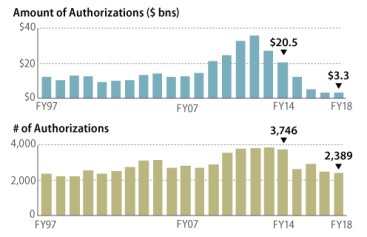 |
|
Source: CRS, based on data from Ex-Im Bank annual reports. |
Ex-Im Bank has a statutory limit on the aggregate amount of loans, guarantees, and insurance that it can have outstanding at any one time.50 The outstanding principal amount of all loans made, guarantees, or insured by the Bank is charged at the full value against the limitation. In FY2018, Ex-Im Bank's exposure was $61 billion—less than half of its statutory exposure cap of $135 billion that year (see Figure 5). Following record highs in exposure levels associated with increased demand for Ex-Im Bank services during the financial crisis, the Bank's exposure level has declined in recent years while the agency was not fully operational and repayments on outstanding transactions exceeded new activity. Ex-Im Bank examines its concentration by program, region, sector, and other measures (see Figure 6) as part of risk management.
|
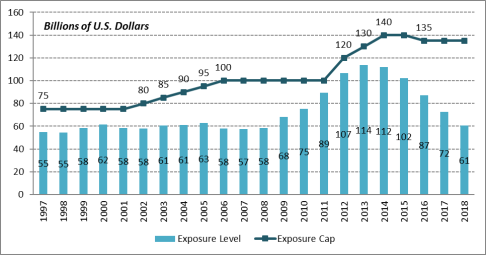 |
|
Source: CRS analysis of data from Ex-Im Bank annual reports. |
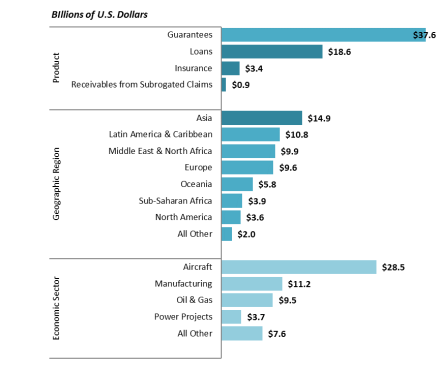
Appropriations and Budget
As with other federal credit programs, beginning with FY1992, Ex-Im Bank's activities have been subject to the Federal Credit Reform Act of 1990 (FCRA, P.L. 101-508), which aimed to measure more accurately the cost of federal credit programs and to make the cost of such credit programs more comparable to direct federal outlays for budgetary purposes. For a given fiscal year, under FCRA, the cost of federal credit activities, including those of Ex-Im Bank, is reported on an accrual basis equivalent with other federal spending, rather than on a cash flow basis, as used previously. Under FCRA, credit subsidy estimates are calculated by discounting them using the rates on U.S. Treasury securities with similar terms to maturity—which traditionally have been considered to be risk-free—and are below the rates of commercial loans.51
Between 1992 and 2008, the Bank received direct appropriations for its administrative expenses and FCRA credit subsidy for those years in which the subsidy was estimated to be positive. Since 2008, Congress and the President gave the Bank permission to use its offsetting collections (e.g., interest, premia, and other fees charged for activities) to fund its administrative and program expenses and to retain a limited amount of any excess collections ("carryover funds") for a certain amount of time. The appropriations language provides that the receipts collected by Ex-Im Bank are credited as offsetting collections in the federal budget and are intended to cover the cost of the Bank's operations. Therefore, the offsetting collections are intended to reduce the appropriations from the General Fund to $0.
At the start of the fiscal year, the U.S. Treasury provides Ex-Im Bank with an "appropriation warrant" for operating costs and administrative expenses. The amount of the warrant is established by the spending limits set by Congress and agreed to by the President in the appropriations process. According to Ex-Im Bank, it uses these offsetting collections to repay the warrant. Thus, Ex-Im Bank initially receives funds from the U.S. Treasury and subsequently repays those funds as offsetting collections come in.
As part of the annual appropriations process, Congress provides a direct appropriation for Ex-Im Bank's Office of Inspector General (OIG) and sets an upper limit on the amount available to the Bank for administrative expenses to carry out its direct loan, loan guarantee, and export credit insurance programs. For FY2019, the President's budget requested $4.8 million in funding for the OIG, a limit of $90.0 million for administration expenses, a cancellation of $10 million carryover funds from prior appropriations, and a cancellation of $13.4 million in the Tied Aid Credit Fund.52 Compared to the President's budget request, congressionally appropriated amounts for FY2019 were $5.7 million for the OIG and $110.0 million for administrative expenses; Congress did not provide any carryover authority for the Bank and rejected the request to cancel tied aid funds. The President's FY2020 budget requests $5 million for the OIG, a limit of $95.5 million for administrative expenses, and a $106 million cancellation in unobligated funds for tied aid (see Table 2).
Ex-Im Bank's revenues include interest, risk premia, and other fees that it charges for its support. Revenues acquired in excess of forecasted losses are recorded as offsetting collections. According to the Bank, since 2000, it has contributed to the Treasury $14.8 billion after covering its administrative and program costs, and other expenses. (This is on a cash basis, and different from the amount calculated on a budgetary basis.53) In FY2017 and FY2018, Ex-Im Bank did not report any contributions to the Treasury. In comparison, Ex-Im Bank contributed to the Treasury $674.7 million in FY2014, $431.6 million in FY2015, and $283.9 million in FY2016. Compared to administration expenses, the portfolio of the agency shrank and its offsetting collections declined with the prior temporary lapse of the charter and loss of a quorum constraining Ex-Im Bank's authority to approve deals.
In addition, borrowings from the U.S. Treasury are used to finance medium- and long-term loans, and carry a fixed interest rate. Ex-Im Bank repays these borrowings primarily as repayments are received from recipients of its medium- and long-term loans.54
|
Category |
FY2014 |
FY2015 |
FY2016 |
FY2017 |
FY2018 |
FY2019 |
FY2020a |
|
Inspector General Amount |
5.1 |
5.8 |
6.0 |
5.7 |
5.7 |
5.7 |
5.0 |
|
Total Credit Subsidyb |
0 |
0 |
0 |
0 |
0 |
0 |
0 |
|
Total Administrative Budget |
115.5 |
106.3 |
106.3 |
110.0 |
110.0 |
110.0 |
95.5 |
|
Carryover amount |
10 |
10 |
10 |
10 |
10 |
0 |
0 |
|
Tied aid amount cancelled |
0 |
0 |
0 |
0 |
0 |
0 |
106.0 |
Source: Office of Management and Budget (OMB), Budget of the United States Government, various years; appropriations legislation, various years; and Ex-Im Bank documents. Differences in amounts requested and appropriated may vary due to different assumptions used in estimating credit subsidies by OMB and the Congressional Budget Office (CBO).
Note: (a) Requested. (b) Credit subsidy refers to program activities (the cost of direct loans, loan guarantees, insurance, and tied aid) conducted by Ex-Im Bank, as estimated for budgetary purposes under the Federal Credit Reform Act (FCRA). Subsidy costs are subject to reestimates.
Risk Management
Ex-Im Bank seeks to manage the risks it faces in its transactions (see Table 3). The charter requires a "reasonable assurance of repayment" for transactions supported by the Bank55 and for the Bank to have "reasonable provision for possible losses,"56 among other provisions. The Bank has a system in place to mitigate risks through credit underwriting and due diligence of potential transactions, as well as monitoring risks of current transactions. If a transaction has credit weaknesses, the Bank aims to try to restructure it to help prevent defaults and increase the likelihood of higher recoveries if the transaction does default. Ex-Im Bank also has a claims and recovery process for transactions in default. The effectiveness of Ex-Im Bank's risk management has been subject to congressional debate.
Based on its charter, Ex-Im Bank assesses and monitors credit and other risks of transactions, maintains reserves against losses, and provides a quarterly report on its default to Congress.57 It reported a default rate of 0.518% as of March 2019 (sent quarterly to Congress). In recent quarters, Ex-Im Bank's default rate has trended slightly upward, but is considered to be well-below that of commercial bank default rates.
In FY2018, Ex-Im Bank's reserves and allowances for total losses were $3.7 billion (6.4% of total outstanding balance). Since 1992, Ex-Im Bank has been able to recover 50 cents on the dollar on average for transactions in default. Backed by the U.S. government, Ex-Im Bank can take legal action against obligors for transactions in default. It is also able to recover assets because its loans are heavily collateralized, as a high percentage of its transactions are asset-backed (e.g., aircraft).
|
Risk |
Definition |
|
Repayment |
The risk that a borrower will not pay according to the original agreement and the Bank may eventually have to write-off some or all of the obligation because of credit or political reasons. |
|
Concentration |
Risk stemming from the composition of the credit portfolio as opposed to the risks related to specific obligors. Ex-Im Bank faces concentration risks in terms of the composition of its portfolio by geographic region, industry, and obligor. |
|
Foreign Currency |
Risk stemming from an appreciation or depreciation in the value of a foreign currency in relation to the U.S. dollar in Ex-Im Bank transactions denominated in that foreign currency. |
|
Operational |
The risk of material losses due to human error, system deficiencies, and control weaknesses. |
|
Interest Rate |
Ex-Im Bank makes fixed-rate loan commitments prior to borrowing to fund loans and takes on the risk of borrowing funds at an interest rate greater than the rate charged on the credit. |
International Context
The United States historically has been a leader in international efforts to develop rules within the Organization for Economic Cooperation and Development (OECD) on ECA financing. In the 1960s and 1970s, many ECAs offered financing at interest rates below market rates, raising concerns and market distortions and inefficiency and a "race to the bottom." The OECD Arrangement on Officially Supported Export Credits (the "Arrangement") arose out of U.S. and other major developed countries' efforts to create "rules of the road" to address such concerns.
Entering into effect in 1978, the Arrangement aims to ensure a level playing field for ECA activity such that the price and quality of exports, not their financing terms, guide purchasing decisions. The Arrangement, which applies to ECA financing with repayment terms of two years or more (medium-and long-term, or MLT, financing) sets minimum interest rates, maximum repayment terms, and other terms and conditions, including on tied aid and transparency, as well as certain sector-specific rules. The rules have been understood to govern "tied financing," that is, financing linked to the procurement of national goods and services. The Arrangement is a "non-binding" agreement but historically has generated compliance. Export credit financing that is covered by the OECD Arrangement generally is exempt from the World Trade Organization (WTO) Agreement on Subsidies and Countervailing Measures (SCM), which disciplines the use of export subsidies and the actions countries can take to counter the effects of these subsidies. The SCM Agreement is interpreted to indicate that, for non-agricultural products, an export credit practice in conformity with the OECD Arrangement on export credits shall not be considered as an export subsidy prohibited by the SCM Agreement.58
Participants to the Arrangement are the United States, Australia, Canada, the European Union, Japan, Korea, New Zealand, Norway, and Turkey—all OECD members. Brazil, which is not an OECD member, is participant of the aircraft sector understanding to the Arrangement.59
Presently, 112 ECAs or other official entities provide some form of export credit support globally.60 The size of ECA programs vary. In 2018, China's MLT export financing was estimated to be $39 billion—larger than that of the next three ECAs combined (Italy, Germany, and South Korea); in comparison, in 2018, Ex-Im Bank's MLT support was $300 million (see Figure 7).61
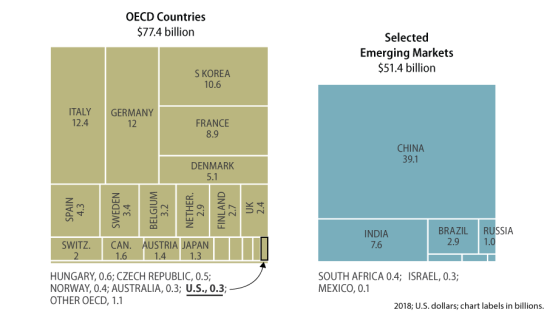
Over time, ECA financing that is outside of the scope of the OECD Arrangement has grown. One driver of this trend is that China and other non-OECD countries increasingly are active in operating ECAs; as non-OECD members, they do not necessarily abide by the rules of the Arrangement. China, in particular, poses the most extensive challenges for U.S. exporters. Over ten years, the level of Chinese ECA activity has grown from being one-tenth of that of the United States and other G-7 countries combined to roughly equal. In addition to the sheer magnitude of its financing, the characteristics of China's ECA financing—such as its opacity and flexibility to provide concessional loans—raise particular concern. Such concerns have intensified with Chinese initiatives such as the Belt and Road Initiative and China Made in 2025. Another driver of the growth of ECA financing outside of the OECD Arrangement's scope is that many OECD members are providing such financing. For example, through "market windows," ECAs offer pricing competitive with the commercial market; since market window transactions are not covered by the Arrangement, ECAs have more flexibility on terms and conditions for financing through them. Ex-Im Bank says it is the only ECA among major developed countries that fully abides by the Arrangement.
The international export finance landscape is undergoing other transformations as well. Many countries rely on exports for a more significant share of their economic growth than the United States, and historically they have placed greater emphasis on export promotion and financing at the highest levels as part of their national strategies.62 Many countries also view export financing and promotion as a way to support strategically important industries and protect "national champions" from foreign competition, such as energy, technology, and defense industries.
Market changes also have influenced the ECA landscape. Commercial banks are experiencing regulatory constraints on their international lending. Regulations imposed after the global financial crisis (more stringent capital and liquidity requirements) have incentivized commercial banks to accept less commercial risk. This has particularly affected the supply of MLT export financing for higher-risk, large-volume, and/or longer-tenor credits from commercial sources. The number of "mega-deals" greater than $1 billion also has grown significantly.
As such, the fundamental nature of ECAs is evolving. Historically, ECAs have operated as reactive "lenders-of-last-resort," and now, they are increasingly operating proactively. Many ECAs have boosted their export financing programs, introduced or expanded use of unregulated trade-related financing programs (including both united and investment financing), and increased the number and flexibility of programs and institutions. One example is new programs to encourage U.S. exporters to shift parts of their supply chain overseas; these programs guarantee access to high volumes of attractive financing that are not related to any specific project or transaction. Another example is increasing flexibility of "content" policies, including to decrease the level of domestic content required to obtain the maximum level of official ECA support (ranging from not requiring any in-country production to 30% domestic content), focusing more on "national interest" or "national benefit requirements," broadening the definition of domestic content to include factors such as research and development expenses, and permitting more exceptions to their content policies for transactions that meet other aims (such as ECA support to help companies shift part of their supply chains to those countries).63
These changes have called some policymakers and stakeholders to question the ongoing relevance of the OECD Arrangement. There have been calls to try to bring non-OECD countries such as China under the tent. As another approach, since 2012, an International Working Group (IWG), composed of the United States, China, and other countries, has been negotiating separate export credit disciplines. The IWG has taken a sectoral focus, and progress reportedly has been limited. China, India, Brazil, and other countries reportedly have expressed little interest in the negotiations, particularly while Ex-Im Bank was not fully authorized or operational.64
Debate Over Ex-Im Bank
Potential congressional consideration of Ex-Im Bank's reauthorization, and Senate consideration of additional nominations to the Board, may raise economic and other policy issues for Congress.
Economic Issues
Much of the economic debate centers on what role Ex-Im Bank plays relative to private financial markets, and whether such government intervention can produce net benefits to the U.S. economy.65 Economic theory predicts that government programs like Ex-Im Bank shift production among sectors within the economy by altering the allocation of capital and labor resources in the economy, and while they may increase exports of certain firms, they do not affect the overall level of exports and employment in the long-run. Rather, the main factors affecting the overall level of a country's exports are economic policies that determine interest rates, capital flows, and exchange rates. While most economists generally favor allowing the market to determine the allocation of resources, government intervention may be viewed as warranted in some instances to correct market limitations or failures.
Supporters assert that Ex-Im Bank supports U.S. jobs through facilitating viable exports that private financial institutions are unwilling or unable to support due to market limitations (such as domestic lending rules, bank-specific constraints, or lack of specialized knowledge of certain geographic regions or economic sectors) and market failures (such as times of financial crisis); these constraints lead commercial banks to charge unfeasible interest rates and other terms for a proposed transaction or to avoid the transaction altogether.66 Opponents question the market failure rationale, taking issue with the U.S. government assuming risks that the private sector deems prudent to avoid. They argue that Ex-Im Bank crowds out private sector activity and distorts the market by changing the allocation of resources among sectors, reducing economic efficiencies.67 Critics charge that Ex-Im Bank picks winners and losers; proponent counter that Ex-Im Bank subjects all transactions to statutory and policy requirements.
In highlighting Ex-Im Bank's "additional" role, supporters often focus on two areas where government-backed financing may play a more significant role. They argue that Ex-Im Bank helps small business exporters directly that face limited credit options because private lenders do not accept export receivables (unlike domestic receivables) as collateral for lending, as well as help the small businesses in the supply chains of larger exporters that are direct users of Ex-Im Bank. Supporters also underscore Ex-Im Bank's role in supporting capital goods exports and exports for large-scale, multi-year infrastructure projects. Commercial banks may lack the specialized information to accurately gauge risk in particular economies and sectors, or may be unwilling to assume longer-term risks or to be involved in regions or countries that they see as high-risk. Critics view Ex-Im Bank as "corporate welfare," as the majority of its transactions historically have been larger businesses by value. Critics also question Ex-Im Bank's actual benefit to small businesses and the agency's definition of small businesses.
In policy debates, a data point that often arises is that Ex-Im Bank activity supports a small share of U.S. exports (around 2%). Supporters argue that this small share means that Ex-Im Bank limits its activities to filling market gaps and is not market-distorting.68 Critics question Ex-Im Bank's significance if the vast majority of exports can go forward without its support, and they argue that the agency imposes more costs than benefits. As discussed earlier, Ex-Im Bank's activities are demand-driven, and they can vary depending on the overall level of activity in the global economy. The prior, more-limited operations of the Bank for nearly four years also may affect the policy debate; supporters argue that the lack of a quorum cost U.S. exports and jobs for direct Ex-Im Bank users and their supply chains. Critics dispute notions of economic loss, holding that private-sector financing was strong for historically major Bank users, such as Boeing.
The issue of whether Ex-Im Bank is a "subsidy" also often arises in economic debates. Supporters point out that Ex-Im Bank financing, as it is within the scope of the OECD Arrangement, is not a "subsidy" under international WTO subsidy rules, and that Ex-Im Bank, by statute, conducts economic impact analyses to measure the economic effects of transactions. Critics charge Ex-Im Bank with "subsidizing" exports purchased by foreign buyers since the terms may be more favorable than what the market charges. Supporters counter that Ex-Im Bank charges interest, premia, and other fees for its services. Critics argue that Ex-Im Bank's analyses do not take into account the full downstream effect. Some supporters also acknowledge that improvements to how Ex-Im Bank measures economic impact may be warranted.
International Competition Issues
Another aspect to the debate is the existence of foreign countries' export financing programs. Many countries have programs that are substantially larger than those of Ex-Im Bank (see Figure 7 above). Supporters of Ex-Im Bank assert that its services are critical to offset the effects of similar programs used by foreign governments and to boost U.S. exporters' competitiveness. Some supporters hold that even if critics' economic arguments have some basis, the foreign competition argument in favor of Ex-Im Bank prevails.69 Supporters further note that for some industries and projects (e.g., nuclear sector, infrastructure), foreign buyers frequently require or expect bidders to bring offers of government-backed export financing alongside their proposal as a prerequisite for being considered in the bid.70 Ex-Im Bank guarantees also may be important for some firms involved in long-term projects in which the implied backing of the U.S. government is needed, for instance, for transactions in countries where there may be political or economic instability and the threat of foreign government intervention may be possible.
Critics question whether the export promotion programs of other countries have a negative effect on U.S. exports. They note that some economists contend that the export promotion programs of other countries are likely to have little effect on the overall level of U.S. exports, although certain foreign government export policies may have harmed certain U.S. industries. Critics also argue that the U.S. policy focus should be on negotiating to further reduce and eliminate ECA financing internationally, and strengthening international rules and disciplines on ECA financing—particularly to make China and other countries that are not a part of the OECD Arrangement more accountable. Supporters may agree with critics on negotiating stronger ECA disciplines, but they counter that "unilateral disarmament" by abandoning Ex-Im Bank would diminish U.S. negotiating leverage, and they are skeptical that other countries would eliminate their ECA programs, given the central role of exports in many of their economies.
The debate over foreign competition increasingly has centered on China, which, as noted above, had MLT financing of nearly $40 billion in 2018—far surpassing that of other ECAs. Proponents hold that, while Ex-Im Bank does not favor one industry over another (rather, subjecting all transactions to the same statutory and policy requirements), Ex-Im Bank financing can support U.S. firms' competitiveness in strategic sectors, particularly vis-à-vis China. Critics oppose Ex-Im Bank support for U.S. exports to Chinese and other state-owned enterprises. They also question how "subsidizing" U.S. exports to China advances the Trump Administration's trade policy goals regarding China.71 Some supporters counter that without Ex-Im Bank, those exports may go to other countries. Some believe that the agency's activities with respect to Chinese SOEs should be restricted for broader trade and foreign policy reasons.
Potential Issues for Congress
Congress could take a range of approaches related to Ex-Im Bank's authority. One option is a "clean" renewal, which would extend the sunset date in the charter. Options to renew Ex-Im Bank's charter also could include limited changes (such as revising the agency's exposure cap) or more substantive "reforms" (such as also making modifications to Ex-Im Bank's scope, structure, conditions, risk management practices, and/or reporting requirements). A range of reasons may motivate "reforms," including enhancing Ex-Im Bank's ability to fill in gaps in private sector financing and offset competition from foreign ECAs; limiting the agency's size and scope and exposure to U.S. taxpayers; and furthering efforts to eliminate all ECA activity internationally. Proposed reforms may raise, among other things, issues regarding balancing Ex-Im Bank's core mission to boost U.S. exports and jobs with other policy goals. Other options include allowing a sunset in Ex-Im Bank's authority, such as by taking no legislative action, or passing legislation setting specific parameters for a wind-down in Ex-Im Bank's functions; the sunset provision in Ex-Im Bank's charter (12 U.S.C. 635f) would set in motion an "orderly liquidation" of Ex-Im Bank's assets, the details of which Congress may consider how to flesh out. Still other options include reorganization of Ex-Im Bank's functions; the existence of a range of federal government agencies that focus on export promotion has prompted debate about whether any overlap in functions constitutes duplication or the use of the same or similar tools to meet different goals.
If pursuing reauthorization, questions that Members may consider include the following.
What should be the purpose of Ex-Im Bank? Congress may revisit Ex-Im Bank's policy role. Historically, the role of ECAs has been to operate as a "lender of last resort." While Ex-Im Bank still subscribes to this model, many other ECAs are increasingly driven by strategic and foreign policy reasons. Ex-Im Bank activity can have strategic and foreign policy impacts, but when Ex-Im Bank is making decisions on what projects to support, it is looking at whether the project meets statutory and policy terms and conditions. In only limited circumstances can Ex-Im Bank make determinations based on noncommercial or nonfinancial reasons. A major point of debate over H.R. 3407 was its restriction on Ex-Im Bank activity with respect to Chinese SOEs.
What length of time is desirable for an extension of Ex-Im Bank's sunset date? Shorter extensions arguably have given Congress the opportunity to weigh in on Ex-Im Bank operations on a more frequent basis through the lawmaking process. On the other hand, Ex-Im Bank and certain stakeholders have asserted that longer-term extensions can enhance U.S. exporters' strategic planning and commercial certainty on the availability of Ex-Im Bank support without disruptions. During reauthorization hearings in the 116th Congress, U.S. businesses advocated for a longer reauthorization period of seven to ten years. H.R. 3407 would provide a seven-year extension of Ex-Im Bank's authority, and S. 2293 would provide a ten-year extension.
What should be Ex-Im Bank's exposure cap? Many past reauthorizations modified Ex-Im Bank's exposure cap. Debate over exposure cap can intersect with broader debates about the appropriate size and scope of the federal government. Supporters generally advocate for expanding Ex-Im Bank's exposure cap. Critics may favor reducing the cap to target Ex-Im Bank's activities, for instance, to supporting small businesses and limiting taxpayer risk. H.R. 3407 and S. 2293 would incrementally raise the exposure cap to $175 billion from the current $135 billion.
Are modifications needed to the Board of Director terms, succession rules, or quorum? For many supporters, the inability of Ex-Im Bank to operate at full capacity for nearly four years due to a lack of quorum of the Board underscored a need to change the current statutory framework for Board operations. Past proposals in appropriations would have relaxed the quorum requirement, while H.R. 3407 and S. 2293 would establish alternative procedures to ensure that Ex-Im Bank is able to continue operations in the event of a future quorum lapse by creating a temporary Board led by the U.S. Trade Representative (USTR). Some have also suggested considering allowing ex officio Board members to vote.
Should the scope of policy criteria for Ex-Im Bank be revisited? Some policymakers have expressed concern that Ex-Im Bank historically has had difficulty meeting its small business target by dollar amount, while others seek to raise the target. Responding to these issues, some emphasize Ex-Im Bank's demand-driven nature. Some Members and civil society groups also have expressed environmental concerns about Ex-Im Bank financing fossil fuel projects and aim to strengthen environmental assessments conducted by the Bank. Other Members and some industry groups favor maintaining the current statutory framework, which includes a requirement for Ex-Im Bank to not discriminate against transactions based on energy source.
Should Ex-Im Bank programs, policies, and/or risk management practices be modified? Supporters argue that Ex-Im Bank operates well overall, and some acknowledge that certain elements could be improved potentially through administrative action, such as further streamlining of operations for small business transactions and improving small business outreach. Critics argue that shortfalls remain in the charter. Areas of debate may include additionality; Ex-Im Bank requires applicants to explain the reason for seeking support (market-based or foreign competition reasons), and the Ex-Im Bank OIG has made recommendations for greater documentation of additionality determinations and evaluation of procedures, to which Ex-Im Bank management concurred.72 H.R. 3407 would impose further additionality documentation and reporting requirements. Some voice concern that such requirements could be overly burdensome for the agency and its users alike. Another area of debate could be risk management. Supporters highlight Ex-Im Bank's low default rate, high recovery rate, reserves, and implementation of reforms pursuant to the 2015 reauthorization act as demonstration of the agency's effective risk management.73 Critics express concern about taxpayer risk, and favor more transparency and accountability, as well as potentially imposing concentration limits on Ex-Im Bank's portfolio.74 Differing views exist on Ex-Im Bank's budgetary impact, with estimates varying based on "federal credit" and "fair value" methods of accounting.75
Is Ex-Im Bank competitive with foreign ECAs? Members may consider whether to press the Administration to modify the U.S. export financing approach to be more competitive with countries operating outside of the scope of the OECD rules, such as through greater use of the tied aid war chest or new flexibilities in policy areas identified by stakeholders in the annual competitiveness report (e.g., Ex-Im Bank's content policy, defense/nuclear prohibition, and U.S. flag shipping requirement). Members could also call for greater emphasis on "leveling the playing field"; they may examine the OECD Arrangement, as well as the status of negotiations under the International Working Group, to see if they comport with U.S. policy objectives and interests. They could direct the Administration to work more intensively to eliminate ECA financing, and/or to pursue ongoing international negotiations on new export credit rules more intensively to impose disciplines on Chinese and other non-OECD ECA activity. Another avenue could be considering ECA rules as part of a potential reform of the WTO.
Author Contact Information
Acknowledgments
Amber Wilhelm, a Visual Information Specialist, and Jennifer Roscoe, a Research Assistant, provided assistance on visuals.
Footnotes
| 1. |
12 U.S.C. §635f. See Ex-Im Bank Office of Inspector General (OIG), Report on EXIM Bank's Activities in Preparation for and During its Lapse in Authorization, March 30, 2017, OIG-EV-17-02. |
| 2. |
P.L. 79-173; 59 Stat. 526. See also National Archives, "Records of the Export-Import Bank of the United States," http://www.archives.gov/research/guide-fed-records/groups/275.html. |
| 3. |
U.S. Congress, Senate Committee on Banking and Currency, Legislative History of the Export-Import Bank of Washington, committee print, 83rd Cong., 1st sess., 1953, p. 2. |
| 4. |
Jordan Jay Hillman, The Export-Import Bank at Work: Promotional Financing in the Public Sector (Westport 1982); and Ex-Im Bank, "80th Anniversary" history webpages, http://archive.exim.gov/about/whoweare/anniversary/History/1930s.cfm. |
| 5. |
12 U.S.C. §635(a). |
| 6. |
See excerpt from Jordan Jay Hillman, The Export-Import Bank at Work, Westport: Quorum Books, 1982, pp. 31-32: The era [1945 - 1953] cannot be brought to its conclusion without mention of imports—in name and formal statutory status constituting one-half of [Ex-Im Bank's] mission. Moreover, if trade-oriented exports were ever to be supported, this was the time. It was, after all, an era when a dominant goal of foreign lending programs was to increase the dollar earning capacity of recipient countries. Nevertheless, even in this period when imports were seen as a positive factor in reducing an excessive U.S. trade surplus, [Ex-Im Bank's] role in financing import trade, as such, was negligible. In general, the Bank considered commercial bank credits adequate for transactions at risk levels that the Bank itself was otherwise likely to undertake. Import trade, of course, involved the financing of U.S. domestic buyers. They presented neither the credit information nor security enforcement problems associated at the time with overseas credit. It thus remained the view of the Bank that efforts to aid and facilitate foreign sales in the United States were best directed to increasing the productive capabilities of foreign countries. Import trade transactions financed by [Ex-Im Bank] were, and were to remain, negligible. |
| 7. |
Ex-Im Bank, "EXIM Board of Directors Approves Preliminary Commitments for U.S. Exports to Projects in Cameroon and Iraq," press release, July 31, 2019. |
| 8. |
Bank for International Settlements (BIS), Committee on the Global Financial System (CGFS), Trade Finance: Developments and Issues, CGFS Papers No. 50 by Clark J. Basel, January 2014, https://www.bis.org/publ/cgfs50.pdf. |
| 9. |
World Trade Organization (WTO), Trade Finance and SMEs: Bridging the Gaps in Provision (interpreting the BIS 2014 report). |
| 10. |
International Chamber of Commerce (ICC), 2018 Global Trade – Securing Future Growth: ICC Global Survey on Trade Finance. |
| 11. |
Alisa DiCaprio et al., 2016 Trade Finance Gaps, Growth, and Jobs Survey, Asian Development Bank (ADB), August 2016. |
| 12. |
See CRS In Focus IF11016, U.S. Trade Policy Functions: Who Does What?, by Shayerah Ilias Akhtar. |
| 13. |
See CRS Report R44985, USDA Export Market Development and Export Credit Programs: Selected Issues, by Renée Johnson; and CRS Report R43155, Small Business Administration Trade and Export Promotion Programs, by Sean Lowry. |
| 14. |
CRS In Focus IF10659, Overseas Private Investment Corporation (OPIC), by Shayerah Ilias Akhtar. The new International Development Finance Corporation (DFC) is to succeed OPIC as the U.S. government's development finance institution. See CRS Report R45461, BUILD Act: Frequently Asked Questions About the New U.S. International Development Finance Corporation, by Shayerah Ilias Akhtar and Marian L. Lawson. |
| 15. | |
| 16. |
12 U.S.C. §635(a)(1). |
| 17. |
12 U.S.C. §635(b)(1)(B). |
| 18. |
12 U.S.C. §635(c)(1). |
| 19. |
12 U.S.C. §635(b)(1)(A) ("fully competitive with the Government-supported rates and terms and other conditions available for the financing of exports of goods and services from the principal countries whose exporters compete with [U.S.] exporters, including countries the governments of which are not members of the [OECD] Arrangement") and 12 U.S.C. §635(b)(1)(B) ("fully competitive with exports of other countries and consistent with international agreements"). |
| 20. |
12 U.S.C. §635(b)(1)(B). |
| 21. |
Refer to Ex-Im Bank's charter (12 U.S.C. §635 et seq.) for full treatment. |
| 22. |
12 U.S.C. §635(b)(1)(B). |
| 23. |
The Bank is required to have "regulations and procedures ... to insure that full consideration is given to the extent that any loan or guarantee is likely to have an adverse effect on industries ... and employment in the United States... " (12 U.S.C. §635a-2). These regulations and procedures are in support of the congressional policy that in authorizing any loan or guarantee the Board of Directors shall take into account any serious adverse effect of such loan or guarantee (12 U.S.C. §635(b)(1)(B)). |
| 24. |
Ex-Im Bank is prohibited from extending any loan or guarantee "for establishing or expanding production of any commodity for export by any other country" if "the commodity is likely to be in surplus on world markets at the time the resulting commodity will first be sold" or "the resulting production capacity is expected to compete with [U.S.] production of the same, similar, or competing commodity" and "may cause substantial injury to [U.S.] producers of the same, or a similar commodity" (12 U.S.C. §635(e)(1)). The Bank also is prohibited from providing any loan or guarantee for the resulting production of substantially the same product that is subject to U.S. trade measures, such as anti-dumping or countervailing duties (12 U.S.C. §635(e)(2)). These prohibitions shall not apply if the Board of Directors determines that the proposed transaction's "short- and long-term benefits to industry and employment in the United States are likely to outweigh the short- and long-term injury to [U.S.] producers and employment of the same, similar, or competing commodity" (12 U.S.C. §635(e)(3)). |
| 25. |
12 U.S.C. §635i-5(a)(1). |
| 26. |
12 U.S.C. §635i-5(a)(2). |
| 27. |
The Ex-Im Bank Supplemental Guidelines for High-Carbon Projects (December 2013) state that: the Bank will not provide support for exports of high carbon intensity plants, except for high carbon intensity plants that (a) are located in the world's poorest countries, utilize the most efficient coal technology available and where no other economically feasible alternative exists, or (b) deploy carbon capture and sequestration (CCS), in each case, in accordance with the requirements set forth in these Supplemental Guidelines. Sec. 7062 of P.L. 116-6, the FY2019 Consolidated Appropriations Act, prohibits funding: …(4) for the enforcement of any rule, regulation, policy, or guidelines implemented pursuant to— …(C) the Supplemental Guidelines for High Carbon Intensity Projects approved by the Export-Import Bank of the United States on December 12, 2013, when enforcement of such rule, regulation, policy, or guidelines would prohibit, or have the effect of prohibiting, any coal-fired or other power-generation project the purpose of which is to: (i) provide affordable electricity in International Development Association (IDA)-eligible countries and IDA-blend countries; and (ii) increase exports of goods and services from the United States or prevent the loss of jobs from the United States. |
| 28. |
12 U.S.C. §635(b)(5). |
| 29. |
The FY2019 Consolidated Appropriations Act (P.L. 116-6) prohibits the use of Ex-Im Bank program account funds for certain nuclear-related support, specifically: to make expenditures, contracts, or commitments for the export of nuclear equipment, fuel, or technology to any country, other than a nuclear-weapon state as defined in Article IX of the Treaty on the Non-Proliferation of Nuclear Weapons eligible to receive economic or military assistance under this Act, that has detonated a nuclear explosive after the date of enactment of this Act. |
| 30. |
12 U.S.C. §635(k). This provision aimed to counter restrictions on Ex-Im Bank financing of coal-related projects. |
| 31. |
Ex-Im Bank, 2014 Competitiveness Report, June 2015, p. 71; and Ex-Im Bank, "Medium- and long-term content policy," http://www.exim.gov/policies/content/medium-and-long-term. |
| 32. |
Ex-Im Bank, "Short-term content policy," http://www.exim.gov/policies/content/short-term-content-policy. |
| 33. |
12 U.S.C. §635(b)(1)(E)(v). The 25% mandate was previously 20%. |
| 34. |
12 U.S.C. §635(b)(1)(K). For FY2008-FY2015, appropriations laws also specified that Ex-Im Bank should make available not less than 10% of its aggregate authority to finance renewable energy exports; the specific language of the 10% target has varied. |
| 35. |
12 U.S.C. §635(9)(A). |
| 36. |
12 U.S.C. §635(b)(5). |
| 37. |
12 U.S.C. §635(b)(10)(A). |
| 38. |
12 U.S.C. §635(b)(2). |
| 39. |
12 U.S.C. §635(b)(5) |
| 40. |
12 U.S.C. §635(b)(6). |
| 41. |
12 U.S.C. §635(b)(3). |
| 42. |
Codified as 46 U.S.C. §55304, by P.L. 109-304, October 6, 2006. The aim is to "ensure a well-trained merchant marine able to maintain the flow of waterborne domestic and foreign commerce during wartime or national emergency." For background, see CRS Report R44254, Cargo Preferences for U.S.-Flag Shipping, by John Frittelli. |
| 43. |
|
| 44. |
|
| 45. |
Ex-Im Bank, OIG, Export-Import Bank's Management of Direct Loans and Related Challenges, OIG-AR-13-05, September 26, 2013, p. 1. |
| 46. |
Ibid. |
| 47. |
A foreign buyer may want to purchase a U.S. small business's goods on credit, rather than on cash. On one hand, the small business may be concerned about extending credit for this purchase due to the risk of nonpayment by the foreign buyer stemming, for instance, from commercial risks of bankruptcy by the foreign buyer and/or political risks such as war or inconvertibility of currency in the buyer's country. On the other hand, the U.S. small business exporter may be reluctant to lose out on the potential sale. |
| 48. |
U.S. Government Accountability Office (GAO), Export-Import Bank: Recent Growth Underscores Need for Continued Improvements in Risk Management, GAO-13-303, March 2013, p. 41. |
| 49. |
|
| 50. |
12 U.S.C. §635e(a). |
| 51. |
Presently, there is a debate about whether the cost of federal credit is appropriately priced under FCRA, or if fair value accounting is a more appropriate measure. For more information, see Deborah Lucas and Marvin Phaup, "Reforming Credit Reform," Public Budgeting & Finance, Winter 2008. |
| 52. |
Tied aid is concessional financing for projects in developing countries linked to procurement from the donor country. Ex-Im Bank does not initiate tied aid for commercial purposes; it aims to match foreign offers, which it has done infrequently in recent years (latest in 2011), in part due to lack of transparency in foreign financing packages. |
| 53. |
See CRS In Focus IF10457, Export-Import Bank (Ex-Im Bank) and the Federal Budget, by Grant A. Driessen. |
| 54. |
The charter limits the aggregate amount of Ex-Im Bank's obligations outstanding (e.g., notes, debentures, and bonds) from the U.S. Treasury to $6 billion at any one time. FCRA introduced changes to the Bank's funding process, and the Bank has proposed eliminating the corresponding language in its charter. |
| 55. |
12 U.S.C. §635(b)(1)(B). |
| 56. |
12 U.S.C. §635(a)(1). |
| 57. |
12 U.S.C. §635g(g). |
| 58. |
The relationship between the OECD Arrangement and the SCM Agreement is established by Section (k) of Annex I to the SCM. See http://www.wto.org/english/res_e/booksp_e/analytic_index_e/subsidies_05_e.htm. |
| 59. |
For the text of the OECD Arrangement, see http://www.oecd.org/trade/topics/export-credits/arrangement-and-sector-understandings/. As background, see CRS Report RS21128, The Organization for Economic Cooperation and Development, by James K. Jackson; and OECD, Smart Rules for Fair Trade: 50 Years of Export Credits, 2011. |
| 60. |
Ex-Im Bank, "EXIM Releases 2018 Competitiveness Report," press release, June 28, 2019. |
| 61. |
Ex-Im Bank, Report to the U.S. Congress on Global Export Credit Competition, for the period January 1, 2018 through December 31, 2018, June 2019. |
| 62. |
The United States, while valuing exports, is less dependent on them given the size of the U.S. economy and other major drivers of growth. |
| 63. |
For more discussion, see Ex-Im Bank, Report to the U.S. Congress on Global Export Credit Competition, for the period January 1, 2018 through December 31, 2018, June 2019. |
| 64. |
See https://financialservices.house.gov/uploadedfiles/hhrg-116-ba00-wstate-dempseyl-20190604.pdf, p. 7. |
| 65. |
Empirical analyses of Ex-Im Bank's economic impact are limited. For contrasting analyses, see, for example, Caroline Freund, The US Export-Import Bank Stimulates Exports, Policy Brief PB 16-23, Peterson Institute for International Economics, December 2016; and Natasha Agarwal and Wang Zheng, Does the US EXIM Bank Really Promote US Exports?, University of Nottingham Research Paper Series, 2016. |
| 66. |
See Chad Moutray (National Association of Manufacturers, NAM, Chief Economist), "The Export-Import Bank is NOT a subsidy," CNBC, August 14, 2014. |
| 67. |
See, for example, Timothy P. Carney (with American Enterprise Institute (AEI)), "Export-Import Bank Subsidizes Exports, But Doesn't Actually Increase Exports," Washington Examiner, July 16, 2019. |
| 68. |
See Ex-Im Bank 2014 annual report, p. 7, discussing Ex-Im Bank as "Plan B" relative to the private sector. |
| 69. |
Neil Irwin, "Why We're All Crony Capitalists, Like It or Not," The New York Times, June 19, 2014. |
| 70. |
Ex-Im Bank, Report to the U.S. Congress on Global Export Credit Competition (for calendar year 2018), June 2019. |
| 71. |
Diane Katz, "Export-Import Bank is Not the Way to Fight China," Heritage, May 1, 2019. |
| 72. |
Ex-Im Bank OIG, Evaluation of EXIM's Additionality Policy and Procedures, November 27, 2018, OIG-EV-19-01. |
| 73. |
See Ex-Im Bank annual reports and quarterly default reports. |
| 74. |
Veronique de Rugy, Nita Ghei, Michael Wilt, Should the US Export-Import Bank Be Reauthorized?, Mercatus Center, George Mason University, July 28, 2015. |
| 75. |
CRS Report R44193, Federal Credit Programs: Comparing Fair Value and the Federal Credit Reform Act (FCRA), by Raj Gnanarajah. |