The Individuals with Disabilities Education Act (IDEA) Funding: A Primer
Changes from August 29, 2019 to February 13, 2026
This page shows textual changes in the document between the two versions indicated in the dates above. Textual matter removed in the later version is indicated with red strikethrough and textual matter added in the later version is indicated with blue.
The Individuals with Disabilities Education Act (IDEA) Funding: A Primer
Contents
-
Contents
Introduction to the IDEA - The Structure and Funding of the IDEA
- Part A—General Provisions
- Part B—Assistance for Education of All Children with Disabilities
- Part C—Infants and Toddlers with Disabilities
-
Part D—National Activities to Improve Education of Children with
- Current IDEA Funding
- IDEA Funding Trends
- Historical Review of Funding Provisions in the IDEA and Related Acts
- The Education of the Handicapped Act (EHA)
- Education for All Handicapped Children Act
- Conference Action
- President Ford Signs the Bill
-
Funding Formula Changes
: IDEA 1997 -
- IDEA 2004 Formula Changes
Procedures Used to Allocate IDEA Funds - Part B Grants to States
- Level or Increased Federal IDEA Part B Funding
- Decreased Federal IDEA Part B Funding
-
Grants to
LEAs - Local Educational Agencies (LEAs) Grants for IDEA Early Childhood Programs
-
Preschool Grants Program (Part B
,Section 619) - Infants and Families Program (IDEA Part C)
- IDEA Funding Issues
- Full Funding
- Maintenance of Effort (MOE)
- Reduction of MOE Requirements: States
- Reduction of MOE Requirements: LEAs
- High-Cost Pools/Risk Pools
Figures
-
Figures
Figure 1. IDEA, Part B,Grantsto-to-States Funding, FY1977-FY2017 - Figure 2. Overview of the IDEA Part B Formula for Determining Grants to States
Tables
- Table 1. Structure and Funding of the IDEA
- FY2025
- Figure 2. IDEA Part B Section 619 and Part C Funding, FY1977-FY2025
- Figure 3. Overview of the IDEA Part B Formula for Determining Grants to States
- Figure 4. IDEA, Part B Grants-to-States Funding, FY2000-FY2025
- Figure 5. Historical Comparison of the Percentage of APPE Funded through Appropriations for IDEA and the IDEA Full-Funding Level (40% of APPE)
Tables
- Table 1. Structure and Funding of the IDEA
Table 2. State Minimum, Maximum, and Final Grant Allocations for IDEA Part B - Table A-1. IDEA, Part B Age Range Covered by State
Appendixes
- Appendix A. IDEA, Part B Age Ranges
-
- Table A-1. Age Range Each State Provides FAPE to Children with Disabilities
Appendixes
- Appendix A. IDEA Part B Age Ranges
Appendix B. Commonly Used Acronyms
Summary
Since the enactment of the Education for all Handicapped Children Act (P.L. 94-142) in 1975P.L. 94-142, the predecessor legislation to the Individuals with Disabilities Education Act (IDEA), in 1975, the federal government has played a prominent role in encouraging the principle of educational equality for children with disabilities through a permanent, broad-scale federal assistance program. The IDEA is a grants statute that provides federal funding for the education of children with disabilities and requires, as a condition for the receipt of such funds, that states agree to provide a free appropriate public education (FAPE; i.e.,) to every eligible child. FAPE means specially designed instruction, provided at no cost to the parents, that meets the needs of aeach individual child with a disability) to every eligible child.
served under the IDEA.
The IDEA, most recently reauthorized by P.L. 108-446 in 2004, was appropriated approximately $13.4515.4 billion in FY2019FY2025. The largest part of the IDEA is Part B, Assistance for Education of allAll Children with Disabilities, which covers special education for children and youth with disabilities between the ages of 3 and 21. Approximately 95% of total IDEA appropriations fund the two Part B programs—the Section 611, grants-to-states program and the Section 619, preschool grants program. Part B was funded at $12.814.6 billion in FY2019FY2025, and in the 2017-20182023-2024 school year (SY), approximately 7.9 million children ages 3 through 21 received educational services under it.
In addition to the Part B grants-to-states program, which provides special education and related services to school-aged children, the IDEA contains two programs for young children with disabilities. Part C authorizes federal funding for early intervention services to infants and toddlers with disabilities ages birth to three years, and Part B, Section 619 authorizes supplementary grants to states for preschool programs serving children with disabilities ages three through five.
Each IDEA program serving children and youth with disabilities has followed a similar funding pattern. Appropriations for IDEA Part B (Sections 611 and 619) and Part C increased steadily from each program's inception until the early 2000s. Since the IDEA's most recent reauthorization in FY2004, the funding for both Part B and Part C programs has fluctuated.
The IDEA has two formulas for determining Part Bhow to allocate grants to states under Part B: one for years when the appropriated amount available for grants to states is greater than or equal to the amount available for grants to states in the previous year, and one for years when the amount available for grants to states is less than the amount available for grants to states the previous year. In years when the appropriated amount for Part B increases or remains the same, each state receives its base-year (FY1999) grant amount plus a share of the "new money" (i.e., the amount above the FY1999 appropriation), based on the state's share of the national child population and national population of children living in poverty, adjusted according to one maximum and three minimum grant calculations, and ratably reduced when necessary. In years when the appropriated amount for Part B decreases, each state receives its base-year grant amount plus a share of the new money the state received the previous year, which has been ratably reduced in proportion to the total new money available for the current year.
This report will examine the development of the allocation formula for the Part B grants-to-states program, the major changes to the formula over the past 4050 years, current funding levels and trends, and how allocations are currently calculated. Issues concerning the funding of special education and related services of interest to Congress will also be discussed.
Introduction to the IDEA
The Individuals with Disabilities Education Act (IDEA)1 provides federal funding for the education of children with disabilities and requires, as a condition for the receipt of such funds, the provision of a free appropriate public education (FAPE) for children with disabilities. The IDEA's predecessor legislation, the Education for All Handicapped Children Act (P.L. 94-142, passedenacted in 1975), responded to increased awareness of the need to educate children with disabilities, and to judicial decisions requiring that states provide an education for children with disabilities if they provided an education for children without disabilities.2
Congress has continued to provide bipartisan support for the policy of providing FAPE to children with disabilities through the provision of special education and related services for the last five decades.
In its current form, the IDEA both authorizes federal funding for special education and related services3 and, for states that accept these funds,4 sets out principles under which special education and related services are to be provided. Over the past four decades50 years, the IDEA has been the subject of numerous reauthorizations to extend services and rights to children with disabilities and their families. The most recent reauthorization of the IDEA was P.L. 108-446 in 2004.5
The Structure and Funding of the IDEA
The IDEA consists of four parts. Part A contains was P.L. 108-446 in 2004.5 Funding for IDEA Part B, Assistance for Education of all Children with Disabilities, is permanently authorized.6 Funding for Part C, Infants and Toddlers with Disabilities, and Part D, National Activities, was authorized through FY2011.7 Funding for the programs continues to be authorized through annual appropriations.
The Structure and Funding of the IDEA
The IDEA consists of four parts. Part A contains the general provisions, including the purposes of the act and definitions. Part B contains provisions relating to the education of school-aged children (the Section 611 grants-to-states program; hereinafter referred to as the "grants-to-states program") and the state grants program for preschool children with disabilities (Section §619). Part C authorizes state grants for programs serving infants and toddlers with disabilities. Part D contains the requirements for various national activities designed to improve the education of children with disabilities.
Funding for IDEA Part B, Assistance for Education of all Children with Disabilities, which encompasses the grants-to-states program and the Section 619 preschool grants program, is permanently authorized.6 Funding for Part C, Infants and Toddlers with Disabilities, and Part D, National Activities, was authorized through FY2011.7 Funding for the programs continues to be authorized through annual appropriations. Table 1 shows the structure and funding of the IDEA and is followed by a more detailed discussion of the four parts of the act.
Table 1. Structure and Funding of the IDEA
(funding in thousands of dollars) IDEA Part Description FY2025 Funding Percentage of Total IDEA Funding Part A—General Provisions Includes findings, purposes, and definitions — — Part B—Assistance for Education of all Children with Disabilities (Funding
in thousands of dollars)
|
IDEA Part |
Description |
FY2019 Funding |
Percentage of Total IDEA Funding |
|||||||||
|
Part A—General Provisions |
Includes findings, purposes, and definitions |
— |
— |
|||||||||
|
Part B—Assistance for Education of all Children with Disabilities |
Contains provisions relating to the education of school-aged children and authorizes the grants-to-states program (Section 611) and state grants program for preschool children with disabilities (Section 619) | |||||||||||
|
$12,364,392 |
92.0% |
||||||||||
|
$391,120 |
2.9% |
||||||||||
|
$12,755,512 |
94.8% |
||||||||||
• Section 611, Grants to States $14,213,704 92.1% • Section 619, Preschool Grants $420,000 2.7% Subtotal, Part B $14,633,704 94.8% | Authorizes state grants for programs serving infants and toddlers with disabilities |
$470,000 |
3.5% |
|||||||||
$540,000 3.5% | Contains the requirements for and authorizes various national activities |
$225,633 |
1.7% |
|||||||||
|
IDEA Total |
$13,451,145 |
100% |
Source: Table prepared by CRS based on a review of the IDEA. Funding amounts are from Department of Education budget tables for FY2019, https://www2.ed.gov/about/overview/budget/tables.html.
Part A—General Provisions
$257,560 1.7% IDEA Total $15,431,264 100% Source: Table prepared by CRS based on a review of the IDEA. Funding amounts are from the FY2024 Further Consolidated Appropriations Act Explanatory Statement, Congressional Record (Part II), pp. H2051-H2052; and P.L. 119-4, Full-Year Continuing Appropriations and Extensions Act, 2025.
, , specific learning disability, , free appropriate public education, , individualized education program, (IEP), local educational agency, (LEA), related services, , special education, , supplementary aids and services, , transition servicesservices, and excess costs.
. Part B—Assistance for Education of All Children with Disabilities
Part B provides federal funding to states for the education of children with disabilities and requires, as a condition for the receipt of such funds, the provision of a FAPE to children with disabilities between the ages of 3 and 21.8 School districts within participating states must identify, locate, and evaluate all children with disabilities, regardless of the severity of their disability, to determine which children are eligible for special education and related services. Each child receiving services must have an Individualized Education Program (IEP)IEP, created by an IEP team, delineating the specific special education and related services to be provided to meet his or her needs. The statute also contains procedural safeguards, which are provisions to protect the rights of parents and children with disabilities to ensure the provision of FAPE.
Section 619 authorizes grants to states for preschool programs serving children with disabilities ages three to five. Section 619 is a relatively brief section of the law and deals mostly with the state and substate funding formulas for the preschool program grants and state-level activities.
Part C—Infants and Toddlers with Disabilities
The general purpose of Part C is to aid each state in creating and maintaining "a statewide, comprehensive, coordinated, multidisciplinary, interagency system that provides early intervention services for infants and toddlers with disabilities and their families."9 Services focus on children (and their families) from birth through age two who are experiencing or have a high probability of experiencing "developmental delay" (as defined by the state) with respect to physical, mental, or other capacities.10 Services are detailed for each child and his or her family in an Individualized Family Service Plan (IFSP). To the maximum extent feasible, services are to be provided in "natural environments," including the home, with other infants and toddlers who are not disabled. States are required to identify a state lead agency, which might be the state educational agency (SEA) but could be other state agencies, to coordinate the system.
Part D—National Activities to Improve Education of Children with Disabilities11
Part D authorizes competitive grants to improve the education of children with disabilities under three subparts with different areas of emphasis: (1) state personnel development; (2) personnel preparation, technical assistance, model demonstration projects, and dissemination of information; and (3) support to improve results for children.
- Under Subpart 1, competitive grants are made to SEAs for state personnel development grants to assist SEAs "in reforming and improving their systems for personnel preparation and professional development in early intervention, educational, and transitions services."12 Under these grants, personnel preparation and development may be provided for special education teachers, regular education teachers, principals, administrators, related services personnel, paraprofessionals, and early intervention personnel serving infants, toddlers, preschoolers, or children with disabilities.
- Under Subpart 2, competitive grants are made to entities such as SEAs, local education agencies (LEAs),13 institutions of higher education (IHEs), and nonprofit organizations for personnel development to help ensure that there are adequate numbers of personnel with skills and knowledge needed to help children with disabilities succeed,14 for technical assistance and dissemination of material based on knowledge gained through research and practice,15 and for studies and evaluations.16
- Under Subpart 3, competitive grants are made to nonprofit organizations for parent training and information centers, which provide parents of children with disabilities with needed training and information to work with professionals in meeting the early intervention and special education needs of their children.17 Competitive grants are also made to entities such as SEAs, LEAs, IHEs, and nonprofit organizations for research, development, and other activities that promote the use of technology in providing special education and early intervention services.18
Current IDEA Funding
Part B is the largest part of the IDEA, and it
As detailed in Table 1, Part B received nearly 95%, $12.76 ($14.63 billion,) of the act's total funding in FY2019FY2025. Part B's funding is authorized in two different sections. The Section 611 grants-to-states program, which covers children between the ages of 3 and 21 receiving special education and related services in public schools,19 received $12.36 billion in FY201914.21 billion (over 92% of all IDEA funding) in FY2025. Section 619, which provides supplementary preschool grants for children between the ages of 3 and 5, received $391.1420.0 million in FY2019.
FY2025.
In comparison, as is shown in Table 1, Part C was appropriated $470received $540.0 million (3.5% of IDEA funding) in FY2019FY2025. Less than 2% of the total IDEA funding went to Part D.
This report will focus on the IDEA, Part B grants-to-states program. IDEA Funding Trends
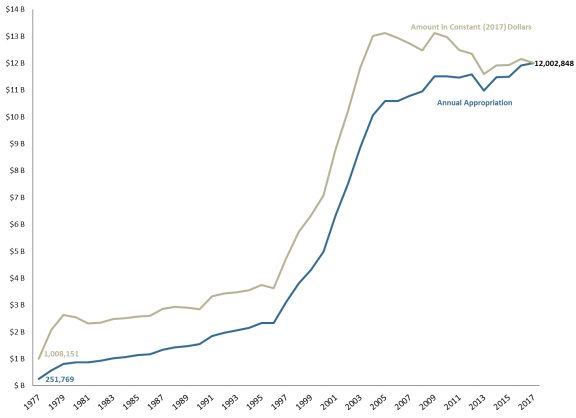
The IDEA is one of the largest educational programs overseenadministered by the U.S. Department of Education (ED). As Figure 1 displays, from the first year of funding in 1977 until about a decade agothe mid-2000s, appropriations for the Part B grants-to-states program20 had been rising rapidly. In the first 20 years of funding for the Part B program, appropriations increased approximately 470250% in constant 2017(inflation-adjusted) 2025 dollars. Between the last two reauthorizations of the IDEA in 1997 and 2004, Part B appropriations rose an average of 1817% per year in constant dollars, increasing 176% in seven years. However, Part B funding trends changed after the 2004 reauthorization, and appropriations have fluctuated in the years since. Part B funding reached its highest levels in FY2005 and FY2009,21 with level of funding in FY200521 with the inflation-adjusted amountsamount exceeding $13.117.54 billion each year. In FY2017 the appropriation was $12 billion, and in FY2018 it was $12.3 billion.
(funding in billions, shown in nominal and constant FY2025 dollars) |
 |
Source: Figure prepared by CRS. Funding amounts are from U.S. Department of Education budget tables, https://www2.ed.gov/about/overview/budget/tables.html.
|
Despite recent fluctuations in Part B appropriations, funding The funding amount for FY2021 also only displays regular appropriations; additional IDEA funding provided by the American Rescue Plan Act of 2021 (ARPA, P.L. 117-2) is not displayed.
Despite the recent flat funding of Part B appropriations, appropriations for the Part B grants-to-states program increased steadily for most ofmost years over its first fourfive decades (Figure 1). In contrast,However, in constant dollar amounts the Part B grants-to-states program's funding has had a different pattern. In constant 2025 dollars, the Part B grants-to-states program's funding increased gradually for its first two decades, then increased sharply between its 1997 and 2004 comprehensive reauthorizations, before generally declining over the past two decades. Similarly, the funding levels for the two early childhood grant programs, after experiencing substantial growth in earlier periods in program history, have declined in constant dollar amounts in more recent periods (Figure 2).
.
The Part B, Section 619 preschool grants program began with a period of relatively low funding between FY1980 and FY1986 ($25 million to $29 million), followed by a period of rapid escalation in funding between FY1987 ($180 million) and FY1995 ($360 million). The year-to-year escalation in Section 619 funding slowed over the next five years. In FY2000, Section 619 funding reached its highest annual appropriation level in actual dollars nominal dollars up to that time ($390 million), and it maintained that appropriation for the next two years. From FY2003 through the present, Section 619 appropriations have fluctuated somewhat in actual dollarsnominal dollars, receiving its highest annual appropriation level in nominal dollars in FY2023, FY2024 and FY2025 ($420 million), and declined in constant dollars. The Section 619 preschool grants program received its highest level of funding in constant FY2017FY2025 dollars in FY1995 ($578761 million). In FY2018FY2025, the Part B, Section 619 preschool grants program was appropriated $381received $420 million.
The Part C, infants and families program experienced a period of relatively constant funding growth for its first 1518 years; Part C appropriations increased from $50 million in FY1987 to over $444 million in FY2004 (Figure 2). In the years since, the IDEA Part C grants program has received relatively level appropriations in actualnominal dollars and declining funding in constant 20172025 dollars. Between FY2004, the year of the IDEA's most recent reauthorization, and FY2012, funding in nominal dollars for the Part C program changed relatively little from one year to the next, while funding in inflation-adjusted dollars eroded. For the past five years, appropriations for the Part C program have fluctuated. In FY2018 and FY2019, the Part C, infants and families program was appropriated $470 million.
Historical Review of Funding Provisions in the IDEA and Related Acts
Since 2013, Part C appropriations have slowly grown, while fluctuating slightly in constant dollars. In FY2023, FY2024, and FY2025, the Part C infants and families program received $540 million.
(funding in millions, shown in nominal and constant FY2025 dollars) Notes: Constant dollars based on the Consumer Price Index for All Urban Consumers (CPI-U), prepared by the U.S. Department of Labor, Bureau of Labor Statistics, and adjusted to a school-year basis (July 2024 to June 2025) by CRS.
P.L. 89-750, the Elementary and Secondary Education Act Amendments of 1966, established a new Title VI of the ESEA, separately authorizing an assistance program for projects in states to educate children with disabilities. Sponsors of this law argued that the U.S. Office of Education had not appropriately responded to the needs of children with disabilities under the ESEA Title I program. P.L. 89-750 authorized a two-year program of project grants to states for the education of children with disabilities at the preschool, elementary, and secondary school levels.22 Allotments of grant funds to states were based on the state's population of children with disabilities ages 3 through 21 in need of special education and related services.23 P.L. 89-750 also authorized a National Advisory Committee on the Education of the Handicapped, and established a bureau within the Office of Education to administer programs for the education and training of children and youth with disabilities.
The Education of the Handicapped Act (EHA)
The ESEA Amendments of 1970 (P.L. 91-230) repealed Title VI and created a separate law, the Education of the Handicapped Act (EHA), to consolidate all federal educational assistance for children with disabilities into one statute. The new program of assistance to states was essentially a grant program that supported projects providing services for students with disabilities, which was authorized for three fiscal years.24
By 1970, some Members of Congress argued that greater emphasis should be placed on EHA assistance to states because of the number of school-aged children with disabilities who reportedly were unserved by states. The House Committee on Education and Labor report on the bill that would become P.L. 91-230 noted that by U.S. Office of Education estimates, 60% of the total school-aged population of children with disabilities in the United States were not receiving special education services.25 The committee did not recommend any changes in the federal program of project grants to states to address the problem, but it urged full program funding at the authorization level. The committee noted that the history of assistance programs for children with disabilities had been "marked by serious discrepancies between authorizations and appropriations." In FY1969, for example, appropriations were only about 18% of the authorization.
By 1974, when the EHA state grant program was next reauthorized in P.L. 93-380, Congress had become increasingly persuaded that the program did not adequately address the educational needs of children with disabilities. States, under court mandates and their own laws, had major new responsibilities to provide educational services to all children with disabilities, but due to financial constraints many were unable to meet minimum educational requirements. The amendments enacted in P.L. 93-380 that provided a one-year "emergency" program of assistance to states set the stage for the enactment of the IDEA's predecessor legislation—the Education of All Handicapped Children Act (P.L. 94-142)—in 1975.
Education for All Handicapped Children Act
As early as 1972, an Education for All Handicapped Children Act was proposed in the 92nd Congress in S. 3614, introduced by Senator Harrison Williams, chairman of the Senate Committee on Labor and Public Welfare, and in H.R. 15727, introduced by Representative John Brademas, chairman of the House Subcommittee on Select Education.26 These basically similar bills would have authorized federal assistance to states to help them implement the Supreme Court's mandate that all children with disabilities receive appropriate educational services. In contrast to the existing federal program of grants supporting projects, the program authorized by these bills would have provided federal payments to states for up to 75% of the excess costs incurred by school districts for educating children with disabilities.
In his statement introducing S. 3614, Senator Williams noted the following:
We have increased Federal assistance [for children with disabilities] from $45 million 5 years ago to $215 million in the present fiscal year. But these have been token expenditures. Nowhere in our public laws or in our budget figures do we find acceptance for the proposition that all handicapped children have the right to an education. It has been the courts which have forced us to the realization that we can delay no longer in making just such a commitment.
[W]e at the Federal level are going to have to change our traditional methods of investing money. The theory that the Federal Government can provide minimal assistance to the states as incentive grants to provide extensive educational services simply does not meet the mark in this instance…It is hard to argue to the states that the Federal Government is serious about full educational opportunity for all handicapped children when we are not willing to invest money to make this goal a reality. If we are going to make a real commitment to full and appropriate services, and expect the states to carry through on this commitment, we will have to put our money where our mouth is.27
At the beginning of the 93rd Congress, Senator Williams and Representative Brademas reintroduced the Education for All Handicapped Children Act as S. 6 and H.R. 70, respectively. The Nixon Administration opposed the Williams and Brademas proposals, and the 93rd Congress ended without action on either bill.
The Education Amendments of 1974 (P.L. 93-380) included a significant change in the EHA state grant program. Offered by Senator Charles Mathias of Maryland, the "Mathias amendment" authorized a program of federal assistance to states for children with disabilities, for FY1975 only, through a funding allotment equaling a state's population of children ages 3 through 21 multiplied by $8.75. This authorization represented a threefold increase in the amount last authorized for the state grant program under P.L. 91-230. The Mathias amendment also, for the first time, required states as a condition of receiving assistance to adopt certain program policies and due process procedures such as those that were being proposed in S. 6 and H.R. 70. When the Mathias amendment was considered, Senators agreed that it should be thought of as an interim emergency measure pending the enactment of S. 6, which was being crafted by the Senate Committee on Labor and Public Welfare after extensive hearings and more thorough examination.28
P.L. 93-380 became law on August 24, 1974. Appropriations for FY1975 for the Mathias amendment were $100 million, approximately 15% of the amount that would have needed to be appropriated to fully fund the program, though twice the FY1974 appropriations for the state grant program. P.L. 93-554, the Supplemental Appropriations Act for Fiscal Year 1975, which provided the FY1975 appropriations for the EHA state grant program, provided an additional $100 million in appropriations for new obligations under the program in FY1976.
The Education for All Handicapped Children Act was reintroduced in the 94th Congress by Senator Williams in the Senate and Representative Brademas in the House, each. Each bill withhad over 20 cosponsors. In addition to the hearings held in the previous Congress, several more days of hearings were devoted to the measures in both the House and Senate in the spring of 1975.29 The major concerns of witnesses before the Senate subcommittee involved the most appropriate formula for the distribution of funds under S. 6, and the best way to enforce the education rights of children with disabilities and measure compliance. Similarly, theThe House committee report accompanying S. 6 included views of certain committee members focusing mainly on whether the authorization levels implied by the formula might be unrealistic.
Conference Action
The Senate and House appointed members to a conference committee to resolve their differing versions of the Education for All Handicapped Children Act. The conference committee met on five days in October 1975 and agreed to a compromise version of the bill on October 30. Some of the most significant differences between the Senate and House proposals related to funding issues, including the funding formula, within-state distribution of funds, the excess costs provisions, preschool incentive grants, and administrative and planning costs.
The conference committee agreed to a formula that would provide a maximum grant for each state that iswas equal to its count of children with disabilities served multiplied by a gradually increasing percentage of the national average per pupil expenditure (APPE)—beginning at 5% of the APPE in FY1978, increasing to 40% in FY1982, and then remaining at 40% every year thereafter. The authorization of appropriations was permanent, and would become effective in FY1978.30 The maximum allowable grant that each state could receive per special education student from FY1982 onward (i.e., 40% of the APPE) came to be known as the "full funding" amount for the Education of All Handicapped Children Act, and later for the IDEA. The funding states received in FY1977 was set as the base-year amount—no state could receive less than it had that year. In years when Congress did not appropriate enough to meet the authorized level of 40% of the national APPE, each state's award was reduced proportionally.
The Senate Committee on Labor and Public Welfare explained its rationale for using states' special education child count in 1975, stating the following:
The Committee wished to develop a formula which would target funding and eligibility for funding on the population of handicapped children for whom services would be provided. The Committee adopted this formula in order to provide an incentive to states to serve all handicapped children and to assure that the entitlement is based on the number of children actually receiving special education and related services within the State and for whom the State or the local educational agency is paying for such education. The formula in existing law, the Education of the Handicapped Act, distributes Federal funds to the States on the number of all children, aged three to twenty-one within such State. The Committee has developed a formula which generates funds on the basis of the handicapped children receiving an education within a State.31
President Ford Signs the Bill
President Gerald Ford signed S. 6 on November 29, 1975, and it became P.L. 94-142. In a statement on the approval of the bill, the President noted his reservations that the legislation falsely raised the hopes and expectations of the disabilities community because of excessive and unrealistic authorization levels. President Ford said, "Despite my strong support for full educational opportunities for our handicapped children, the funding levels proposed in this bill will simply not be possible if Federal expenditures are to be brought under control and a balanced budget achieved over the next few years."32 In the fourfive decades since the signing of the Education for All Handicapped Children Act, appropriations for the Part B grants-to-states program have never met the authorizedoriginal Part B formula's "full-funding" level of 40% of the national APPE.
Funding Formula Changes: IDEA 1997
Since 1975, Congress has reauthorized the federal special education law five times, most recently in 2004. Known as the Individuals with Disabilities Education Act (IDEA) since its 1990 reauthorization, the act's funding provisions have undergone several changes over the past 40 years, the most significant of which were implemented in the 1997 reauthorization.33
In an effort to ensure that states would identify and serve all children in need of special education services, Congress designed P.L. 94-142'sthe 94th Congress designed the original Part B funding formula to reward states for identifying students with disabilities for special education services and for continuing to provide them with special education once they were identified. Congress encouraged states to serve all children in need of special education and related services by tying Part B funding to the number of special education students each state served.
By the mid-1990s, Congress found that their goal of ensuring public schools would identify and serve children with disabilities had been successful; however, a growing concern was a disproportionate number of minority children being identified as disabled, particularly in the more subjective disability categories of specific learning disability (SLD), intellectual disability, and emotional disturbance.34 The committee reports accompanying the 1997 IDEA amendments presented Congress's concern about the disproportionate representation of minorities in special education and explained their rationale for a new state allocation formula.35 The House report of the Committee on Education and the Workforce36 stated the following:
The Committee developed the change in formula to address the problem of over-identification of children with disabilities. When the Act was first passed in 1975, States were not providing educational services to many children with disabilities. Therefore, Congress proposed to distribute federal funds for special education services in order to encourage and reward States for serving eligible children. In the 22 years since then, the States have made excellent progress in identifying children with disabilities and providing them access to special education, and are now serving 5.5 million children with disabilities or approximately 10 percent of children aged 3 through 17. Logically, a formula was established at that time that based funding on counting the number of children with disabilities identified. This was to encourage States to proactively locate children with disabilities.
Today, the growing problem is over identifying children as disabled when they might not be truly disabled. The challenge today is not so much how to provide access to special education services but how to appropriately provide educational services to children with disabilities in order to improve educational results for such children. As States consider this issue, more and more States are exploring alternatives for serving more children with learning problems in the regular educational classroom. But in doing so, they face the prospect of reductions in Federal funds, as long as funding is tied to child counts.
While it is unlikely that individual educators ever identify children for the additional funding that such identification brings, the financial incentive reduces the proactive scrutiny that such referrals would receive if they did not have the additional monetary benefit. It also reduces the scrutiny of children who might be moved back out of special education. In-State funding formulas that follow the current disability-based Federal child-count formula further reduce such scrutiny, with more children being identified to draw additional State funds.
This problem is most intense with minority children, especially African-American males. Over-identification of minority children, particularly in urban schools with high proportions of minority students, remains a serious and growing problem in this Nation. The problem also contributes to the referral of minority special education students to more restrictive environments. The committee is also cognizant, however, that in some areas under identification remains a problem, particularly for minority children.
The report explained the change from a formula based on the number of children receiving special education (100%) to a formula based on the total population of children in each state (85%) and the percentage of those children living in poverty (15%):
:
The Committee has squarely faced this problem by shifting, once the targeted threshold is reached, to a formula of which 85 percent of additional funds is based on the total school age population and 15 percent is based on the poverty statistic for children in a State. This system was encouraged in the 1994 report of the Department of Education's Inspector General. The Inspector General noted: ``Because [a population-based] method [of allocating funds] uses objective data derived for other purposes, [this method] eliminates the financial incentives for manipulating student counts [that exist in the current formula], including retaining students in special education just to continue receiving Federal funds.'' The Committee added a poverty factor to the formula because there is a link between poverty and certain forms of disability. This concept was also encouraged by the Inspector General's report.
Based on the significant progress that has been made in providing access to special education and concerns about the over-identification of children as disabled, the Committee believes this new formula will address many of these concerns. This change will enable States to undertake good practices for addressing the learning needs of more children in the regular classroom without the unnecessary categorization or labeling thereby risking the loss of Federal funds. Changing the Federal formula may also motivate States to change their own formulas for distributing State aid in ways that eliminate inappropriate financial incentives for referring children to special education.
37
The funding formula adopted through the 1997 IDEA amendments was set to take effect the year the federal appropriation for the grants-to-states program first exceeded $4.9 billion. The formula guaranteed states a minimum base-year amount, which was set as the amount states received the year before the new formula took effect.3738 Since the IDEA appropriation exceeded $4.9 billion for the first time in FY2000, the base-year amount states were guaranteed was their FY1999 funding level.
In
Instead of basing IDEA grants-to-states allocations on the number of students with disabilities served by each state, as had been the case since 1975, the 1997 amendments based new funding (i.e., funding over a set base-year amount) on the total number of public-school children in the state and the total number of those children living in poverty. Under 1997 law, in years when Congress appropriated more funding to the grants-to-states program than it had the year before, funding exceeding the base-year amount would bewas allocated to states based on the total population of children ages 3 through 213839 in the state and the percentage of those children living in poverty. Of the funding over the base-year amount, 85% was awarded based on the population of children ages 3 through 21 in the state (not only children with disabilities), and the remaining 15% was based on the state's share of children living in poverty. The full fundingmaximum grant amount of 40% of the national APPE was maintained in the formula adopted through the 1997 amendments. While there were changes and additions made to the IDEA formula in the 2004 reauthorization, which will be discussed in the next section of this report, the basic framework of the formula adopted through the 1997 amendments remains in place today.
Procedures Used to Allocate IDEA Funds
Part B Grants to States
While the basic framework of the formula adopted through the 1997 amendments remains in place today, there were changes made to the IDEA Part B funding formula in the 2004 reauthorization. First, there were changes to the maximum grant calculation. Prior to the enactment of P.L. 108-446, the maximum amount states could receive under the Part B grants-to-states program was based on 40% of the national APPE for public K-12 education multiplied by the number of children with disabilities the state served.40 The sum of those maximum grants was equal to the "full funding" amount established in 1975 (40% of the national APPE). The IDEA's 2004 amendments41 changed the maximum grant calculation to align with the IDEA funding formula established in the 1997 IDEA amendments. In addition, P.L. 108-446 provided specific authorization levels for FY2005-FY2011, aimed at reaching the maximum grant level for each state within seven years. However, neither the 2004 grants-to-states maximum grant level nor the 1975 "full funding" level was reached by FY2011. If a state's relevant population for school year 2007-2008 rose by 3% above its 2004-2005 population and its number of children living in poverty rose by 2% above the 2004-2005 number, then its 2007-2008 maximum grant would have been the appropriate APPE for that year multiplied by the 2004-2005 number of children with disabilities served increased by 2.85% (85% of 3% plus 15% of 2% = 2.55% + 0.3% = 2.85%).What follows is a description of grant allocation procedures authorized under current law. After the Secretary of Education (the Secretary) has reserved funds for technical assistance39 and for payments to the outlying areas, the freely associated states, and the Secretary of the Interior40 for a fiscal year, the Secretary allocates the remaining IDEA Part B
IDEA 2004 Formula Changes
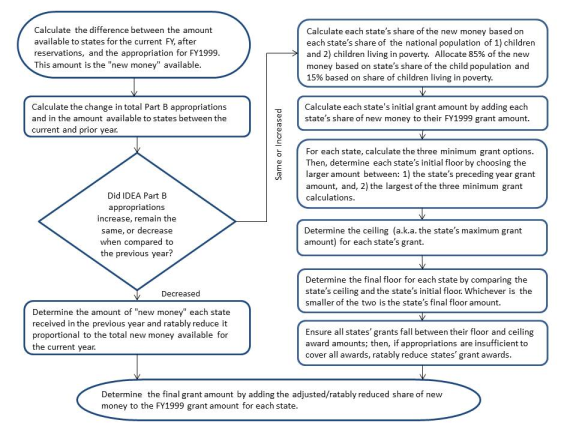
amount among the states. Part B formula grants to states are calculated based on one of two scenarios: (1) the appropriated amount available to states for the current fiscal year is greater than or equal to the amount that was available to states in the previous year, or (2) the appropriated amount available to states in the current year is less than the amount available to states the previous year. Figure 23 summarizes the process of determining state allocations whether appropriations increase, remain the same, or decrease. The following two sections of this report will examine how IDEA allocations are calculated in years when funding increases or remains the same, and in years when funding decreases.
|
 |
|
Source: Figure prepared by CRS. |
Source: Figure prepared by CRS based on CRS analysis of IDEA Part B Section 611.
Level or Increased Federal IDEA Part B Funding
Source: Figure prepared by CRS based on CRS analysis of IDEA Part B Section 611.
The IDEA Part B provisions specifying the allocation procedures when Part B appropriations are the same as or greater than they were in the preceding fiscal year are more complicated than the formula used when Part B appropriations are less than they were in the preceding year. A Part B appropriation equal to or greater than the previous year's appropriation is also the more common scenario, occurring in 3623 of the 4026 years between FY1977 and FY2017FY2000 and FY2025 (as displayed in Figure 14).4149 The calculations used in years when Part B funding increases or remains the same are outlined below.
Basic IDEA State Grant Funding Calculation
(funding in billions, shown in nominal and constant FY2025 dollars) Notes: Constant dollars based on the Consumer Price Index for All Urban Consumers (CPI-U), prepared by the U.S. Department of Labor, Bureau of Labor Statistics, and adjusted to a school-year basis (July 2024 to June 2025) by CRS.As discussed previously, the base
Basic IDEA State Grant Funding Calculation
As discussed previously, the basic formula for state allocations was historically designed to target funds toward states with higher proportions of children with disabilities. After concerns arose that an IDEA formula based on the number of children found eligible for special education services in a state might incentivize special education placement and contribute to the disproportionate number of minority students receiving special education services, Congress changed the basebasic formula during the reauthorization of the IDEA in 1997 to target funds toward states with larger total populations of children ages 3 through 21 years old, not specifically children with disabilities. In the current IDEA Part B formula, states with higher rates of children living in poverty are also targeted.
and higher rates of children living in poverty, not specifically children with disabilities.
Currently, the basic formula for allocating Part B grants, in years when appropriations to states are equal to the prior year or have increased, remains the same as the one put in place during the 1997 reauthorization of the IDEA. Under this formula, 85% of any funds over the base-year appropriation50 (FY1999) are distributed based on theeach state's share of the United States' total population of children ages 3 through 21,4251 and the remaining 15% is distributed according to theeach state's share of children of the same age range living in poverty.
Each state's initial Part B grant is the sum of three factors: (1) the state's FY1999 base-year grant, (2) the state's share of new money based on population, and (3) the state's share of new money based on poverty. The second twoand third factors are calculated using the state's share of the national population of children ages 3 through 21 and the state's share of children living in poverty. Each state's share of the national child population is calculated by dividing a state's total population of children4352 by the national population of children ages 3 through 21 (State Grantpop); and each state's share of the national population of children in poverty is calculated by dividing the state's population of children living in poverty by the U.S. population of children living in poverty.
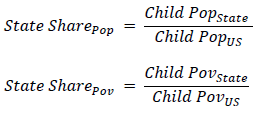
(State Grantpov).
To calculate fully the initial Part B grant for an individual state, one first has to determine the state's grant based on the state's population of children ages 3 through 21 and the state's grant based on their share of children ages 3 through 21 living in poverty. State grants based on population (State GrantpopPop) are calculated by allocating 85% of the "new money" (i.e., funds over the FY1999 base-year appropriation) based on the state's share of the U.S. child population, and state grants based on poverty (State GrantpovPov) are calculated by allocating 15% of the new Part B money based on the state's share of the U.S. child population living in poverty.

Each state's initial Part B grant is the sum of the state's FY1999 base-year grant, their initial state grant based on population, and their initial state grant based on poverty.

Once each state's initial or "basic" grant has been calculated it may be adjusted based on each state's minimum and maximum grant levels, which also must be calculated, statutory language requires minimum and maximum grant amounts to be calculated for each state. If the initial grant a state would receive based on the basic IDEA funding formula would fall outside the range determined by the minimum and maximum grant calculations, the state's IDEA grant is set to its floor or ceiling grant allocation as appropriate.
Allocation Floor
(minimum) or ceiling (maximum) grant allocation as appropriate. This means that a state with an initial grant calculation below its floor (or minimum) will have its grant increased to that amount, and a state with an initial grant calculation above its ceiling (or maximum) will have its grant decreased to the amount.
Allocation Floor
Part B describes four amounts used to determine a state's minimum grant amount or allocation floor. First, determineAfter each of thesethe four amounts; then set the largest of them is calculated, the largest amount is used as the state's allocation floor.
The first amount is the state's preceding-year allocation, commonly known as the "hold harmless" amount.44 The other three 53 Beyond the hold harmless amount, three minimum amounts are calculated using three formulas for determining minimum grant amounts outlined in the IDEA:
- 1. Calculate the first state minimum grant award amount by adding the FY1999 award level for a state and
1⁄3% (i.e., 0.0033)0.33% of the amount by which the current year's (CY's) appropriation exceeds the amount appropriated for Part B in FY1999:
This calculation only results in the highest minimum grant award amount for states with small populations, and therefore is sometimes referred to as the "small state minimum." - 54
2. Calculate the second state minimum grant award amount by adding the state's prior-year (PY) award level, and that
prior-yearPY amount multiplied by any percentage increase in appropriations for Part B in excess of 1.5% above the preceding fiscal year's appropriation:
This calculation results in the greatest minimum allocation for states in years when there is a large (e.g., >15%) increase in the amount appropriated for Part B. -
3. The third state minimum grant award is calculated by adding a state's prior-year award level and that PY award level
and that prior-year amountmultiplied by 90% of the percentage increase in the amount appropriated for Part B from the preceding fiscal year.45
55This calculation is used for most states in years when the increase in the Part B appropriation is less than 15% above the previous fiscal year. In practical terms, this third minimum state grant will always result in a grant amount equal to or greater than a state's preceding-year allocation.
The state's preceding-year allocation is compared to the results of three state award minimum calculations. The largest of these four quantities is then set as that state's allocation floor.
Allocation Ceiling
There is one calculation to determine each state's maximum award or ceiling (i.e., the amount the state's allocation may not exceed). The maximum award is calculated as the sum of the amount the state received the preceding fiscal year and that prior-year amount multiplied by the sum of 1.5% and the percentage increase in the amount appropriated from the preceding fiscal year.46

56
A state's maximum award is the amount the state's allocation may not exceed, as opposed to the maximum amount it can receive. And, when determining a state's final floor, the lesser amount between the minimum and maximum grant for the state is the amount awarded. Therefore, when a state's maximum grant is lower than the state's highest calculated minimum grant, the maximum grant amount is allocated. Once each state's floor and ceiling amounts are calculated, those amounts are compared to the basic grant amount calculated based upon population and poverty data.58 Each state's grant amount must be adjusted to fit within the range of its floor and ceiling grant levels. States' initial grant amounts that fall outside this range are either brought up to equal their floors or brought down to equal their ceilings. FY2025 State Minimum Grant Maximum Grant Final Grant Calculation Alabama $221,059,640 $224,375,535 $221,059,640 Hold Harmless Alaska $45,257,370 $45,907,026 $45,228,597 Hold Harmless Arizona $249,608,658 $253,352,788 $249,608,658 Hold Harmless Arkansas $138,632,623 $140,712,112 $138,632,623 Hold Harmless California $1,470,487,107 $1,492,544,414 $1,470,487,107 Hold Harmless Colorado $199,842,742 $202,840,383 $199,842,742 Hold Harmless Connecticut $158,823,892 $161,206,250 $158,823,892 Hold Harmless Delaware $44,234,682 $44,869,657 $44,206,559 Hold Harmless $38,653,810 $24,436,757 $24,075,623 Hold Harmless Florida $785,596,408 $797,380,354 $785,596,408 Hold Harmless Georgia $421,759,531 $428,085,924 $421,759,531 Hold Harmless Hawaii $49,215,851 $49,954,089 $49,215,851 Hold Harmless Idaho $70,855,334 $71,918,164 $70,855,334 Hold Harmless Illinois $602,555,133 $611,593,460 $602,555,133 Hold Harmless Indiana $315,638,302 $320,372,877 $315,638,302 Hold Harmless Iowa $145,940,335 $148,129,440 $145,940,335 Hold Harmless Kansas $131,438,816 $133,410,398 $131,438,816 Hold Harmless Kentucky $196,467,467 $199,414,479 $196,467,467 Hold Harmless Louisiana $225,277,998 $228,657,168 $225,277,998 Hold Harmless Maine $65,411,743 $66,392,919 $65,411,743 Hold Harmless Maryland $248,268,696 $251,992,726 $248,268,696 Hold Harmless Massachusetts $339,339,359 $344,429,449 $339,339,359 Hold Harmless Michigan $473,533,818 $480,636,825 $473,533,818 Hold Harmless Minnesota $232,947,616 $236,441,830 $232,947,616 Hold Harmless Mississippi $144,872,088 $147,045,169 $144,872,088 Hold Harmless Missouri $273,149,625 $277,246,869 $273,149,625 Hold Harmless Montana $46,007,617 $46,668,043 $45,978,367 Hold Harmless Nebraska $90,915,942 $92,279,681 $90,915,942 Hold Harmless Nevada $96,817,708 $98,269,974 $96,817,708 Hold Harmless New Hampshire $56,713,037 $57,563,733 $56,713,037 Hold Harmless New Jersey $432,091,008 $438,572,373 $432,091,008 Hold Harmless New Mexico $108,763,942 $110,395,401 $108,763,942 Hold Harmless New York $905,507,664 $919,090,279 $905,507,664 Hold Harmless North Carolina $414,178,532 $420,391,210 $414,178,532 Hold Harmless North Dakota $42,124,309 $39,463,478 $38,880,274 Hold Harmless Ohio $520,667,408 $528,477,419 $520,667,408 Hold Harmless Oklahoma $181,250,221 $183,968,974 $181,250,221 Hold Harmless Oregon $159,821,386 $162,218,707 $159,821,386 Hold Harmless Pennsylvania $518,944,156 $526,728,318 $518,944,156 Hold Harmless Puerto Rico $149,556,625 $151,799,974 $149,556,625 Hold Harmless Rhode Island $52,275,509 $53,059,642 $52,275,509 Hold Harmless South Carolina $220,145,020 $223,447,195 $220,145,020 Hold Harmless South Dakota $43,867,511 $44,497,216 $43,839,622 Hold Harmless Tennessee $289,114,308 $293,451,023 $289,114,308 Hold Harmless Texas $1,250,501,548 $1,269,259,071 $1,250,501,548 Hold Harmless Utah $142,871,872 $145,014,950 $142,871,872 Hold Harmless Vermont $41,797,934 $38,050,326 $37,488,006 Hold Harmless Virginia $345,739,785 $350,925,882 $345,739,785 Hold Harmless Washington $274,745,913 $278,867,102 $274,745,913 Hold Harmless West Virginia $90,785,429 $92,147,210 $90,785,429 Hold Harmless Wisconsin $249,617,277 $253,361,536 $249,617,277 Hold Harmless Wyoming $42,229,413 $39,918,565 $39,328,635 Hold Harmless Source: Prepared by CRS based on unpublished data provided by the U.S. Department of Education (ED), Budget Service. Notes: All grant amounts include penalties when present. The Part B appropriation remained the same at $14.214 billion (0.00% increase) in current dollars between FY2024 and FY2025. Because Part B's appropriation increased less than 15% from FY2024 to FY2025, the calculations used to determine allocations resulted in all states receiving their hold harmless amount in FY2025. For small population states that in years with increasing Part B funding would receive the small state minimum (i.e., Minimum1) the hold harmless amount is lower than either their minimum or maximum grant would have been. The states for whom that was the case in FY2025 were Alaska, Delaware, the District of Columbia, Montana, South Dakota, and Vermont. If the amount appropriated for Part B grants is below the amount appropriated for the preceding fiscal year but above the amount appropriated in FY1999, a single additional calculation is used. Each state is allocated the sum of its FY1999 base-year grant and an amount of the current fiscal year's ratably reduced Part B new money proportional to the share of new money the state received the prior fiscal year.61 First, calculate the amount of new money provided to each state the previous year: After totaling the new money available to all states in the previous year, calculate each state's ratably reduced funding amount for the current year: Determine the final grant amount for each state by adding the state's ratably reduced new money grant amount to the state's FY1999 grant amount. If Congress provided the Part B program an annual appropriation less than or equal to the amount it provided in FY1999,62 a single, simpler calculation would be used.63 The amount each state received in FY1999 would be ratably reduced based on the amount of the reduction in overall funding for the program. This calculation has not been used to date. In FY2024, the IDEA grants-to-states program was appropriated $12.36 billion, over $8 billion more than it received in FY1999, suggesting it may be unlikely IDEA funding will drop below FY1999 levels in the future. Section 619 of IDEA Part B authorizes grants to states for preschool programs serving children with disabilities ages three through five. Because Part B grants to states are used to serve children with disabilities as young as three years of age (as well as school-aged children), Section 619 is not so much a separate program as it is supplementary funding for services to preschool children with disabilities. In general, the provisions, requirements, and guarantees under the grants-to-states program that apply to school-aged children with disabilities also apply to children in this age group. Part B Section 619 preschool grants follow the calculations previously discussed for determining Part B grants-to-states for children ages 3 through 21 years old, with the following adjustments:, but do not set a limit on the maximum funding a state may receive.57 The maximum grant level allows for the possibility that some funds would be unallocated in years in which IDEA funding rises enough that every state can receive its maximum grant. In some cases,Without a maximum grant level creating a cap on each state's allocation, even in years with dramatic increase in IDEA Part B funding, all Part B funds could be allocated among the states. With the maximum grant level cap, in cases when the calculated maximum award for a state is less than the calculated minimum for that state. When this happens, the state's final floor is set equal to its ceiling, and the state receives(the minimum award it can receive) is set equal to its ceiling (the maximum award it can receive). In such cases, the state should receive the lesser of the two amounts—, which is the maximum award.
Final Part B State Grant Funding Calculation
District of Columbia
Infants and Families Program (IDEA Part C)
The calculations used to determine the IDEA Part C infants and families program grants are simpler than those used for either of the Part B grant programs. After the Secretary has reserved funds for payments to the outlying areas,67 and for tribes, tribal organizations, and consortia of those groups for the provision of early intervention services on reservations,68 the Secretary allocates the remaining IDEA Part C amount among the 50 states, the District of Columbia, and Puerto Rico according to the ratio of infants and toddlers in each state to the number of infants and toddlers in all states. The minimum allotment for each state is either $500,000 or one-half of 1% of the total Part C funds allotted to the states, whichever is greater.69 If the appropriation for Part C is funded at a level insufficient to pay the full amounts that all states are eligible to receive in a given year, the Secretary must ratably reduce the states' payments, meaning the reduction will be proportionately reflected in the allotment for each state, including states initially receiving the minimum Part C grant amount.70
IDEA Funding Issues
Full Funding
When Congress enacted the predecessor legislation to the IDEA in 1975, it strove to ensure that (1) states would provide every eligible child a FAPE in the least restrictive environment, and (2) states would not take on an undue burden by agreeing to provide special education and related services.71 the maximum award.
When Part B grants to the 50 states, the District of Columbia, and Puerto Rico for FY2018 (shown in Table 2) are examined, the majority of states (47 out of 52; 90%) received their minimum award amount. Only four of those states (Alaska, Delaware, Montana, and South Dakota) received the "small state minimum" allocation. In other words, the first of the three state-grant-award-minimum calculations (shown above) was used to determine minimum and final grant allocations for only four states. The other 43 states receiving their minimum award amount received the allocation derived from the third minimum state grant calculation.47 As mentioned previously, the third minimum grant calculation is used for most states in years when the Part B appropriation is less than 15% greater than the previous fiscal year's appropriation. One state (Arizona) received a Part B grant allocation between its minimum and maximum grant. The remaining five states received their maximum allocations.48
As stated previously, a state's maximum award is the amount the state's allocation may not exceed, as opposed to the maximum amount it can receive. And, when determining a state's final floor, the lesser amount between the minimum and maximum grant for the state is the amount awarded. Therefore, when a state's maximum grant is lower than the state's highest calculated minimum grant, the maximum grant amount is allocated. This can be seen in the cases of the states awarded their maximum allocations in Table 2.
|
State |
Minimum Grant |
Maximum Grant |
Final Grant |
Calculation |
|||
|
Alabama |
$191,704,256 |
$194,695,969 |
$191,704,256 |
3rd Minimum |
|||
|
$39,092,997 |
$39,660,110 |
$39,092,997 |
1st Minimum |
|||
|
$212,666,499 |
$215,985,346 |
$215,703,278 |
| |||
|
Arkansas |
$118,077,245 |
$119,919,944 |
$118,077,245 |
3rd Minimum |
|||
|
California |
$1,289,886,774 |
$1,310,016,588 |
$1,289,886,774 |
3rd Minimum |
|||
|
Colorado |
$168,563,574 |
$171,194,156 |
$168,563,574 |
3rd Minimum |
|||
|
Connecticut |
$140,425,382 |
$142,616,843 |
$140,425,382 |
3rd Minimum |
|||
|
$38,070,309 |
$38,614,873 |
$38,070,309 |
1st Minimum |
|||
|
District of Columbia |
$32,489,437 |
$20,100,949 |
$20,100,949 |
Maximum |
|||
|
Florida |
$678,801,133 |
$689,394,420 |
$678,801,133 |
3rd Minimum |
|||
|
Georgia |
$363,687,565 |
$369,363,228 |
$363,687,565 |
3rd Minimum |
|||
|
Hawaii |
$41,985,838 |
$42,641,064 |
$41,985,838 |
3rd Minimum |
|||
|
Idaho |
$59,642,504 |
$60,573,277 |
$59,642,504 |
3rd Minimum |
|||
|
Illinois |
$534,100,818 |
$542,435,929 |
$534,100,818 |
3rd Minimum |
|||
|
Indiana |
$273,052,993 |
$277,314,224 |
$273,052,993 |
3rd Minimum |
|||
|
Iowa |
$128,973,897 |
$130,986,648 |
$128,973,897 |
3rd Minimum |
|||
|
Kansas |
$112,638,007 |
$114,395,822 |
$112,638,007 |
3rd Minimum |
|||
|
Kentucky |
$166,783,529 |
$169,386,333 |
$166,783,529 |
3rd Minimum |
|||
|
Louisiana |
$198,963,616 |
$202,068,618 |
$198,963,616 |
3rd Minimum |
|||
|
Maine |
$57,807,236 |
$58,709,369 |
$57,807,236 |
3rd Minimum |
|||
|
Maryland |
$211,199,244 |
$214,495,194 |
$211,199,244 |
3rd Minimum |
|||
|
Massachusetts |
$299,889,126 |
$304,569,158 |
$299,889,126 |
3rd Minimum |
|||
|
Michigan |
$421,468,719 |
$428,046,108 |
$421,468,719 |
3rd Minimum |
|||
|
Minnesota |
$200,246,668 |
$203,371,693 |
$200,246,668 |
3rd Minimum |
|||
|
Mississippi |
$126,410,148 |
$128,382,889 |
$126,410,148 |
3rd Minimum |
|||
|
Missouri |
$239,942,211 |
$243,686,719 |
$239,942,211 |
3rd Minimum |
|||
|
$39,843,244 |
$40,426,899 |
$39,843,244 |
1st Minimum |
|||
|
Nebraska |
$78,884,231 |
$80,115,289 |
$78,884,231 |
3rd Minimum |
|||
|
Nevada |
$80,795,419 |
$82,056,302 |
$82,056,302 |
Maximum |
|||
|
New Hampshire |
$50,129,598 |
$50,911,914 |
$50,129,598 |
3rd Minimum |
|||
|
New Jersey |
$381,857,840 |
$387,817,066 |
$381,857,840 |
3rd Minimum |
|||
|
New Mexico |
$96,223,277 |
$97,724,926 |
$96,223,277 |
3rd Minimum |
|||
|
New York |
$801,336,476 |
$813,842,035 |
$801,336,476 |
3rd Minimum |
|||
|
North Carolina |
$355,551,567 |
$361,100,261 |
$355,551,567 |
3rd Minimum |
|||
|
North Dakota |
$35,959,936 |
$32,461,481 |
$32,461,481 |
Maximum |
|||
|
Ohio |
$460,721,435 |
$467,911,397 |
$460,721,435 |
3rd Minimum |
|||
|
Oklahoma |
$156,665,705 |
$159,110,611 |
$156,665,705 |
3rd Minimum |
|||
|
Oregon |
$135,895,210 |
$138,015,974 |
$135,895,210 |
3rd Minimum |
|||
|
Pennsylvania |
$449,731,894 |
$456,750,354 |
$449,731,894 |
3rd Minimum |
|||
|
Rhode Island |
$46,198,168 |
$46,919,131 |
$46,198,168 |
3rd Minimum |
|||
|
South Carolina |
$186,823,424 |
$189,738,968 |
$186,823,424 |
3rd Minimum |
|||
|
$37,703,138 |
$38,239,606 |
$37,703,138 |
1st Minimum |
|||
|
Tennessee |
$250,893,359 |
$254,808,770 |
$250,893,359 |
3rd Minimum |
|||
|
Texas |
$1,075,095,895 |
$1,091,873,709 |
$1,075,095,895 |
3rd Minimum |
|||
|
Utah |
$121,521,416 |
$123,417,865 |
$121,521,416 |
3rd Minimum |
|||
|
Vermont |
$35,633,561 |
$31,299,065 |
$31,299,065 |
Maximum |
|||
|
Virginia |
$299,990,870 |
$304,672,490 |
$299,990,870 |
3rd Minimum |
|||
|
Washington |
$232,881,501 |
$236,515,821 |
$232,881,501 |
3rd Minimum |
|||
|
West Virginia |
$80,231,079 |
$81,483,156 |
$80,231,079 |
3rd Minimum |
|||
|
Wisconsin |
$219,603,832 |
$223,030,943 |
$219,603,832 |
3rd Minimum |
|||
|
Wyoming |
$36,065,040 |
$32,835,822 |
$32,835,822 |
Maximum |
|||
|
Puerto Rico |
$128,646,346 |
$130,653,986 |
$128,646,346 |
3rd Minimum |
Source: Prepared by CRS based on unpublished data provided by the U.S. Department of Education (ED), Budget Service.
a. Four states—Alaska, Delaware, Montana, and South Dakota—received their "small state minimum" grant in FY2019.
b. Arizona received a modified version of their third minimum.
Final Part B State Grant Funding Calculation
Once each state's floor and ceiling amounts are calculated, those amounts are compared to the initial grant amount calculated based upon population and poverty data. Each state's grant amount must be adjusted to fit within the range of its floor and ceiling grant levels. States' initial grant amounts that fall outside this range are either brought up to equal their floors or brought down to equal their ceilings.
If sufficient funds are not available to fully cover the calculated grant levels, ratable reduction is used to arrive at allocations across the states. During the ratable reduction process, no state's grant amount may be reduced below its prior-year allocation or its hold harmless level.49 Final state grant amounts are calculated by adding each state's adjusted and ratably reduced new money grant and the state's FY1999 base-year grant.
Decreased Federal IDEA Part B Funding
If the amount appropriated for Part B grants is below the amount appropriated for the preceding fiscal year but above the amount appropriated in FY1999, a single calculation is used. Each state is allocated the sum of its FY1999 base-year grant and an amount of the current fiscal year's Part B new money proportional to the share of new money the state received the prior fiscal year.50
First, calculate the amount of new money provided to each state the previous year:

After totaling the new money available to all states in the previous year, calculate each state's ratably reduced funding amount for the current year:

Determine the final grant amount for each state by adding the state's ratably reduced new money grant amount to the state's FY1999 grant amount.

If Congress provided the Part B program an annual appropriation less than or equal to the amount it provided in FY1999,51 a single, simpler calculation would be used.52 The amount each state received in FY1999 would be ratably reduced based on the amount of the reduction in overall funding for the program. This calculation has not been used to date. In FY2019, the IDEA grants-to-states program was appropriated $12.36 billion, over $8 billion more than it received in FY1999, suggesting it may be unlikely IDEA funding will drop below FY1999 levels in the future.
Grants to LEAs
States may reserve a portion of their federal IDEA funding for statewide activities,53 but they are required to distribute the majority of their IDEA allocation to local educational agencies (LEAs) and public charter schools that operate as LEAs. In order for states to allocate IDEA funds to individual LEAs they must use a formula similar to the one used to divide IDEA funds among states, except that the sources of population and poverty data vary from state to state. First, the states are required to award each LEA an amount based on its FY1999 base-year allocation. Then states distribute the remaining allocation according to the share of the population of children in both public and private schools in the LEA (85%) and the LEA's share of children living in poverty (15%). If a state educational agency determines that an LEA is providing a free appropriate public education to all children with disabilities in the LEA using only state and local funds, the SEA may reallocate any unneeded federal IDEA Part B funds to other LEAs in the state that are not adequately providing FAPE to all the children with disabilities they serve.54
Grants for IDEA Early Childhood Programs
Preschool Grants Program (Part B, Section 619)
Section 619 of IDEA Part B authorizes grants to states for preschool programs serving children with disabilities ages three through five. Because Part B grants to states are used to serve children with disabilities as young as three years of age (as well as school-aged children), Section 619 is not so much a separate program as it is supplementary funding for services to preschool children with disabilities. In general, the provisions, requirements, and guarantees under the grants-to-states program that apply to school-aged children with disabilities also apply to children in this age group.
Part B, Section 619 preschool grants follow the calculations previously discussed for determining Part B grants to states for children ages 3 through 21 years old, with the following adjustments:
- The reservation for administration and state-level activities that states may reserve from their Part B, Section 619 grant awards is greater than the amount states may reserve from their larger Part B, Section 611 grants (25% vs. 5%).
- Where the FY1999 grant is used in a calculation to determine "Part B Grants to States," it is replaced by the FY1997 grant in Part B, Section 619 calculations.55
Infants and Families Program (IDEA Part C)
The calculations used to determine the IDEA Part C infants and families program grants are simpler than those used for either of the Part B grant programs. After the Secretary has reserved funds for payments to the outlying areas,56 and for tribes, tribal organizations, and consortia of those groups for the provision of early intervention services on reservations,57 the Secretary allocates the remaining IDEA Part C amount among the 50 states, the District of Columbia, and Puerto Rico according to the ratio of infants and toddlers in each state to the number of infants and toddlers in all states. The minimum allotment for each state is either $500,000 or one-half of 1% of the total Part C funds allotted to the states, whichever is greater.58 If the appropriation for Part C is funded at a level insufficient to pay the full amounts that all states are eligible to receive in a given year, the Secretary must ratably reduce the states' payments, meaning the reduction will be proportionately reflected in the allotment for each state, including states initially receiving the minimum Part C grant amount.59
IDEA Funding Issues
Full Funding
The amount required to provide the maximum amount for each state's grant is commonly referred to as "full funding" of the IDEA. When Congress enacted the predecessor legislation to the IDEA in 1975, they strove to ensure that (1) states would provide every eligible child FAPE in the least restrictive environment, and (2) states would not take on an untenable financial burden by agreeing to provide special education and related services.
At the time, the available estimate of the cost of educating children with disabilities was, on average, twice the cost of educating other children.At the time, the available estimate of the cost of educating children with disabilities was, on average, twice the cost of educating other children.72 A determination was made that the federal government would pay some of this additional or "excess" cost of educating children with disabilities. The metric for determining this excess cost was the national average per-pupil expenditure (APPE). Congress's final determination was that the federal government would pay up to 40% of the excess cost of providing special education and related services, and; 40% of the national APPE adjusted by the number of children with disabilities a state served came to be known as the "full funding" amount of IDEA Part B grants to states.
IDEA funding has fallen short of the full funding amount each year from the formula's enactment through
FY1981 to FY2025 Source: Prepared by CRS using data from the U.S. Department of Education (ED). Notes: Calculations of the percentage of the national average per pupil expenditure (APPE) funded through regular appropriations and the 40% of national APPE full-funding level are based on data provided by ED, including annual IDEA appropriation amounts, national APPE for the relevant year, applicable child count, and funds set aside for technical assistance and related activities. In 1975, P.L. 94-142 set the federal maximum payment for Part B grants to states at 40% of the national APPE and phased in the maximum over a period of five years beginning in FY1977. FY1981 is the initial year shown in this figure because it was the first year for which full funding was set at 40% of APPE. The percentage of the national APPE for FY2009 was calculated based on regular appropriations; calculations based on additional IDEA funding provided by the American Recovery and Reinvestment Act (ARRA, P.L. 111-5) are not displayed. P.L. 108-446 set a new calculation to determine the maximum amount that each state may receive in IDEA grants-to-states funding.74 P.L. 108-446 tied its new maximum grant calculation to the full funding calculation developed in P.L. 94-142 by setting it to 40% of the national APPE multiplied by a number of child count measures.75 FY2019FY2025 (See Figure 5). For example, in FY2019FY2025 the amount appropriated for Part B73 accounted for approximately 14.310.2% of the national APPE, less than halfjust over 25% of the 40% full funding level. In FY2009, Part B appropriationsfunding approached closer to the full funding amount than theyit had before or havehas since, when, with the addition of federal stimulus dollars (not shown in Figure 5) provided by the American Recovery and Reinvestment Act (ARRA; P.L. 111-5), IDEA funding rose to almost 35% of the national APPE.
since, when, with the addition of federal stimulus dollars, IDEA funding rose to almost 35% of the APPE.
Prior to the enactment of P.L. 108-446 in 2004, the maximum amount a state could receive under the Part B grants-to-states program was based on 40% of the national APPE multiplied by the number of children with disabilities the state serves.60 P.L. 108-446 changed the method of calculating the maximum amount of states' grants.
A state's maximum grant amount for purposes of calculating "full funding" differs from the maximum grant level calculation performed in years when the IDEA Part B appropriation has increased, as described earlier in this report. The maximum grant level calculation described earlier is used in years when the most common funding scenario occurs—IDEA Part B appropriations increase but remain below the full funding level. In contrast, the maximum amount of each state's grant for the purposes of full funding would only be calculated in a year when IDEA Part B was fully funded. A state may never receive more than its full funding maximum grant amount, even if Congress were to appropriate more than the amount necessary to fully fund all state grant awards.
P.L. 108-446 set a new calculation to determine the maximum amount of state grants under full funding. Beginning in FY2007 and used for all subsequent fiscal years, the maximum amount of state grants for the purposes of full funding has been calculated as 40% of APPE multiplied by the number of children with disabilities the state served in school year 2004-2005, and then adjusted by the annual rates of change in the state's population in the age range comparable to ages for which the state provides FAPE for children with disabilities61 (85% of the adjustment) and in the state's population of children living in poverty in the same age range (15% of the adjustment).62 That is, a state's maximum grant amount or full funding level under the Part B grant-to-states program is 40% of APPE multiplied by the number of children with disabilities served and adjusted for each state's annual changes in child population and poverty rate.63
Prior to the enactment of P.L. 108-446, the IDEA authorized "such sums as may be necessary" for the Part B grants-to-states program. In response to debate over how and when to reach full funding for the IDEA, P.L. 108-446 (§611(i)) amended the act to include several years of specific authorization of appropriations levels, which culminated in an amount estimated to provide each state with its maximum grant amount in FY2011. The Part B grants-to-states program was not appropriated the amounts authorized by P.L. 108-446 and did not obtain full funding in FY2011.
Maintenance of Effort (MOE)
The IDEA was intended to help states and LEAs increase overall educational spending for special education, rather than substituting federal funds for special education spending at the state and local levels. The grants to states made under Part B may only be used to pay for the excess costs of providing special education and related services to students with disabilities6476 and may not replace state or local funding. To these ends, the IDEA contains supplement, not supplant (SNS) and maintenance of effort (MOE) requirements. IDEA's SNS requirements prohibit a state or LEA from using IDEA grants to provide services, purchase equipment, etc., that state, local, or other federal funds currently provide or purchase or, in the absence of the IDEA funds, would have provided or purchased. The IDEA MOE provisions require that a state or an LEA not reduce their support for special education and related services below the level of support provided the previous fiscal year.65
77
In general, a state may not reduce the amount of state financial supportsupport for special education and related services for children with disabilities below the amount of that support for the preceding fiscal year.66 In any fiscal year in which a state does not meet this MOE requirement, the Secretary of Education is required to reduce the state's subsequent year grant by the same amount by which the state fails to meet the requirement.6778 States support special education in different ways and through a variety of agencies;6879 however, for each state to meet the MOE provision of the IDEA, it must provide support for special education at no lower than the same aggregate level each year as it did in the preceding fiscal year. As long as a state maintains its level of financial support for special education from one year to the next, theThe level of financial support for special education and related services in a state may be maintained by a combination of state agencies, including, but not necessarily limited to, the state educational agency (SEA).
SEA. In any fiscal year in which a state does not meet this MOE requirement, the Secretary is required to reduce the state's subsequent year grant by the same amount by which the state fails to meet the requirement.80
The MOE provision for LEAs is similar to the MOE provision for states. However, the LEA may not "reduce the level of expenditures for the education of children with disabilities made by the local educational agency from local funds below the level of those expenditures for the preceding fiscal year."6981 At the local level, the individual LEAs, and no other local agencies, are responsible for maintaining their levels of IDEA expenditures from one fiscal year to the next. Stated another way, states and LEAs are both responsible for maintaining effort, however, states may count contributions to SEAs and other state agencies to meet this requirement, while LEAs must maintain their level of expenditures on special education themselves—they may not consider funds provided to other agencies in order to maintain their level of effort. The key difference between the state and LEA MOE requirements pertains to whether a single agency or multiple agencies bear the responsibility for maintaining financial effort.
As noted above, if a state or LEA fails to meet the MOE requirement in any fiscal year, its funding allocation will be reduced during the next fiscal year in the amount by which it failed to meet the requirement.7082 However, for both states and LEAs there are permissible reasons for reductions in MOE requirements; these reasons are discussed next.
Reduction of MOE Requirements: States
In certain rare instances a state may be granted a one-year waiver of the MOE requirement. The Secretary may grant a waiver, for one fiscal year at a time, in the case of "exceptional or uncontrollable circumstances" such as a natural disaster or a "precipitous and unforeseen decline in the financial resources of the state."7183 In addition, waivers can be granted if the state can provide "clear and convincing evidence" that FAPE is available for all children with disabilities in the state despite the decline in support.84.72 Proving that FAPE is available to every eligible child with a disability in the state is a high standard and, since the MOE provisions were first included in the IDEA in 1997, this type of waiver has never been granted.
If a state does not meet its MOE requirement for any given year, including any year for which the state was granted a waiver, the state financial support required in future years is not reduced. That is, the state must provide the amount that would have been required in the absence of failing to meet MOE in the previous year.7385 A waiver will reduce a state's financial support requirement for the year it is granted but not for subsequent years. A penalty may be imposed on a state for any fiscal year after the fiscal year the state reduces its special education funding.
state may be penalized in subsequent years for failing to meet MOE requirements unless another waiver is provided. Reduction of MOE Requirements: LEAs
LEAs vary in size, from large urban districts like New York City Public Schools and Los Angeles Unified School District to individual charter schools that operate as their own LEAs. Small LEAs, which lack the benefits economies of scale provide to large school districts, may find their special education budgets varying considerably from one year to the next due to changes in their staffing or student population. The IDEA potentially allows any LEA to reduce educational expenditures below the level of the preceding fiscal year if the reduction is attributable to
- the voluntary departure (e.g., by retirement) or departure for just cause of special education personnel;
- a decrease in enrollment of students with disabilities;
- the termination of an obligation to provide an individual child with a disability an exceptionally costly program, either because the child moved out of the LEA's jurisdiction, graduated, aged out of special education services, or no longer needs the program;
- the termination of costly expenditures for long‐term purchases such as the acquisition of equipment or construction of school facilities;
-
the assumption of cost by the high‐cost fund/high-risk pool operated by the SEA under the IDEA provisions for high-cost funds; or
74 - 86
an increase in the allocation of IDEA funds from the previous year that allows an LEA to employ the "50%" rule.
75
87ED has clarified in its policy letters that an LEA's reduction in MOE should only be for one of the reasons on this list.7688 When the Minnesota Department of Education wanted to know if an LEA's increased efficiency at providing services and its subsequent cost savings could justify a reduction in MOE, providing the example of an LEA that consolidated bus routes, ED's response was two-fold. Increased efficiency alone is not a suitable reason to allow an LEA to reduce its MOE according to ED. However, if the LEA could explain how the increased efficiency was attributable to one of the circumstances outlined in the statute (listed as the six bullet points above), it could potentially justify the reduction in spending.
High-Cost Pools/Risk Pools
As previously mentioned, when Congress enacted the predecessor legislation to IDEA in 1975,7789 the assumption was that education for children with disabilities was, on average, twice as costly as education for other children. While on average it is possible that this estimate was accurate, it did not account for the exceptional expenses of providing special education and related services to high-need/high-cost children with disabilities. The APPE for children with high-cost special needs can range from 3 to over 13 times more than the APPE for general education students.78
90 To help LEAs with the extraordinary costs of paying for the most expensive special education services, many states set up risk pools or high-cost funds91 that LEAs may apply to for extra funding when they are required to provide special education services that meet state-determined criteria for "high need." The definition of a high-need child with a disability varies from state to state. Some states set a specific dollar amount above which a child's services are considered high cost/high need. Other states define a high-need child with a disability as a child for whom the LEA's expenditures are a certain number of times higher than the APPE for a general education student.
How states choose to provide additional funding to LEAs with high-need children with disabilities also varies. The state may choose to pay for a percentage of the additional costs with or without a spending cap. For example, a state could decide it will pay 50% of all expenses over $25,000 up to $100,000, or 75% of all expenses over $50,000 with no upper limit. A state may also base the amount given for each child on the total number of requests for funding from the risk pool received from all LEAs in the state in a given year. In such a scenario, funding may be distributed to LEAs on a prorated basis depending on the total number of requests the state received.
This could also result in changes in the amount of funding an LEA receives from year-to-year to serve a particular child or group of children, even if those children's needs are not changing.
Amendments adopted in the 2004 reauthorization of the IDEA allow states to use 10% of their Part B funds reserved for state-level activities to establish and make disbursements from a high-cost fund to LEAs.7992 Though this was the first inclusion of risk pools or high-cost funds in the IDEA, many states used risk pools prior to 2004. States that had risk pool systems in place could use authorized Part B funds to support their existing risk pools as long as their systems met federal requirements. AnyThe 2004 IDEA amendments require any state that wants to use Part B funds to support a local risk pool needs to follow IDEA provisions for risk pools, including the following requirements:
- The SEA, in consultation with the state's LEAs, will develop a definition of a "high-need child with a disability" that addresses the financial impact a high-need child has on the budget of the child's LEA; and defines a high-need child with a disability as a child for which the cost of providing special education and related services is greater than 3 times the APPE in the state.
- The SEA will develop a state plan establishing eligibility criteria for LEAs to participate in the risk pool system that takes into account the number and percentage of high-need children with disabilities served by an LEA.
-
LEAs will only be allowed to use disbursements from risk pools to provide direct services outlined in the
individualized education programs (IEPs)IEPs of high-cost children with disabilities.80
93States may operate a risk pool or high-cost fund that does not meet these requirements provided no Part B funds are used to support their risk pool or high-cost fund.
Appendix A.
IDEA, Part B Age Ranges
Table A-1. IDEA, Part B Age Range Covered by State
(The
Table A-1. Age Range Each State Provides FAPE to Children with Disabilities
(the population used in IDEA formula calculations is based on the age range served in each state)
|
State |
Age Range (years) |
|
Alabama |
|
|
Alaska |
3-21 |
|
Arizona |
3-21 |
|
Arkansas |
3-20 |
|
California |
3-18 |
|
Colorado |
3-20 |
|
Connecticut |
3-20 |
|
Delaware |
3-20 |
|
District of Columbia |
3-21 |
|
Florida |
3-21 |
|
Georgia |
3-21 |
|
Hawaii |
3-19 |
|
Idaho |
3-20 |
|
Illinois |
3-20 |
|
Indiana |
3-21 |
|
Iowa |
3-20 |
|
Kansas |
3-20 |
|
Kentucky |
3-20 |
|
Louisiana |
3-21 |
|
Maine |
3-19 |
|
Maryland |
3-20 |
|
Massachusetts |
3-21 |
|
Michigan |
3-21 |
|
Minnesota |
3-20 |
|
Mississippi |
3-20 |
|
Missouri |
3-20 |
|
Montana |
3-18 |
|
Nebraska |
3-20 |
|
Nevada |
3-21 |
|
New Hampshire |
3-20 |
|
New Jersey |
3-20 |
|
New Mexico |
3-21 |
|
New York |
3-20 |
|
North Carolina |
3-21 |
|
North Dakota |
3-20 |
|
Ohio |
3-21 |
|
Oklahoma |
3-21 |
|
Oregon |
3-20 |
|
Pennsylvania |
3-20 |
|
Rhode Island |
3-20 |
|
South Carolina |
3-20 |
|
South Dakota |
3-20 |
|
Tennessee |
3-21 |
|
Texas |
3-21 |
|
Utah |
3-21 |
|
Vermont |
3-21 |
|
Virginia |
3-21 |
|
Washington |
3-20 |
|
West Virginia |
3-20 |
|
Wisconsin |
3-20 |
|
Wyoming |
3-20 |
|
Puerto Rico |
3-21 |
Source: Table created by CRS using information provided by U.S. Department of Education Budget Service.
Appendix B.
Commonly Used Acronyms
|
APPE |
Average Per Pupil Expenditure |
|
APR |
Annual Performance Report |
|
CEIS |
Coordinated Early Intervening Services |
|
CY |
Current Year |
|
ED |
U.S. Department of Education |
|
ESEA |
Elementary and Secondary Education Act |
|
FAPE |
Free Appropriate Public Education |
|
FY |
Fiscal Year |
|
IDEA |
The Individuals with Disabilities Education Act |
|
IEP |
Individualized Education Program |
|
LEA |
Local Educational Agency |
|
MOE |
Maintenance of Effort |
|
PY |
Prior Year |
|
RTI |
Response to Intervention |
|
SEA |
State Education Agency |
|
SNS |
Supplement, Not Supplant |
|
SPP |
State Performance Plan |
Author Contact Information
Acknowledgments
Mariam Ghavalyan, CRS Research Assistant, and Clarissa Cooper, CRS Analyst in Education Policy, assisted in the updating of this report.
Footnotes
| 1. |
20 U.S.C. §1400 et seq.; P.L. 108-446. |
|||||||||||||||||||||||||||||||||||||||||||||||||||||||||||||||||||||||||||||||||||||||||||||||||||||||||||||||||||||||||||||||||||||||||||||||||
| 2. |
State Age Range (years) Alabama 3-20 Alaska 3-21 Arizona 3-21 Arkansas 3-20 California 3-18 Colorado 3-20 Connecticut 3-20 Delaware 3-21 District of Columbia 3-21 Florida 3-21 Georgia 3-21 Hawaii 3-19 Idaho 3-20 Illinois 3-20 Indiana 3-21 Iowa 3-20 Kansas 3-20 Kentucky 3-20 Louisiana 3-21 Maine 3-19 Maryland 3-20 Massachusetts 3-21 Michigan 3-21 Minnesota 3-20 Mississippi 3-20 Missouri 3-20 Montana 3-18 Nebraska 3-20 Nevada 3-21 New Hampshire 3-20 New Jersey 3-20 New Mexico 3-21 New York 3-20 North Carolina 3-21 North Dakota 3-20 Ohio 3-21 Oklahoma 3-21 Oregon 3-20 Pennsylvania 3-20 Rhode Island 3-20 South Carolina 3-20 South Dakota 3-20 Tennessee 3-21 Texas 3-21 Utah 3-21 Vermont 3-21 Virginia 3-21 Washington 3-20 West Virginia 3-20 Wisconsin 3-20 Wyoming 3-20 Puerto Rico 3-21 Source: Table created by CRS using information provided by U.S. Department of Education Budget Service, December 19, 2025. APPE Average Per Pupil Expenditure APR Annual Performance Report CEIS Coordinated Early Intervening Services CY Current Year ED U.S. Department of Education ESEA Elementary and Secondary Education Act FAPE Free Appropriate Public Education FY Fiscal Year IDEA Individuals with Disabilities Education Act IEP Individualized Education Program IFSP Individualized Family Service Plan LEA Local Educational Agency MOE Maintenance of Effort PY Prior Year RTI Response to Intervention SEA State Educational Agency SNS Supplement, Not Supplant SPP State Performance Plan Isobel Sorenson, CRS Research Assistant, assisted in the updating of this report. 20 U.S.C. §1400 et seq. | |||||||||||||||||||||||||||||||||||||||||||||||||||||||||||||||||||||||||||||||||||||||||||||||||||||||||||||||||||||||||||||||||||||||||||||||||
| 3. |
Related services (e.g., assistive technology or physical therapy) assist children with disabilities to help them benefit from special education (20 U.S.C. §1401(26); | |||||||||||||||||||||||||||||||||||||||||||||||||||||||||||||||||||||||||||||||||||||||||||||||||||||||||||||||||||||||||||||||||||||||||||||||||
| 4. |
Currently, all states receive IDEA funding. The IDEA defines the term "State" as "each of the 50 States, the District of Columbia, the Commonwealth of Puerto Rico, and each of the outlying areas | |||||||||||||||||||||||||||||||||||||||||||||||||||||||||||||||||||||||||||||||||||||||||||||||||||||||||||||||||||||||||||||||||||||||||||||||||
| 5. |
For a discussion of the 2004 amendments made by P.L. 108-446, congressional clients may request archived CRS Report RL32716, Individuals with Disabilities Education Act (IDEA): Analysis of Changes Made by P.L. 108-446 | |||||||||||||||||||||||||||||||||||||||||||||||||||||||||||||||||||||||||||||||||||||||||||||||||||||||||||||||||||||||||||||||||||||||||||||||||
| 6. | For more information on Part B of the IDEA, see CRS Report R41833, The Individuals with Disabilities Education Act (IDEA), Part B: Key Statutory and Regulatory Provisions. | |||||||||||||||||||||||||||||||||||||||||||||||||||||||||||||||||||||||||||||||||||||||||||||||||||||||||||||||||||||||||||||||||||||||||||||||||
| 7. | IDEA authorizes appropriations for Part C and Part D programs and activities through FY2010. These authorities were automatically extended for an additional fiscal year by the General Education Provisions Act (GEPA; 20 U.S.C.§1226a). For more information on Part C of the IDEA, see CRS Report R43631, The Individuals with Disabilities Education Act (IDEA), Part C: Early Intervention for Infants and Toddlers with Disabilities. | |||||||||||||||||||||||||||||||||||||||||||||||||||||||||||||||||||||||||||||||||||||||||||||||||||||||||||||||||||||||||||||||||||||||||||||||||
| 8. |
| |||||||||||||||||||||||||||||||||||||||||||||||||||||||||||||||||||||||||||||||||||||||||||||||||||||||||||||||||||||||||||||||||||||||||||||||||
| . 9. |
20 U.S.C. §1431(b)(1); | |||||||||||||||||||||||||||||||||||||||||||||||||||||||||||||||||||||||||||||||||||||||||||||||||||||||||||||||||||||||||||||||||||||||||||||||||
| 10. |
Under certain circumstances, children with disabilities age three and over may continue to receive Part C early intervention services until they are eligible to enter kindergarten; 20 U.S.C. §14345(c); | |||||||||||||||||||||||||||||||||||||||||||||||||||||||||||||||||||||||||||||||||||||||||||||||||||||||||||||||||||||||||||||||||||||||||||||||||
| 11. |
In addition to the statutory provisions in Part D, see the following for more information on these activities and current listings of grants funded under Part D: U.S. Department of Education, Fiscal Year | |||||||||||||||||||||||||||||||||||||||||||||||||||||||||||||||||||||||||||||||||||||||||||||||||||||||||||||||||||||||||||||||||||||||||||||||||
| 12. | Individuals with Disabilities Education Act (IDEA), "Discretionary Grants," https://sites.ed.gov/idea/discretionary-grants/.
20 U.S.C. §1451(a); IDEA §651(a). | |||||||||||||||||||||||||||||||||||||||||||||||||||||||||||||||||||||||||||||||||||||||||||||||||||||||||||||||||||||||||||||||||||||||||||||||||
| 13. | The term "local educational agency" means "a public board of education or other public authority legally constituted within a state for either administrative control or direction of, or to perform a service function for, public elementary schools or secondary schools in a city, county, township, school district, or other political subdivision of a state, or for such combination of school districts or counties as are recognized in a state as an administrative agency for its public elementary schools or secondary schools." 20 U.S.C. §14011(19); | |||||||||||||||||||||||||||||||||||||||||||||||||||||||||||||||||||||||||||||||||||||||||||||||||||||||||||||||||||||||||||||||||||||||||||||||||
| 14. |
20 U.S.C. §1462; | |||||||||||||||||||||||||||||||||||||||||||||||||||||||||||||||||||||||||||||||||||||||||||||||||||||||||||||||||||||||||||||||||||||||||||||||||
| IDEA §662. 15. |
20 U.S.C. §1463; | |||||||||||||||||||||||||||||||||||||||||||||||||||||||||||||||||||||||||||||||||||||||||||||||||||||||||||||||||||||||||||||||||||||||||||||||||
| IDEA §663. 16. |
20 U.S.C. §1464; | |||||||||||||||||||||||||||||||||||||||||||||||||||||||||||||||||||||||||||||||||||||||||||||||||||||||||||||||||||||||||||||||||||||||||||||||||
| IDEA §664. 17. |
20 U.S.C. §§1471, 1472, 1473; | |||||||||||||||||||||||||||||||||||||||||||||||||||||||||||||||||||||||||||||||||||||||||||||||||||||||||||||||||||||||||||||||||||||||||||||||||
| 18. |
20 U.S.C. §1474; | |||||||||||||||||||||||||||||||||||||||||||||||||||||||||||||||||||||||||||||||||||||||||||||||||||||||||||||||||||||||||||||||||||||||||||||||||
| IDEA §674. 19. |
The age range provided a FAPE varies by state and likewise the age range in the funding formula varies according to state policies. See footnote | |||||||||||||||||||||||||||||||||||||||||||||||||||||||||||||||||||||||||||||||||||||||||||||||||||||||||||||||||||||||||||||||||||||||||||||||||
| 20. | For further information, see CRS Report R41833, The Individuals with Disabilities Education Act (IDEA), Part B: Key Statutory and Regulatory Provisions. | |||||||||||||||||||||||||||||||||||||||||||||||||||||||||||||||||||||||||||||||||||||||||||||||||||||||||||||||||||||||||||||||||||||||||||||||||
| 21. |
The FY2009 amount refers only to regular appropriations; additional IDEA funding provided by the American Recovery and Reinvestment Act (ARRA, P.L. 111-5) is not considered. Including the $11.3 billion in ARRA funds, the total amount appropriated of IDEA Part B grants-to-states in FY2009 was $22.8 billion in nominal dollars, or $ | |||||||||||||||||||||||||||||||||||||||||||||||||||||||||||||||||||||||||||||||||||||||||||||||||||||||||||||||||||||||||||||||||||||||||||||||||
| 22. | The authorization of appropriations for Title VI under P.L. 89-750 was $50 million for FY1967 and $150 million for FY1968. | |||||||||||||||||||||||||||||||||||||||||||||||||||||||||||||||||||||||||||||||||||||||||||||||||||||||||||||||||||||||||||||||||||||||||||||||||
| 23. | A limited number of disabilities covered by the IDEA were considered qualifying conditions for the receipt of special education and related services under P.L. 89-750. Of the 14 categories of disabilities currently included in the IDEA regulations, eight were listed in P.L. 89-750. In current terminology, the categories in P.L. 89-750 were intellectual disability, hearing impairment, deafness, speech or language impairment, emotional disturbance, orthopedic impairment, other health impairment, and visual impairment including blindness. | |||||||||||||||||||||||||||||||||||||||||||||||||||||||||||||||||||||||||||||||||||||||||||||||||||||||||||||||||||||||||||||||||||||||||||||||||
| 24. | The EHA program of assistance to states was authorized for three fiscal years at the following levels: $200 million for FY1971; $210 million for FY1972; and $220 million for FY1973. | |||||||||||||||||||||||||||||||||||||||||||||||||||||||||||||||||||||||||||||||||||||||||||||||||||||||||||||||||||||||||||||||||||||||||||||||||
| 25. | U.S. Congress, House Committee on Education and Labor, Elementary and Secondary Amendments of 1969, Report to accompany H.R. 514, 91st Cong., 1st session, Report. No. 91-114, Washington, DC, U.S. GPO, 1969, p. 5. | |||||||||||||||||||||||||||||||||||||||||||||||||||||||||||||||||||||||||||||||||||||||||||||||||||||||||||||||||||||||||||||||||||||||||||||||||
| 26. |
Congressional Research Service No. 86-552 EPW, P.L. 94-142, The Education for All Handicapped Children Act: Its development, implementation, and current issues, by C. J. Fraas, February 10, 1986 | |||||||||||||||||||||||||||||||||||||||||||||||||||||||||||||||||||||||||||||||||||||||||||||||||||||||||||||||||||||||||||||||||||||||||||||||||
| ). 27. | Congressional Record, v. 118, May 16, 1972, p. 17478. | |||||||||||||||||||||||||||||||||||||||||||||||||||||||||||||||||||||||||||||||||||||||||||||||||||||||||||||||||||||||||||||||||||||||||||||||||
| 28. | Hubert Humphrey, Education Amendments of 1974, Congressional Record, v. 120, May 20, 1974, p. 15273. | |||||||||||||||||||||||||||||||||||||||||||||||||||||||||||||||||||||||||||||||||||||||||||||||||||||||||||||||||||||||||||||||||||||||||||||||||
| 29. | Senate Hearings: Education for all handicapped children, A75. Hearings, 94th Cong., 1st sess., on S. 6. April 8, 9, and 15, 1975, Washington, DC, U.S. GPO, 1975. House Hearings: Extension of Education of the Handicapped Act, Hearings, 94th Cong., 1st sess., on part X, April 9-10 and June 9, 1975, Washington, DC, U.S. GPO, 1975. | |||||||||||||||||||||||||||||||||||||||||||||||||||||||||||||||||||||||||||||||||||||||||||||||||||||||||||||||||||||||||||||||||||||||||||||||||
| 30. | In the interim, the "Mathias amendment formula" would apply under the following limits on appropriations: $100 million for FY1976; "such sums as are necessary" for the transition period; and $200 million for FY1977. The federal fiscal year's end date changed in FY1976 from June 30 to September 30. The "transition period" was the three months between these dates and the beginning of FY1977 on October 1, 1976. | |||||||||||||||||||||||||||||||||||||||||||||||||||||||||||||||||||||||||||||||||||||||||||||||||||||||||||||||||||||||||||||||||||||||||||||||||
| 31. | U. S. Congress, Senate Committee on Labor and Public Welfare, Education of the Handicapped Act as Amended Through December 31, 1975, Report No. 72-611, June 2, 1975, Washington, DC: U.S. GPO, pp. 204-205. | |||||||||||||||||||||||||||||||||||||||||||||||||||||||||||||||||||||||||||||||||||||||||||||||||||||||||||||||||||||||||||||||||||||||||||||||||
| 32. | Education for All Handicapped Children Act of 1975, Weekly Compilation of Presidential Documents, v. 11, no. 9, p. 1335. | |||||||||||||||||||||||||||||||||||||||||||||||||||||||||||||||||||||||||||||||||||||||||||||||||||||||||||||||||||||||||||||||||||||||||||||||||
| 33. | ||||||||||||||||||||||||||||||||||||||||||||||||||||||||||||||||||||||||||||||||||||||||||||||||||||||||||||||||||||||||||||||||||||||||||||||||||
| 34. | In 1997, the term "mental retardation" was used in place of "intellectual disability" and "serious emotional disturbance" was used instead of "emotional disturbance" (P.L. 105-17, §1401(3)). P.L. 108-446 used the term "emotional disturbance" without the word "serious" preceding it for the first time. P.L. 111-256, commonly referred to as Rosa's Law, required references to "mental retardation" in IDEA and other federal laws to be changed to "intellectual disability." | |||||||||||||||||||||||||||||||||||||||||||||||||||||||||||||||||||||||||||||||||||||||||||||||||||||||||||||||||||||||||||||||||||||||||||||||||
| 35. | H.Rept. 105-95. See also S.Rept. 105-17. | |||||||||||||||||||||||||||||||||||||||||||||||||||||||||||||||||||||||||||||||||||||||||||||||||||||||||||||||||||||||||||||||||||||||||||||||||
| 36. | H.Rept. 105-95 (Funding formula §611). | |||||||||||||||||||||||||||||||||||||||||||||||||||||||||||||||||||||||||||||||||||||||||||||||||||||||||||||||||||||||||||||||||||||||||||||||||
| 37. |
P.L. 105-17 §611(e)(1). |
|||||||||||||||||||||||||||||||||||||||||||||||||||||||||||||||||||||||||||||||||||||||||||||||||||||||||||||||||||||||||||||||||||||||||||||||||
| 38. | P.L. 105-17 §611(e)(1). | |||||||||||||||||||||||||||||||||||||||||||||||||||||||||||||||||||||||||||||||||||||||||||||||||||||||||||||||||||||||||||||||||||||||||||||||||
| 39. |
34 C.F.R. §300.702. |
|||||||||||||||||||||||||||||||||||||||||||||||||||||||||||||||||||||||||||||||||||||||||||||||||||||||||||||||||||||||||||||||||||||||||||||||||
| 40. |
34 C.F.R. §300.701. "The Secretary shall … make payments to the Secretary of the Interior to be distributed to tribes, tribal organizations, or consortia of the above entities for the coordination of assistance in the provision of early intervention services by the States to infants and toddlers with disabilities and their families on reservations served by elementary schools and secondary schools for Indian children operated or funded by the Department of the Interior." P.L. 108-446 §643(b)(1). |
|||||||||||||||||||||||||||||||||||||||||||||||||||||||||||||||||||||||||||||||||||||||||||||||||||||||||||||||||||||||||||||||||||||||||||||||||
| 41. |
Funding for IDEA Part B grants to states was less than it had been the previous year in FY1996, FY2006, FY2011, and FY2013. Part B funding remained the same between FY1980 and FY1981 and FY2009 and FY2010. In all other years, Part B funding increased. |
|||||||||||||||||||||||||||||||||||||||||||||||||||||||||||||||||||||||||||||||||||||||||||||||||||||||||||||||||||||||||||||||||||||||||||||||||
| 42. |
| |||||||||||||||||||||||||||||||||||||||||||||||||||||||||||||||||||||||||||||||||||||||||||||||||||||||||||||||||||||||||||||||||||||||||||||||||
| 43. |
See footnote 42. |
|||||||||||||||||||||||||||||||||||||||||||||||||||||||||||||||||||||||||||||||||||||||||||||||||||||||||||||||||||||||||||||||||||||||||||||||||
| 44. | .
P.L. 105-17 §611(a)(2). P.L. 108-446, the Individuals with Disabilities Education Improvement Act of 2004. P.L. 108-446 set the base year child count for the number of children with disabilities in each state to the school year in which the amendments passed (SY2004-2005) and made no provision for those data to be adjusted over time. The SY2004-2005 data remain the base year amount today, despite changes in the number and percentage of students with disabilities served in each state in the decades since the P.L. 108-446 was enacted. For most states this age range is 3 through 20 or 3 through 21. See Section 611(a)(2)(B) of IDEA. Under P.L. 108-446, the calculation of maximum state grants changed in FY2007. For a discussion of this change, congressional clients may request archived CRS Report RL32716, Individuals with Disabilities Education Act (IDEA): Analysis of Changes Made by P.L. 108-446. 34 C.F.R. §300.702. "The Secretary may reserve not more than one-half of one percent of the amounts appropriated under Part B of the Act for each fiscal year to support technical assistance activities … The maximum amount the Secretary may reserve … for any fiscal year is $25,000,000, cumulatively adjusted by the rate of inflation as measured by the percentage increase, if any, from the preceding fiscal year in the Consumer Price Index For All Urban Consumers, published by the Bureau of Labor Statistics of the Department of Labor." 34 C.F.R. §300.701. "Secretary of the Interior. From the amount appropriated for any fiscal year under section 611(i) of the Act, the Secretary reserves 1.226 percent to provide assistance to the Secretary of the Interior in accordance with §§300.707 through 300.716." 20 U.S.C. §1411(b)(2); IDEA §616(b)(2). Funding for IDEA Part B grants to states was less than it had been the previous year in FY2006, FY2011, and FY2013. Part B funding remained the same between FY2009 and FY2010 and between FY2024 and FY2025. In all other years, Part B funding increased. Funds over the base-year appropriation are hereinafter referred to as "new money." See footnote 51. The hold harmless provision states that "no State's allocation shall be less than its allocation under this section for the preceding fiscal year." 20 U.S.C. §1411(d)(3)(B)(i); IDEA §611(d)(3)(B)(i). "The small state minimum" is the only calculation that does not use the prior-year's (PY) appropriation and award level. Because the current year (CY) and PY award levels are based on states' relative populations of children (85%) and children living in poverty (15%), their use favors high population states. Low-population small states benefit more from the Minimum1 formula, which uses the CY appropriation and the FY1999 appropriation and grant level. | |||||||||||||||||||||||||||||||||||||||||||||||||||||||||||||||||||||||||||||||||||||||||||||||||||||||||||||||||||||||||||||||||||||||||||||||||
| 45. |
| |||||||||||||||||||||||||||||||||||||||||||||||||||||||||||||||||||||||||||||||||||||||||||||||||||||||||||||||||||||||||||||||||||||||||||||||||
20 U.S.C. §1411(d)(3)(B)(iii), Some formula grant programs administered by ED, such as the Title I-A program authorized by the Elementary and Secondary Education Act, place maximum and minimum amounts on individual factors used to calculate grant amounts. Basic State Grant = Grant FY1999 + State Grant Pop + State Grant Pov A ratable reduction means a proportional reduction applied when funds are insufficient to cover all recipients. | ||||||||||||||||||||||||||||||||||||||||||||||||||||||||||||||||||||||||||||||||||||||||||||||||||||||||||||||||||||||||||||||||||||||||||||||||||
| 47. |
The second formula is used in years when IDEA's appropriation increases more than 15%. Because Part B's appropriation increased less than 15% in this example, the third formula was the appropriate minimum allocation formula for all states not using the small state minimum formula. |
|||||||||||||||||||||||||||||||||||||||||||||||||||||||||||||||||||||||||||||||||||||||||||||||||||||||||||||||||||||||||||||||||||||||||||||||||
| 48. |
The five states that received their maximum allocation were the District of Columbia, Nevada, North Dakota, Vermont, and Wyoming. |
|||||||||||||||||||||||||||||||||||||||||||||||||||||||||||||||||||||||||||||||||||||||||||||||||||||||||||||||||||||||||||||||||||||||||||||||||
| 49. |
| |||||||||||||||||||||||||||||||||||||||||||||||||||||||||||||||||||||||||||||||||||||||||||||||||||||||||||||||||||||||||||||||||||||||||||||||||
| 50. | 34 C.F.R. §300.701(d)(1). | |||||||||||||||||||||||||||||||||||||||||||||||||||||||||||||||||||||||||||||||||||||||||||||||||||||||||||||||||||||||||||||||||||||||||||||||||
The FY1999 IDEA Part B appropriation was $4,301,000,000. | ||||||||||||||||||||||||||||||||||||||||||||||||||||||||||||||||||||||||||||||||||||||||||||||||||||||||||||||||||||||||||||||||||||||||||||||||||
20 U.S.C. §1411(d)(4)(A); | ||||||||||||||||||||||||||||||||||||||||||||||||||||||||||||||||||||||||||||||||||||||||||||||||||||||||||||||||||||||||||||||||||||||||||||||||||
State activities include state administration, technical assistance, personnel preparation, professional development and training, supporting or improving the use of technology in the classroom by children with disabilities (including assistive technology devices) to enhance learning and maximize accessibility to the general education curriculum, developing and implementing transition programs, or assisting LEAs in meeting personnel shortages. For the full list of state activities and the amount states may reserve for state activities, see 20 U.S.C. §1411(e), | ||||||||||||||||||||||||||||||||||||||||||||||||||||||||||||||||||||||||||||||||||||||||||||||||||||||||||||||||||||||||||||||||||||||||||||||||||
20 U.S.C. §1411(f)(3), | ||||||||||||||||||||||||||||||||||||||||||||||||||||||||||||||||||||||||||||||||||||||||||||||||||||||||||||||||||||||||||||||||||||||||||||||||||
| 55. | The funding formula adopted through the 1997 IDEA amendments for the grants-to-states program took effect the year the federal appropriation for the grants-to-states program first exceeded $4.9 billion. Because the IDEA grants-to-states program appropriation first exceeded $4.9 billion in FY2000, the base-year amount states were guaranteed for their Part B | |||||||||||||||||||||||||||||||||||||||||||||||||||||||||||||||||||||||||||||||||||||||||||||||||||||||||||||||||||||||||||||||||||||||||||||||||
20 U.S.C. §1411(b)(1); | ||||||||||||||||||||||||||||||||||||||||||||||||||||||||||||||||||||||||||||||||||||||||||||||||||||||||||||||||||||||||||||||||||||||||||||||||||
Section 643(b)(1) reserves 1.25% of the Part C appropriation for the Department of the Interior for the "coordination of assistance in the provision of early intervention services by the States to infants and toddlers with disabilities and their families on reservations served by elementary schools and secondary schools for Indian children operated or funded by the Department of the Interior." | ||||||||||||||||||||||||||||||||||||||||||||||||||||||||||||||||||||||||||||||||||||||||||||||||||||||||||||||||||||||||||||||||||||||||||||||||||
$500,000 is one half of 1% of $100 million. Part C of the IDEA has been appropriated more than $100,000,000 every year since FY1991. Therefore, in practice, the minimum Part C allotment for each state is one half of 1% of the IDEA Part C appropriation available to be allocated to states; in recent years, | ||||||||||||||||||||||||||||||||||||||||||||||||||||||||||||||||||||||||||||||||||||||||||||||||||||||||||||||||||||||||||||||||||||||||||||||||||
If additional funds become available for making payments for a fiscal year in which payments to states were ratably reduced, the allotments that were reduced must be increased on the same basis the allotments were reduced. §643(c)(3). | ||||||||||||||||||||||||||||||||||||||||||||||||||||||||||||||||||||||||||||||||||||||||||||||||||||||||||||||||||||||||||||||||||||||||||||||||||
|
P.L. 105-17 §611(a)(2). |
||||||||||||||||||||||||||||||||||||||||||||||||||||||||||||||||||||||||||||||||||||||||||||||||||||||||||||||||||||||||||||||||||||||||||||||||||
| 61. |
For most states this age range is 3 through 20 or 3 through 21. |
|||||||||||||||||||||||||||||||||||||||||||||||||||||||||||||||||||||||||||||||||||||||||||||||||||||||||||||||||||||||||||||||||||||||||||||||||
| 62. |
For example, if a state's relevant population for school year 2007-2008 rose by 3% above its 2004-2005 population and its number of children living in poverty rose by 2% above the 2004-2005 number, then its 2007-2008 maximum grant would be the appropriate APPE for that year multiplied by the 2004-2005 number of children with disabilities served increased by 2.85% (85% of 3% plus 15% of 2% = 2.55% + 0.3% = 2.85%). |
|||||||||||||||||||||||||||||||||||||||||||||||||||||||||||||||||||||||||||||||||||||||||||||||||||||||||||||||||||||||||||||||||||||||||||||||||
| 63. |
See Section 611(a)(2)(B) of IDEA. Under P.L. 108-446, the calculation of maximum state grants changed in FY2007. For more information, congressional clients may request archived CRS Report RL32716, Individuals with Disabilities Education Act (IDEA): Analysis of Changes Made by P.L. 108-446, for a discussion of this change. |
|||||||||||||||||||||||||||||||||||||||||||||||||||||||||||||||||||||||||||||||||||||||||||||||||||||||||||||||||||||||||||||||||||||||||||||||||
| 64. |
P.L. 94-142 and U.S. Congress, House Education and Workforce Committee, Early Childhood, Elementary, and Secondary Education Subcommittee, Financial Assistance for Improved Educational Services for Handicapped Children, 93rd Cong., 2nd sess., March 6, 7, 18, and 22, 1974.
U.S. Congress, House Education and Workforce Committee, Early Childhood, Elementary, and Secondary Education Subcommittee, Financial Assistance for Improved Educational Services for Handicapped Children, 93rd Cong., 2nd sess., March 6, 1974, pp. 58-84. Based on continuing resolutions that kept IDEA grants-to-states funding at its FY2024 appropriation level of $14.2 billion. For more information on the changes made in the method of calculating the maximum amount of states' grants in P.L. 108-446, see the "Funding Formula Changes" section in this report. Ibid. | |||||||||||||||||||||||||||||||||||||||||||||||||||||||||||||||||||||||||||||||||||||||||||||||||||||||||||||||||||||||||||||||||||||||||||||||||
Exceptions to the basic requirements of MOE are discussed in "Reduction of MOE Requirements: States" and "Reduction in MOE: LEAs," in this report. | ||||||||||||||||||||||||||||||||||||||||||||||||||||||||||||||||||||||||||||||||||||||||||||||||||||||||||||||||||||||||||||||||||||||||||||||||||
20 U.S.C. §1412(a)(18)(A); | ||||||||||||||||||||||||||||||||||||||||||||||||||||||||||||||||||||||||||||||||||||||||||||||||||||||||||||||||||||||||||||||||||||||||||||||||||
| 67. |
20 U.S.C. §1412(a)(18)(B); P.L. 108-446 §612(a)(18)(B). |
|||||||||||||||||||||||||||||||||||||||||||||||||||||||||||||||||||||||||||||||||||||||||||||||||||||||||||||||||||||||||||||||||||||||||||||||||
| 68. | For example, in Office of Special Education Programs (OSEP) Memorandum 10-5, ED explains that while SEAs provide most of the special education and related services and therefore supervise the majority of the federal IDEA funds appropriated to the state, other state agencies such as the State Vocational Rehabilitation Agency or the State Department of Health may provide children with disabilities services pursuant to their IEPs, and their contributions to providing IEP services would be included in the "State financial support for special education and related services for children with disabilities," that must be maintained to meet the MOE requirement. Letter from Alexa Posny, Acting Director of OSEP, U.S. Department of Education, to Chief State School Officers, State Directors of Special Education, December 2, 2009, http://www2.ed.gov/policy/speced/guid/idea/letters/2009-4/index.html. | |||||||||||||||||||||||||||||||||||||||||||||||||||||||||||||||||||||||||||||||||||||||||||||||||||||||||||||||||||||||||||||||||||||||||||||||||
| 69. |
20 U.S.C. §1412(a)(18)(B); IDEA §612(a)(18)(B). | |||||||||||||||||||||||||||||||||||||||||||||||||||||||||||||||||||||||||||||||||||||||||||||||||||||||||||||||||||||||||||||||||||||||||||||||||
States: 20 U.S.C. §1412(a)(18)(B); LEAs: 20 U.S.C. §1413(d). | ||||||||||||||||||||||||||||||||||||||||||||||||||||||||||||||||||||||||||||||||||||||||||||||||||||||||||||||||||||||||||||||||||||||||||||||||||
This type of waiver has been granted in the past. See http://www2.ed.gov/policy/speced/guid/idea/monitor/smfs-partb-waivers.html for links to state waiver applications and ED's letters of response. 20 U.S.C. §1412(a)(18)(C)(i), | ||||||||||||||||||||||||||||||||||||||||||||||||||||||||||||||||||||||||||||||||||||||||||||||||||||||||||||||||||||||||||||||||||||||||||||||||||
20 U.S.C. §1412(a)(18)(C)(ii); | ||||||||||||||||||||||||||||||||||||||||||||||||||||||||||||||||||||||||||||||||||||||||||||||||||||||||||||||||||||||||||||||||||||||||||||||||||
20 U.S.C. §1412(a)(18)(D); | ||||||||||||||||||||||||||||||||||||||||||||||||||||||||||||||||||||||||||||||||||||||||||||||||||||||||||||||||||||||||||||||||||||||||||||||||||
34 C.F.R. §300.204. | ||||||||||||||||||||||||||||||||||||||||||||||||||||||||||||||||||||||||||||||||||||||||||||||||||||||||||||||||||||||||||||||||||||||||||||||||||
The 50% rule states "for any fiscal year for which the allocation received by a local educational agency under section 611(f) [of the IDEA] exceeds the amount the local educational agency received for the previous fiscal year, the local educational agency may reduce the level of expenditures…by not more than 50 percent of the amount of such excess." In addition, it requires the LEA to "use an amount of local funds equal to the reduction in expenditures…to carry out activities authorized under the Elementary and Secondary Education Act of 1965." 20 U.S.C. §1413(a)(2)(C) | ||||||||||||||||||||||||||||||||||||||||||||||||||||||||||||||||||||||||||||||||||||||||||||||||||||||||||||||||||||||||||||||||||||||||||||||||||
Letter from Melody Musgrove, OSEP Director, to Carol Hokenson, Manager, Minnesota Department of Education, January 30, 2013, http://www2.ed.gov/policy/speced/guid/idea/index.html. | ||||||||||||||||||||||||||||||||||||||||||||||||||||||||||||||||||||||||||||||||||||||||||||||||||||||||||||||||||||||||||||||||||||||||||||||||||
| 77. |
Education for All Handicapped Children Act, P.L. 94-142. |
|||||||||||||||||||||||||||||||||||||||||||||||||||||||||||||||||||||||||||||||||||||||||||||||||||||||||||||||||||||||||||||||||||||||||||||||||
| 78. |
P.L. 94-142, Education for All Handicapped Children Act. | |||||||||||||||||||||||||||||||||||||||||||||||||||||||||||||||||||||||||||||||||||||||||||||||||||||||||||||||||||||||||||||||||||||||||||||||||
| 79. |
P.L. 108-446 uses both the term "risk pool" and the term "high cost fund." 20 U.S.C. §1412 (e)(3)(A). | |||||||||||||||||||||||||||||||||||||||||||||||||||||||||||||||||||||||||||||||||||||||||||||||||||||||||||||||||||||||||||||||||||||||||||||||||
| 80. | 20 U.S.C. §1412 (e)(3)(C to E). For more information on special education services and IEPs, see CRS Report R41833, The Individuals with Disabilities Education Act (IDEA), Part B: Key Statutory and Regulatory Provisions. |