Air Force MQ-9A Reaper: Background and Issues for Congress
The MQ-9A Reaper is a multi-role uncrewed aircraft system (UAS, or drone) produced by General Atomics Aeronautical Systems, Inc. Within the U.S. Department of Defense (DOD), the Air Force operates the greatest number of Reapers; the Air National Guard and Marine Corps also operate the MQ-9A. (DOD is "using a secondary Department of War designation," under Executive Order 14347 dated September 5, 2025.)
The Air Force's inventory of MQ-9A Reaper aircraft has declined as the Air Force has divested older-variant MQ-9As and lost aircraft in accidents and combat operations (see Figure 1). The Air Force has proposed developing a successor for the MQ-9A known as the Massed Modular Aircraft (MMA). As currently conceived, an MMA would cost less per unit than the Reaper, which has a unit cost of between $30 million and $50 million, and potentially perform many of the same missions. Some Members of Congress have expressed concern about the reported decrease in the Air Force inventory of MQ-9As and have introduced legislation that would, if enacted, prohibit the service from divesting the aircraft in most circumstances (e.g., H.R. 9119; S. 4677, 119th Congress).
Background
The Reaper is part of the Predator aircraft series, the origins of which date to the early 1980s, which has included the Air Force MQ-1A/B Predator (now retired), the Army MQ-1C Gray Eagle, and other variants. In 1999, General Atomics began developing a Predator B model as an internal project. In 2001, the Air Force awarded General Atomics a contract for work on developing the Predator B aircraft—later renamed the Reaper. The Air Force and Air National Guard began fielding the aircraft in 2007 and 2008, respectively, while the Marine Corps first leased Reapers for operations in 2018.
In FY2021 and FY2022 budget requests to Congress, the Air Force proposed ending production of the MQ-9A and iteratively divesting older Block 1 variants of the MQ-9A in favor of the newer Block 5s. Air Force officials expressed concern that the Reaper "was not designed for operation in a future highly contested environment." In 2020-2021, the Air Force reportedly considered concepts for a successor aircraft, one potentially capable of surviving in contested environments. The extent to which the service pursued such concepts is unclear. The MQ-9A production line is closed and is estimated to take 2-3 years to restart, a company official said in an email to CRS.
Design and Cost
The Reaper is what DOD categorizes as a Group 5 UAS, meaning the largest and highest-flying drones. (The department categorizes UAS on the basis of their weight, speed, and operating altitude.) The Reaper is capable of flying up to 27 hours and is designed to conduct intelligence, surveillance, and reconnaissance (ISR) and strike missions, as well as electronic reconnaissance and communications relay missions. DOD has explored using the Reaper for ballistic missile defense.
Beginning in the early 2020s, the Air Force began retrofitting MQ-9A Block 5s to the Multi-Domain Operations (M2DO) configuration, which included changes to the aircraft's communications, sensors, and software. The Air Force stated that these changes were "aimed at increasing MQ-9s effectiveness against near-peer adversary threats" and designed to "allow the Air Force to rapidly integrate new capabilities."
In FY2020, the Air Force estimated that an MQ-9A would have an average procurement unit cost of $23.5 million ($28.7 million in 2026 dollars). Estimates of the aircraft's unit cost have varied based on payloads, such as sensors and other equipment. For example, an Air Force official stated in congressional testimony in May 2026 that the MQ-9A "can cost up to $50 million a copy" depending on its sensor package.
Operations and Inventory
The Air Force has used the Reaper and Predator extensively in combat operations. In 2019, the Air Force reported that its Reaper and Predator fleet had surpassed a total of four million lifetime flight hours—several times that of the Air Force's crewed reconnaissance aircraft. The Reaper and Predator's role in U.S. strikes on counterterrorism targets since the attacks of September 11, 2001, has been a subject of congressional oversight hearings. Some Members of Congress, as well as human rights and media organizations, have raised concerns about civilian deaths resulting from airstrikes involving Reapers and the Pentagon's decisionmaking process for such strikes.
As of May 2026, the Air Force maintained 56 Reaper combat lines (i.e., continuous coverage of a geographic area, previously known as combat air patrols, or CAPs), each of which could require multiple aircraft. A portion of the Air Force's combat lines are flown by the Air National Guard. In an email to CRS, Air Force officials said that as of mid-2026, 12 Air National Guard units in 11 U.S. states operated the Reaper, in most cases remotely from locations in the United States.
The Reaper has had a prominent role in Operation Epic Fury (OEF), the name of the U.S. military operation against Iran in 2026. In congressional testimony in May 2026, Air Force Chief of Staff General Kenneth Wilsbach described the MQ-9A as "maybe the most valuable player" of OEF. The Air Force has not officially disclosed how many MQ-9s the service has lost in OEF. In congressional testimony in May 2026, another Air Force official said of the MQ-9A that the service was "concerned about how they've attrited." An August 2026 news article, citing U.S. government sources, reported that the United States had lost 45 MQ-9A Reapers in operations against Iran.
According to figures in its annual budget submissions to Congress, the Air Force's inventory of Reapers has decreased since FY2022, when the Air Force reported an inventory of 351 MQ-9A aircraft (see Figure 1). In congressional testimony in May 2026, an Air Force official stated that 135 MQ-9As remained in service and that the Air Force could meet its requirement for 56 combat lines at that level.
|
Source: CRS graphic based on the enacted column in the "Aircraft Inventory" tables in Air Force Budget Overview documents; and congressional testimony. Note: The FY2026 figure is based on congressional testimony in May 2026. |
Massed Modular Aircraft Proposal
The Air Force has proposed developing and fielding a near-to-midterm successor to the MQ-9A Reaper known as MMA. Under the MMA proposal, which the Air Force approved in May 2026 and released in July, the service has proposed acquiring a Group 5 aircraft that costs less than the MQ-9A Reaper and that retains "the ability … to execute missions that the MQ-9A performs today."
In July 2026, the Air Force and the Defense Innovation Unit (DIU) released a commercial solutions opening (CSO) solicitation to industry, which closed later that month. DIU and the Air Force reportedly described an MMA as "in-theater reconfigurable," or tailored to specific missions, and as having sufficient automation to allow one operator to control multiple aircraft. The Air Force has not said whether it would change the service's force structure should it transition to an MMA.
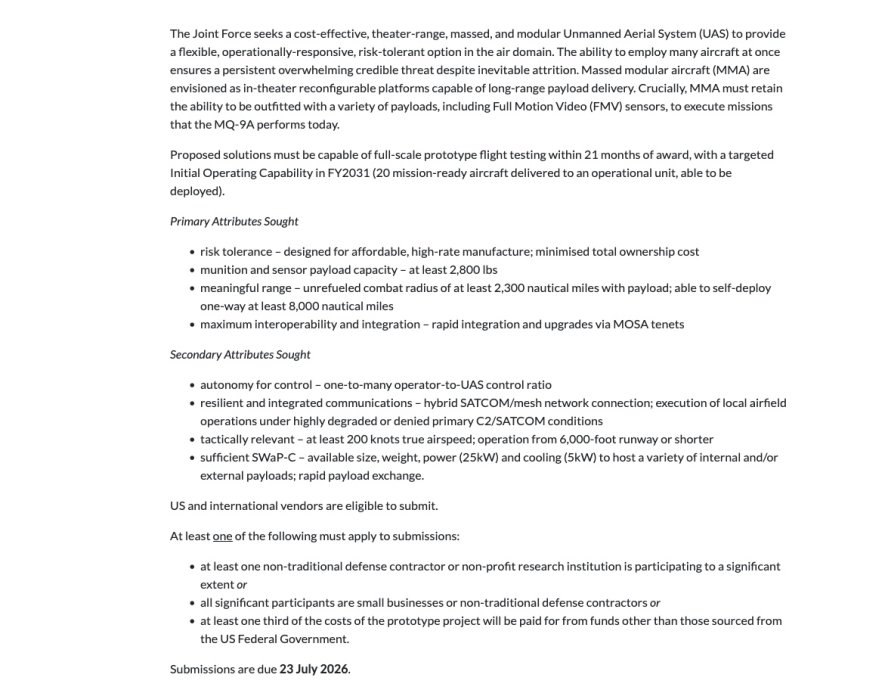
To fund initial efforts, the Air Force plans to use a $40 million FY2026 appropriation to DIU for "theater-range UAS mass manufacturing." The Air Force plans to select up to four companies by the end of 2026 to develop prototypes. The Air Force has reportedly estimated an MMA would cost approximately $10 million per unit and reportedly plans to request FY2028 procurement funds to begin purchasing MMAs, with a goal of having 500 MMAs in service by 2032.
FY2027 Budget Request
For FY2027, DOD requested $766.2 million in procurement and research, development, test, and evaluation (RDT&E) funding for the MQ-9A Reaper, including a Navy request for five MQ-9As for the Marine Corps. The Air Force did not request funding for new MQ-9As or for the proposed MMA program.
As part of its June 2026 supplemental funding request to Congress, the Trump Administration sought funding for military "drones." In a July 2026 statement to the Senate Appropriations Committee, Secretary of Defense Pete Hegseth, who is using "Secretary of War" as a "secondary title" under Executive Order 14347 dated September 5, 2025, indicated that an unspecified portion of the funds would be spent on "MQ-9 platforms." Some Members of Congress have asked that DOD provide a "detailed accounting" of the requested supplemental funding.
Legislative Activity
Proposed defense authorization and appropriation legislation (H.R. 8800; S. 4784; H.R. 9495) would authorize and provide approximately the level of FY2027 discretionary funding requested for the MQ-9A Reaper. Section 134 of the Senate Armed Services Committee (SASC)-reported version of a National Defense Authorization Act for Fiscal Year 2027 (FY2027 NDAA; S. 4784) would prohibit the Air Force Secretary from divesting or reducing the inventory of MQ-9 aircraft until September 30, 2031, among other actions. Section 147 of the House-passed version of an FY2027 NDAA (H.R. 8800) would prohibit the Air Force from retiring the MQ-9 until the Air Force Secretary certifies that a replacement has achieved initial operational capability, among other conditions.
Potential Issues for Congress
Potential issues for Congress include but are not necessarily limited to the following:
Operational Capability. An issue for Congress is whether or not the Air Force has sufficient MQ-9A aircraft to meet operational requirements today and until a replacement is available. Congress may consider what options the Air Force has explored to increase its inventory of MQ-9As, the potential time needed for doing so, whether doing so is cost and operationally effective, and options for performing MQ-9A missions with other military assets.
Force Structure and Training. An issue for Congress is whether or not the reported attrition of MQ-9As has affected the training and staffing of Air Force and Air National Guard MQ-9A units. Another issue is the potential effects that a transition to an MMA could have on those MQ-9A units and on Air Force manpower requirements.
Effectiveness of the Proposed Massed Modular Aircraft. The Air Force has stated that the MMA concept would provide field commanders with a similar capability as the Reaper at a lower per-unit cost. Representatives for General Atomics have criticized the Air Force's cost target for MMAs as not realistic. Congress could consider what sort of analysis of alternatives informed the MMA proposal. Congress might also consider how the Air Force is applying lessons from the Iran conflict to the development of the MMA.
Technical, Schedule, and Cost Risks. Congress may consider the risks of cost growth, schedule delay, or technical challenges of the MMA proposal; whether the proposed technical attributes and cost of an MMA support the Air Force's employment concept; and the capacity of the U.S. industrial base to produce MMAs at the anticipated rate.