Multiemployer Defined Benefit (DB) Pension Plans: A Primer
Changes from April 3, 2020 to June 10, 2026
This page shows textual changes in the document between the two versions indicated in the dates above. Textual matter removed in the later version is indicated with red strikethrough and textual matter added in the later version is indicated with blue.
Contents
-
Contents
Introduction -
- Background on Multiemployer Pension Plans
- Multiemployer Defined Benefit Plan Funding
- Funding Standard Accounts and Funding Deficiencies
- Funding Ratios
- Reporting of Plan Funded Status
- PBGC's Multiemployer Insurance Program
- PBGC Maximum Guarantees
- Financing of PBGC's Multiemployer Program
- Financial Condition of the Multiemployer System Prior to FY2021
- Congressional Actions Related to Improving the Solvency of the Multiemployer System Prior to FY2021
- Special Financial Assistance (SFA)
- Eligibility for Special Financial Assistance
- Amount of Special Finance Assistance
- Conditions on Receiving Special Financial Assistance
- Policy Considerations
Figures
Tables
- Table 1. Multiemployer Defined Benefit Plans in 2023
- Table 2. Distribution of Multiemployer Defined Benefit Pension Plans by Funding Ratios in 2023 on an Actuarial Basis
- Table 3. Distribution of Multiemployer Defined Benefit Pension Plans by Funding Ratios in 2023 on an RPA '94 Basis
- Table 4. Multiemployer Defined Benefit Plan Zone Certifications in 2023
- Table 5. PBGC Multiemployer Program Financial Information in FY2025
Appendixes
Summary
Multiemployer defined benefit (DB) pension plans are private sector pensions sponsored by more than one employer and maintained as part of a collective bargaining agreement. In 2023, about 3% of all DB pension plans, covering 36Background on Pensions - Tax-Qualified Pension Plans
- Defined Benefit and Defined Contribution Plans
- Single-Employer, Multiple-Employer, and Multiemployer Pension Plans
- Data on Pension Plans and Participants
- Funding Levels in Multiemployer Defined Benefit Pension Plans
- Background on Multiemployer Defined Benefit Plan Funding
- Reporting of Plan Funded Status
- PBGC Multiemployer Insurance Program
- PBGC Maximum Guarantees
- Financing of PBGC's Multiemployer Program
- Inadequacy of PBGC Premiums and Investment Income
- Current and Future Financial Assistance to Multiemployer Pension Plans
- Plans Currently Receiving Financial Assistance
- Probable Exposure to Future Financial Assistance
- Reasonably Possible Exposure to Future Financial Assistance
- Projections of Insolvency for PBGC's Multiemployer Program
- Multiemployer Defined Benefit Pension Plan Policy Issues
- Likely Insolvency of Some Multiemployer Pension Plans and PBGC Insurance Program
- Multiemployer Pension Reform Act of 2014 (MPRA)
- Applications for Benefit Reductions
- The Joint Select Committee on Solvency of Multiemployer Pension Plans
- The Bipartisan American Miners Act of 2019
Figures
Tables
Summary
Multiemployer defined benefit (DB) pension plans are private-sector pensions sponsored by more than one employer and maintained as part of a collective bargaining agreement. In 2017, about 3% of all DB pension plans, covering 29% of all DB pension plan participants, were multiemployer plans. Nearly all of the remaining DB pension plans were maintained by a single employer. A few DB pension plans were maintained by more than one employer but were not maintained under a collective bargaining agreement. In DB pension plans, participants receive a monthly benefit in retirement that is based on a formula. In multiemployer DB pensions, the formula typically multiplies a dollar amount by the number of years of service the employee has worked for any of the employers that participate in the DB plan.
DB pension plans are subject to funding rules in the Internal Revenue Code (26 U.S.C. §431) designed to ensure they have sufficient resources from which to pay promised benefits. Because single-employer and multiemployer DB pension plans have different structures, Congress has established separate funding rules for these plans.
Although many multiemployer DB pension plans have sufficient resources from which to pay their promised benefits, 10% to 15% of participants are in plans that are projected to become insolvent in the next 20 years.
When a multiemployer DB pension plan becomes insolvent (i.e., unable to pay participants the entirety of their promised benefits in a given year), the Pension Benefit Guaranty Corporation (PBGC)—a federally chartered corporation—is to insureinsures the benefits of participants up to a statutory maximum. PBGC operates two separate insurance programs: one for single -employer plans and one for multiemployer plans. PBGC does not become the trustee of insolvent multiemployer DB pension plans; rather, it makes loans to them so that the plans may continue to pay participants' guaranteed benefits.
As a result of a number of factors, such as the recessions in 2001 and that from 2007 to 2009, stakeholders became concerned about the financial health of some multiemployer plans, with PBGC indicating in the mid-2010s that 10% to 15% of multiemployer plan participants were in plans that could become insolvent. The projected insolvencies of these multiemployer plans would likely have resulted in the insolvency of PBGC's multiemployer plan insurance program, and, in the absence of increased financial resources, PBGC indicated that the multiemployer insurance program would have been highly likely to become unable to pay 100% of participants' benefits at the guaranteed level. In response to these concerns, Congress enacted Special Financial Assistance (SFA) in Section 9704 in Title IX, Subtitle H, of the American Rescue Plan Act of 2021 (ARPA; P.L. 117-2). SFA provides financial assistance in the form of grants to eligible financially troubled multiemployer DB pension plans. Plans receiving special financial assistance are expected to be able to pay benefits through 2051. As of May 15, 2026, 196 SFA applications from 161 plans covering 1.8 million participants had been approved for SFA. The dollar amount of SFA for these approved plans is approximately $77.9 billion. After adjusting the amount of SFA-approved grants because of plan census adjustments, 67 plans have repaid a total of $261.9 million in SFA. While SFA provides for financial assistance for eligible multiemployer plans, it did not require any structural changes to multiemployer plans. A pension is a benefit offered by employers to assist employees in providing for their financial security in retirement. Department of Labor (DOL) data indicated that 81% of full-time private sector workers in the United States had access to, and 62% participated in, a retirement plan sponsored by their employer in March 2025.1 The projected insolvencies of some multiemployer plans will likely result in the insolvency of PBGC's multiemployer plan insurance program. In the absence of increased financial resources for PBGC, participants in insolvent multiemployer DB pension plans might not receive all of the benefits guaranteed by PBGC. In its FY2018 Projections Report, PBGC indicated that the multiemployer insurance program is highly likely to become insolvent by 2025 and will be
Introduction
unable to pay 100% of participants' benefits at the guaranteed level.
The Multiemployer Pension Reform Act of 2014, enacted as Division O in the Consolidated and Further Continuing Appropriations Act, 2015 (MPRA; P.L. 113-235), made changes to some of the funding rules for multiemployer DB pensions and allowed plans that are expected to become insolvent to cut benefits to plan participants or to apply for a partition of the plan. As of April 1, 2020, the U.S. Treasury has received 41 applications to reduce benefits under MPRA. Five applications, including the application by the Central States, Southeast and Southwest Areas Pension Plan (a very large plan with 400,000 participants), have been denied. Fifteen applications have been withdrawn, and 17 applications have been approved. Decisions are still pending for the remaining four applications.
The Bipartisan Budget Act of 2018 (P.L. 115-123), enacted February 9, 2018, created the Joint Select Committee on Solvency of Multiemployer Pension Plans to address the impending insolvencies of several large multiemployer DB pension plans and PBGC. The committee did not produce a report or legislative proposals to improve the solvency of multiemployer DB plans and the PBGC by its November 30, 2018, deadline.
Introduction
A pension is a voluntary benefit offered by employers to assist employees in providing for their financial security in retirement. In 2019, Department of Labor (DOL) data indicated that 61% of full-time private-sector workers in the United States participated in a retirement plan sponsored by their employer.1 The two types of pension plans are defined contribution (DC) plans, in which participants have individual accounts that can provide a source of income in retirement;, and defined benefit (DB) plans, in which participants receive regular monthly benefit payments in retirement (which some refer to as a "traditional" type of pension).2 Pension plans are also classified by whether they are sponsored by one employer (single-employer plans) or by more than one employer (multiemployer and multiple-employer plans). Multiemployer pension plans are typically sponsored by employers in the same industry and maintained as part of a collective bargaining agreement between a union or unions and participating employers. Multiple-employer plans are sponsored by more than one employer but are not maintained as part of a collective bargaining agreement. Multiple-employer pension plans are not common and are not discussed in this report.3
Congress may be interested in multiemployer DB plans for several reasons, including because Prior to the enactment of SFA (in Section 9704 in Title IX, Subtitle H, of the American Rescue Plan Act of 2021 [P.L. 117-2]), Congress had expressed concern about the multiemployer system's finances for years. As a result of the 2007-2009 recession and market downturn, the financial condition of some multiemployer plans worsened to the point that PBGC projected a large increase in plan insolvencies. A large increase in plan insolvencies would likely have resulted in the insolvency of PBGC's multiemployer insurance program, which is financed by premiums that multiemployer plans pay. The insolvency of PBGC would have led to reduced benefits for participants in plans receiving PBGC financial assistance. As of May 15, 2026, 196 SFA applications from 161 plans covering 1.8 million participants had been approved for $77.9 billion in SFA.4 As a result, many multiemployer plans that were expected to become insolvent are now able to pay benefits through 2051, and the PBGC's multiemployer insurance program is operating with a surplus. The final deadline for submitting an application for SFA was December 31, 2025. 5 The two kinds of pension plans are DC and DB pension plans. In a DC plan, of which the 401(k) is the most common, participants and/or their employer make regular contributions to a tax-advantaged retirement account. The contributions are invested, most often in mutual funds or collective investment trusts (CITs), and the accumulated contributions and earnings, if any, are used as a source of income in retirement. In DB plans, employers make contributions to a trust from which benefits are paid to participants in retirement. An employee's benefit is typically paid as a monthly payment for the life of the participant and, if married, to the spouse. Some DB plans allow participants to receive the benefit as an equivalent, lump-sum payment. The amount of the participant's benefit is calculated using a formula based on either (1) an accrual rate, length of employment, and salary or (2) a flat dollar amount times the number of months or years in the plan. Participants' DB benefits must be prefunded; that is, the employer must make an annual contribution to the plan to pay for the amount of benefits earned by participants in that year, even though the benefits may be paid many years in the future. An employer's contribution may include additional amounts if the plan is underfunded as a result of past investment losses. Most DB plans are sponsored by one employer for the benefit of eligible workers of the company. However, multiemployer DB plans are sponsored jointly by a union and the employers who are part of a collective bargaining agreement (CBA) with the union. Employer contributions to the DB plan are typically established in the CBA and are typically expressed as a dollar amount per hour worked. Many multiemployer plans are in unionized industries such as construction, manufacturing, and transportation. Because a union member might work for several employers who participate in the CBA, the union member continues to earn benefits in a single DB plan. Multiemployer DB pension plans pool risk so that the withdrawal of a few employers from the plan does not place the plan in financial jeopardy, because when a company wishes to exit a multiemployer DB plan, the company is responsible for paying its withdrawal liability, defined as its share of unfunded vested benefits (i.e., benefits to which participants have a contractual right but for which the plan has insufficient assets to pay).6 In some instances, employers do not pay the full amount of their assessed withdrawal liability because they either negotiate a lower amount or have declared bankruptcy. The 2007-2009 recession and associated declines in the value of plan assets as a result of stock market losses resulted in the underfunding of many plans, some of which were significantly underfunded. In addition, an increasing number of employers left multiemployer pension plans (either voluntarily or through employer bankruptcy). Exiting employers leave behind plan participants with vested benefits (sometimes called orphan participants because they do not have an employer that will make additional contributions to the plan for their unfunded benefits).7 The existence of orphan plan participants can result in a worsening funding situation for the multiemployer plan, because (1) the underfunding becomes the responsibility of the remaining employers in the plan8 and (2) DB plan assets are commingled in a trust and are not assigned to a particular employer's contributions or participant's benefit. Thus, benefit payments for all participants draw down general plan assets. The remaining employers might have difficulty meeting the increases in required contributions, which could cause employers to become bankrupt and could threaten the solvency of some multiemployer plans (which some refer to as a death spiral).9 Number of plans and participants; total assets in plans Number of Plans 1,341 Number of Participants and Beneficiaries 11.4 million Active Participants 4.2 million Retired or Separated Participants Receiving Benefits 3.4 million Other Retired or Separated Participants with Vested Right to Benefits 3.1 million Beneficiaries 0.7 million Total Assets $728.6 billionNearly all private-This report focuses on multiemployer DB pension plans. For an overview of pensions plans, see CRS Report R47119, Pensions and Individual Retirement Accounts (IRAs): An Overview.
Nearly all private sector pension plans are governed by the Employee Retirement Income Security Act of 1974 (ERISA; P.L. 93-406), which is enforced by the Department of the Treasury, DOL, and the Pension Benefit Guaranty Corporation (PBGC).43 Because of differences in the structure of the plansplan structures, single, multiple, and multiemployer DB pension plans have different rules under some sections of ERISA. For example, single-employer and multiemployer plans have separate funding rules, and the PBGC's pension insurance programs that cover them function differently.
Source: Department of Labor, Private Pension Plan Bulletin, Abstract of 2023
, single, multiple, and multiemployer DB pension plans have different rules under some sections of ERISA. Examples include the existence of separate funding rules for each type of plan and pension insurance program.
Congress may be interested in multiemployer DB plans for several reasons, including because
- about 10% to 15% of participants are in plans that are projected to have insufficient assets within the next 20 years to pay 100% of the benefits promised to plan participants;5 and
- the liabilities of the pension plans that are projected to become insolvent are so great, PBGC would likely be unable to continue to guarantee participants' benefits if one or two of these plans became insolvent.6
To address the projected increase in plan insolvencies, Congress enacted the Multiemployer Pension Reform Act of 2014 (MPRA; P.L. 113-235) to provide options to improve funding for multiemployer plans. Among other provisions, MPRA allows financially distressed plans that meet certain conditions to apply to the U.S. Treasury to reduce participants' benefits to stave off insolvency. In 2015, one relatively large plan, the Central States, Southeast and Southwest Areas Pension Plan (Central States), applied to reduce benefits. In 2016, its application was denied.7
In addition, the Bipartisan Budget Act of 2018 (P.L. 115-123), enacted on February 9, 2018, created the Joint Select Committee on Solvency of Multiemployer Pension Plans to address the impending insolvencies of several large multiemployer DB pension plans and PBGC, but the committee did not provide legislative language by its November 30, 2018, deadline.
Possible solutions to plan underfunding could involve some combination of increased contributions from the employers that sponsor pension plans, cuts in future benefits to plan participants who are currently working, cuts in current benefits to retired participants, or financial assistance from the U.S. government.
Background on Pensions
To protect the interests of pension plan participants and beneficiaries, Congress enacted ERISA (P.L. 93-406). ERISA is codified in the U.S. Code in Title 26 (Internal Revenue Code, or IRC) and Title 29 (Labor Code). ERISA sets standards that pension plans must follow with regard to plan participation (who must be covered); minimum vesting requirements (how long an employee must work for an employer to be covered); plan funding (how much employers must set aside to pay for future benefits); and fiduciary duties, which require that a pension plan be operated in the sole interests of plan participants by plan sponsors, administrators, and others who oversee the plan. ERISA also established PBGC, an independent federal agency that insures certain DB pension plans. ERISA covers only private-sector pension plans and plans run by nonprofit organizations; pension plans established by the federal, state, and local governments and by churches are exempt from ERISA's coverage.
Pension plans may be classified in a variety of ways, such as whether they receive tax preferences, whether they are sponsored by one or more than one employer, and whether the benefits are payable as a lifetime annuity at retirement or accrue in accounts for each of the participants.
Tax-Qualified Pension Plans
Sponsors of pension plans may choose for their plans to be tax qualified. Tax-qualified plans receive certain tax advantages. For example, employer contributions to qualified DB plans are tax-deductible expenses for employers in the year contributions are made. Qualified plans also meet IRC requirements with respect to vesting schedules (which determine when participants have a legal right to their benefits) and funding requirements (which determine the amounts employers must contribute to the plans they sponsor). In general, qualified DB pension plans must prefund future benefits.8 Nonqualified pension plans are not required by the IRC to be prefunded. Because one of the requirements to be a tax-qualified plan is to cover a broad range of employees in a company, nonqualified pension plans are designed for top-level executives and other highly-compensated employees.
Defined Benefit and Defined Contribution Plans
Pension plans are either DB or DC. Over the past 30 years, employers have been offering fewer DB plans and more DC pensions. DOL data indicate that 64.2% of all pension plan participants were in DB plans in 1981, and that percentage declined to 25.4% in 2017.9
Defined Benefit Pension Plans
Participants in DB pension plans frequently receive monthly payments in retirement. In multiemployer DB pension plans, the payment is typically calculated as the length of service with employers that contribute to the plan multiplied by a dollar amount.10 The dollar amount is agreed to by a board of trustees—of which labor and management are equally represented—or between employers and unions during collective bargaining negotiations.11 The payments are made by the plan for the lifetime of the worker after he or she retires. Plan participants who are married may receive a joint-and-survivor annuity, which is an annuity payable for the lifetime of the participant or the participant's spouse, whichever is longer.
DB pension plans in the private sector are generally funded entirely by employer contributions. DOL data in 2011 (the most recent year for which this data point is available) indicated that among private-sector workers who participated in DB plans, 4% were required to make an employee contribution to their plans.12 In contrast, among public-sector workers who participated in DB plans in 2019, 91% were required to make a contribution to their DB pension plans.13
Defined Contribution Pension Plans
Workers in DC pension plans contribute a percentage of their wages to an individually-established account arranged by their employer. Employers may also contribute a match to the DC plan, which is an additional contribution equal to some or all of the worker's contribution. Workers determine individually how their account contributions are invested. The account may accrue investment returns and then can be used as a source of income in retirement. Because DC plans do not provide guarantees of lifetime income (unless participants purchase an annuity), there are no issues of underfunding in these plans. Examples of DC plans are 401(k), 403(b), and 457(b) plans and the Thrift Savings Plan (TSP).14
Single-Employer, Multiple-Employer, and Multiemployer Pension Plans
Pension plans are also classified by whether they are sponsored by one employer (single-employer pension plans) or by more than one employer (multiple and multiemployer pension plans). Most pension plans are sponsored by one employer; DOL data indicate that 99.6% of all pension plans (covering 89.4% of all pension plan participants) are single-employer pension plans.15
Single-Employer Pension Plans
Single-employer pension plans are sponsored by one employer and cover eligible workers employed by the plan sponsor. When an employee stops working for the employer sponsoring the plan, the worker stops accruing benefits under that plan. The sponsor may decide to cease offering its employees benefits under the plan, in which case the plan may be frozen or terminated. If a DB pension plan is frozen, participants no longer accrue benefits but employers maintain responsibility for the frozen plan (for example, employers may have to make additional contributions to make up for funding shortfalls that may result from decreases in the value of plan assets). Alternatively, employers may decide to terminate their pension plans. Employers that terminate their DB pension plans must guarantee participants' future benefits by purchasing annuities (a guaranteed monthly payment) from an insurance company for each participant's accrued benefit. If underfunded DB pension plans are terminated pursuant to company bankruptcy, PBGC becomes the trustee of the plans and pays participants their promised benefits, up to a statutory maximum benefit.16
Multiple-Employer Pension Plans
Multiple-employer pension plans are sponsored by more than one employer and are not maintained under collective bargaining agreements. They are treated as single-employer pension plans for the purposes of funding rules.
Multiemployer Pension Plans
Multiemployer pension plans are sponsored by more than one employer and, unlike multiple-employer plans, are maintained under collective bargaining agreements. Participants continue to accrue benefits while working for any employer that participates in the plan. Multiemployer pension plans pool risk so that the withdrawal of a few employers from the plan does not place the plan in financial jeopardy, because withdrawing employers are required to pay for their share of unfunded benefits (called withdrawal liability). However, in recent years, an increasing number of employers have left multiemployer pension plans (either voluntarily or through employer bankruptcy). In addition, declines in the value of plan assets (such as during the 2007-2009 recession) have resulted in the underfunding of many plans—some of which have large amounts of underfunding. It is possible that stock market losses in 2020 during the Coronavirus Disease 2019, or COVID-19, pandemic will worsen plan underfunding. When contributing employers withdraw from plans and do not pay their share of unfunded benefits, the underfunding becomes the responsibility of the remaining employers in the plan.17 Because many remaining employers are unable to meet the required large contributions, some plans face insolvency.
Data on Pension Plans and Participants
Table 1 provides information on the number of single- and multiemployer DC and DB pension plans in 2017 (the most recent year for which data are available) and the number of active and retired participants by plan type. In 2017, there were 1,398 multiemployer DB pension plans that covered 10.5 million participants, of which 40% were active participants, meaning that 60% were retired (thus receiving benefits). DB pension plans that have high percentages of active workers are better able to rely on future contributions from plan sponsors to make up for plan underfunding. This is because, on a per participant basis, employers' contributions toward the underfunding will be lower in plans with higher percentages of active workers.
|
Single-Employer Pension Plans |
Multiemployer Pension Plans |
|||
|
Defined Contribution |
Defined Benefit |
Defined Contribution |
Defined Benefit |
|
|
Number of Plans |
661,733 |
45,300 |
1,096 |
1,398 |
|
Number of Active Participants (millions) |
78.1 |
9.3 |
3.0 |
4.2 |
|
Number of Retired Participants (millions) |
1.0 |
8.4 |
0.1 |
3.2 |
|
Number of Other Retired or Separated Participants with Vested Right to Benefits (millions) |
19.3 |
6.8 |
0.9 |
3.1 |
|
Total Participants, Including Beneficiaries (millions) |
98.6 |
25.9 |
4.1 |
11.1 |
|
Active as a Percentage of Total Participants |
|
35.9% |
|
37.8% |
|
Plan Assets (billions) |
$6,387 |
$2,653 |
$163 |
$556 |
Notes: Active participants include any workers currently in employment covered by a plan and who are earning or retaining credited service under a plan. Retired or separated participants with a vested right to benefits are those who are owed benefits from a plan but have not yet begun receiving them.Source: DOL, Employee Benefits Security Administration, Private Pension Plan Bulletin Abstract of 2017 Form 5500 Annual Reports, Tables A2, A6, and B1A6, at https://www.dol.gov/sites/dolgov/files/EBSAebsa/researchers/statistics/retirement-bulletins/private-pension-plan-bulletins-abstract-20172023.pdf
.pdf.
Notes: Multiple-employer plans are included in single-employer plan counts because they are treated as such under the Employee Retirement Income Security Act of 1974 (P.L. 93-406). Active participants include any workers currently in employment covered by a plan and who are earning or retaining credited service under a plan. This category includes any nonvested former employees who have not yet incurred a break in service. Active participants also include individuals who are eligible to elect to have the employer make payments to a 401(k) plan. Total participant counts include beneficiaries.
a. Unlike defined benefit plans, which pay benefits from a common pool of funds, defined contribution plans consist of individual accounts. The category Active as a Percentage of Total Participants is not meaningful for defined contribution plans.
Funding Levels in Multiemployer Defined Benefit Pension Plans
The funding levels of multiemployer DB pension plans are varied: some plans are well funded and have adequate funds from which to pay all of their promised benefits, and some plans are poorly funded. Although some plans have already become insolvent and are currently receiving PBGC assistance, over 800,000 participants are in plans that are expected to become insolvent from 2020 to 2030.18 An insolvent multiemployer DB pension plan has depleted all of its assets and is unable to pay all of its current benefit obligations. Insolvent DB pension plans are eligible to receive financial assistance from PBGC. The Pension Protection Act of 2006 (PPA; P.L. 109-280) requires a plan that is funded below specified levels (among other criteria) to notify DOL of the plan's funding status and establish a plan to improve funding levels over time.
Background on Multiemployer Defined Benefit Plan Funding
DB pension benefits are accrued by eligible employees while working. The benefit is paid, typically as a monthly annuity, during the worker's retirement. The benefits in DB plans subject to ERISA are required to be prefunded, which means that in each year the plan sponsor sets aside adequate funds, taking into account expected future investment returns, for pension benefits earned in that year.1915 Plan sponsors may also be required to make additional contributions for investment losses that occurred in previous years, as well as increases in the present value of future plan obligations. Plan participants receive their monthly benefit in retirement from these funds that have been set aside.
The required contributions for employers in multiemployer DB pension plans are fixed for several years as established in collective bargaining agreements. Various situations have led to many pension plans havingCBAs. Even if plans make their required contributions each year, various situations may arise that cause a plan to become underfunded (i.e., have a smaller amount of funds than the amount of benefits that have been promised by the plan). These situations include (1) declines in the values of plan assets (such as occurred during thewhich can occur during stock market decline in 2008) anddeclines), (2) increases in the current value of future benefit obligations (such as occurred when interest rates declined as a result of the Federal Reserve's efforts to strengthen the economy). Appendix A provides background for understanding pension plan funding issues.
which can occur when the Federal Reserve lowers interest rates), or (3) changes in plan assumptions (such as mortality assumptions, which are assumptions about how many participants will receive plan benefits and the length of time that they will receive them).16 Funding Standard Accounts and Funding Deficiencies
Multiemployer DB plans keep track of their funding with a funding standard account, which facilitates the administration of funding requirements. Charges (debits) to the account reduce the account balance and include the cost of benefits earned by participants during the year and investment losses.2017 Credits increase the funding standard account balance and include employer contributions to the plan and investment gains.21
18 When the total credits to a multiemployer DB pension plan exceed the total charges, the plan has a "credit balance" and no contributions are required until future charges eliminate the credit balance. When the total charges exceed the total credits, a funding deficiency results and additional contributions to the plan may be required.
Funding Ratios
Pension funding consists of several elements. These include the value of plan benefits that participants will receive in the current and in future years, the amount a plan has set aside to pay for these benefits, and the employer contributions required each year to ensure the plan has sufficient funds to pay benefits when participants retire. A pension plan's benefits are a liability spread out over many years in the future. These future benefits are calculated and reported as present values (also called current values). Using a formula, benefits that are expected to be paid in a particular year in the future are calculated so they can be expressed as a present value.19 This process is called discounting, and it is the reverse of the process of compounding, which projects how much a current dollar amount will be worth at a point in the future. DB plan assets are the value of the investments made with accrued employer (and employee, if any) contributions to the plan. The investments are typically short-term securities (such as Treasury bills), equity (such as corporate stock), debt (such as corporate bonds), and alternative investments (such as private equity).A plan's funding ratio is a common measure used to assess the plan's financial health. A plan with a funded ratio of 100% has sufficient assets to pay all promised benefits. In contrast, a plan with a funded
Plans
Multiemployer plans report two values of assets and two values of liabilities: the actuarial (or smoothed) value and the current value of assets, and the actuarial value and the current value (RPA '94, named for the Retirement Protection Act of 1994) of liabilities. 20
The two values of assets are generally similar; the two values of liabilities often differ. The main difference is the value of the discount rate used to value plan liabilities. The actuarial valuation of liabilities typically discounts them using the expected return on assets. The RPA '94 current liability uses a lower discount rate, based on interest rates on 30-year Treasury securities. The RPA '94 valuation method results in a higher valuation of plan liabilities compared with the actuarial valuation method. Certain liabilities are calculated based on the purchase price for an annuity at the beginning of the year; PBGC uses this rate to calculate funding ratios, as shown in Table 2.
.21
Table 2 provides the distribution of funding ratios in 2016 (the most recent year for which PBGC data are available)on an actuarial basis for the 2023 plan year among (1) multiemployer DB pension plans and (2) the participants in these plans. SevenOne hundred seventy-five plans, or 56.4% of all multiemployer DB plansand one plans, covering 1.2 million participants, had a funding ratio of less than 50%. These 775101 plans had about 7.81.2 million participants, or 74.310.6% of all multiemployer DB plan participants in 2016—suggesting that some of the poorly funded plans have large numbers of participants.
2023.
Table 2. Distribution of Multiemployer Defined Benefit Pension Plans by Funding Ratios in 2016
|
Funding Ratio |
Plans |
Participants |
||
|
Number |
Percentage |
Number |
Percentage |
|
|
65 |
4.7% |
76,451 |
0.7% |
|
63 |
4.6% |
72,747 |
0.7% |
|
Less than 50% |
775 |
56.4% |
7,780,385 |
74.3% |
|
50% to 59% |
292 |
21.3% |
2,118,004 |
20.2% |
|
60% to 79% |
146 |
10.6% |
341,211 |
3.3% |
|
80% to 99% |
21 |
1.5% |
67,727 |
0.6% |
|
100% or more |
12 |
0.9% |
8,630 |
0.1% |
|
Total |
1,374 |
100% |
10,465,155 |
100% |
Source: PBGC, Table M-13, 2017 Pension Insurance Data Tables, https://www.pbgc.gov/sites/default/files/2017_pension_data_tables.pdf.
Plans Participants Funding Ratio Number (Percentage) Number (Percentage) Less than 50% 101 (8.5%) 1,185,432 (10.6%) 50% to 59% 36 (3.0%) 287,379 (2.6%) 60% to 69% 60 (5.0%) 343,544 (3.1%) 70% to 70% 77 (6.5%) 1,048,366 (9.4%) 80% to 89% 228 (19.2%) 2,362,275 (21.1%) 90% to 99% 256 (21.5%) 3,306,598 (29.6%) 100% or more 431 (36.2%) 2,641,795 (23.6%) Total 1,189 11,175,389 Source: CRS analysis of DOL Form 5500 data among plans that had a plan year ending in calendar year 2023. Notes: Percentages may not sum to 100% because of rounding. Multiemployer defined benefit plans are those that on Form 5500 (1) indicated they were a multiemployer plan in Part I(A) and had DB plan characteristics in Part II(8a) or (2) indicated they filed Schedule MB with their Form 5500 in Part II(10)(a)(2). Plans Participants Funding Ratio Number (Percentage) Number (Percentage) Less than 50% 732 (61.8%) 7,999,517 (71.6%) 50% to 59% 284 (24.0%) 2,450,488 (21.9%) 60% to 69% 101 (8.5%) 468,111 (4.2%) 70% to 70% 32 (2.7%) 69,594 (0.6%) 80% to 89% 17 (1.4%) 61,771 (0.6%) 90% to 99% 8 (0.7%) 36,978 (0.3%) 100% or more 11 (0.9%) 87,149 (0.8%) Total 1,185 11,173,608 Source: CRS analysis of DOL Form 5500 data among plans that had a plan year ending in calendar year 2023. Notes: Percentages may not sum to 100% because of rounding. Multiemployer defined benefit plans are those that on Form 5500 (1) indicated they were a multiemployer plan in Part I(A) and had DB plan characteristics in Part II(8a) or (2) indicated they filed Schedule MB with their Form 5500 in Part II(10)(a)(2). Not all plans reported funding on an RPA '94 basis.Notes: Totals of percentages might not sum to 100% due to in 2023 on an Actuarial Basis
rounding.
a. Plans receiving financial assistance are insolvent and are receiving financial assistance from PBGC to pay promised benefits.
b. Booked plans are plans that are expected to become insolvent and whose liabilities have been included in PBGC's financial position and liabilities; however, these plans are not yet insolvent and may never require financial assistance.
Withdrawal Liability
When a company wishes to exit a multiemployer DB plan, the company is responsible for its withdrawal liability, defined as its share of unfunded vested benefits (benefits to which participants have a contractual right but which the plan has insufficient assets to pay).22 In instances in which an employer withdraws from a multiemployer DB pension plan because of the employer's bankruptcy, it may not be possible to recover the employer's withdrawal liability. As a result, there may be plan participants with vested benefits who worked for an employer that no longer participates in the plan. These participants are sometimes called orphan participants because they do not have an employer that will make additional contributions to the plan for their unfunded benefits.23 The existence of orphan plan participants can result in a worsening funding situation for the multiemployer plan, because DB plan assets are comingled in a trust and are not assigned to a particular employer's contributions or participant's benefit. Thus, benefit payments for all participants draw down general plan assets.
Reporting of Plan Funded Status
The Pension Protection Act of 2006 (PPA; P.L. 109-280) requires that the actuary of a multiemployer DB pension plan annually certify the plan's status in one of three categories—known as the plan's zone status—based on, among other factors, the funded status of the plan.24 A plan can be in critical status, endangered status, or neither category. A plan in critical or endangered status must take measures to improve its financial conditions. The PPA provisions that created the zone status were scheduled to sunset on December 31, 2014, but were made permanent by Multiemployer Pension Reform Act of 2014, enacted as Division O in the Consolidated and Further Continuing Appropriations Act, 2015 (MPRA; P.L. 113-235). In addition, MPRA added critical and declining as a fourthan additional funded status category. These zone statuses are presented below in order from strongest to weakest financial status.
Green (No Zone) Status
Plans that are in Table 4 provides the number of multiemployer DB plan certifications within each funded status category for 1,188 plans that reported their plan status for the 2023 plan year (the most recent year for which complete information is available).
Green (No Zone) Status
Plans that are not in endangered, seriously endangered, critical, or critical and declining status are considered to be in green status. These plans most likely will be able to pay all of the participants' benefits without changes to employers' contributions or participants' benefits.
Table 3 provides the number of multiemployer DB plan certifications within each funded status category for 1,229 plans that reported their plan status in 2017 (the most recent year for which complete information is available).
Endangered (Yellow Zone) Status
A plan is in endangered status if (1) the plan's funding ratio is less than 80%, or (2) the plan has a funding deficiency in the current year or is projected to have one in the next six years. A subcategory of endangered status is seriously endangered (orange zone). A plan is seriously endangered if it meets both of these criteria.
Plans in endangered status must adopt a funding improvement plan, which is a range of options (such as increased contributions and reductions in future benefit accruals) that, when adopted, will reduce the plan's underfunding25 by 33% during a 10-year result in an increase in the plan's funded percentage by the end of the funding improvement period. Plans in seriously endangered status must adopt a funding improvement plan that will reduce underfunding by 20% during a 15-year funding improvement period. Plans in endangered or seriously endangered status cannot increase benefits during the funding improvement period.
Plans in. The increase in the funded percentage must equal or exceed the sum of (1) the plan's funded percentage as of the beginning of the first plan year in which it is considered endangered and (2) 33% of the difference between 100% and the plan's funded percentage as of the beginning of the first plan year in which the plan is in endangered status. For example, a plan with a funded percentage of 70% at the beginning of the first year in which it is considered endangered must adopt a plan that would improve its funded percentage to at least 79.9% (100% minus 70% is 30%; 33% of 30% is 9.9%; and 70% plus 9.9% equals 79.9%)23 Plans in seriously endangered status adopting a funding improvement plan must increase their funded status in a similar way, though substituting "20%" for "33%." Plans in endangered status or seriously endangered status must provide notice to plan participants, beneficiaries, the collective bargaining parties, PBGC, and DOL.26
24 Critical (Red Zone) Status
A plan is in critical status if any of the following conditions apply: (1) the plan's funding ratio is less than 65% and the value of the plan's assets and contributions will be less than the value of benefits in the next six years; (2) in the current year, the employers are not expected to make 100% of the required contributions, or the employers are not expected to make 100% of the required contributions for any of the next three years (four years if the plan's funding ratio is 65% or less); (3) the plan is expected to be insolvent within five years (within seven years if the plan's funding ratio is 65% or less); or (4) the cost of the current year's benefits and the interest on unfunded liabilities are greater than the contributions for the current year, the present value of benefits for inactive participants is greater than the present value of benefits for active participants, and there is expected to be a funding deficiency within five years.
Plans in critical status must adopt a rehabilitation plan. A rehabilitation plan is a range of options (such as increased employer contributions and reductions in future benefits accruals) that, when adopted, will allow the plan to emerge from critical status duringby the end of a 10-year rehabilitation period. If a plan cannot emerge from critical status by the end of the rehabilitation period using reasonable measures, it must either install measures to emerge from critical status at a later time (after the end of the rehabilitation period) or forestall insolvency. Plans in critical status may not increase benefits during the rehabilitation period.
Plans in critical status must provide notice to plan participants, beneficiaries, the collective bargaining parties, PBGC, and DOL.27
25 Critical and Declining (Deep Red Zone) Status
A plan is in critical and declining status if (1) it is in critical status and (2) the plan actuary projects the plan will become insolvent within the current year or within either the next 14 years or the next 19 years, as specified in law. Plans in critical and declining status must provide notice to plan participants, beneficiaries, the collective bargaining parties, PBGC, and DOL.28
26
Table Status Number of Plans (Percentage) Number of Participants (Percentage)3. 4. Multiemployer Defined Benefit Plan Zone Certifications in 2023
Defined Benefit Multiemployer Plan Certification in 2017
|
Status |
Number of Plans |
Neither Critical nor Endangered (Green Zone) |
794 (64.6%) |
|
Endangered (Yellow Zone) |
128 (10.4%) |
|
Seriously Endangered (Orange Zone) |
4 (0.3%) |
|
Critical (Red Zone) |
190 (15.5%) |
|
Critical and Declining (Deep Red Zone) |
113 (9.2%) |
Source: CRS analysis of Form 5500 data sets available from DOL website for the 2017 plan year available at https://www.dol.gov/agencies/ebsa/about-ebsa/our-activities/public-disclosure/foia/form-5500-datasets.
Notes: Percentages of plans and participants do not add to 100% due to rounding. For more information on the data used for this table, see CRS Report R45187, Data on Multiemployer Defined Benefit (DB) Pension Plans. Sixty-four insolvent plans that received PBGC financial assistance are not included, even if the plan filed Schedule MB, because not all plans that received PBGC financial assistance filed Schedule MB. In addition, 25 plans that were not classified as terminated or not receiving PBGC financial assistance filed Schedule MB in the Form 5500 data but did not report a zone status for the 2017 plan year. For these plans, CRS examined the Form 5500 filed with DOL and added the plans' zone statuses after an examination of the Schedule MB attached to a plan's actuarial report. In 22 of the 25 instances, the zone status was in the Schedule MB attached to the plan's actuarial report. In 3 of the 25 instances, there was no zone status but the plans had a funded percentage of over 90% and were assumed to be green zone.
PBGC Multiemployer Insurance Program
862 (72.6%) 7,199,336 (66.9%) Endangered (Yellow Zone) 46 (3.9%) 368,082 (3.4%) Seriously Endangered (Orange Zone) 1 (0.1%) 1290 (0.0%) Critical (Red Zone) 155 (13.0%) 2,169,422 (20.2%) Critical and Declining (Deep Red Zone) 124 (10.4%) 1,019,324 (9.5%) All Plans with Zone Status 1,188 10,757,454 Source: CRS analysis of DOL Form 5500 data among plans that had a plan year ending in calendar year 2023 and had a zone certification on Schedule MB. Note: Percentages may not add up to 100% because of rounding. Some multiemployer plans did not file a Schedule MB and among those that did several did not include a zone certification.PBGC is a federal government agency created by ERISA in 1974 to protect the benefits of participants in private-
PBGC Maximum Guarantees
PBGC guarantees benefits in pension plans up to a statutory maximum level. When a multiemployer DB pension plan becomes insolvent, the plan must reduce participants' benefitbenefits to the PBGC maximum amount before the plan receives the assistance. The statutory maximum benefit in multiemployer plans that receive financial assistance from PBGC is the product of a participant's years of service multiplied by the sum of (1) 100% of the first $11 of the monthly benefit accrual rate and (2) 75% of the next $33 of the accrual rate. For a participant with 30 years of service, the statutory monthly maximum benefit is $1,073, or an annual maximum benefit of $12,870 per year.2927 The multiemployer guarantee limit has been unchanged since 2001.
Financing of PBGC's Multiemployer Program
PBGC's multiemployer insurance program receives revenues from two sources: (1) premium revenue paid by the sponsors of multiemployer pension plans and (2) interest income from holdings of the U.S. Treasury debt
Unlike the single-employer insurance program, PBGC does not become trustee of insolvent multiemployer pension plans. For this reason, the only sources of funding for the financial assistance to insolvent multiemployer pension plans are (1) the collection of premiums that multiemployer plan sponsors pay to PBGC and (2) interest income from the investment of past premium income in U.S. Treasury bonds. Premium revenue is, by law, placed in a revolving fund. PBGC's policy is to invest the assets in the revolving fund in U.S. Treasury securities.30
At the end of FY2019, PBGC reported a deficit of $65.2 billion in the multiemployer insurance program.31 If a sufficient number of multiemployer pension plans exhaust their plan assets and become unable to pay promised benefits, it is likely that PBGC's multiemployer program would also exhaust its assets. Table 4 summarizes PBGC's financial information in FY2019.
PBGC Premium Levels
28 If the amount of financial assistance were to exceed the amount of premium revenue, then the revolving fund containing the investments in U.S. Treasury bonds could become depleted.
At the end of FY2025, PBGC reported a surplus of $2.6 billion in the multiemployer insurance program.29
PBGC Premium Levels
The PBGC multiemployer insurance program is funded by a per participant premium paid by each pension plan. In 20202026, the sponsors of multiemployer DB pension plans pay an annual premium of $3040 for each participant in the plan.3230 The premium is set by law and is indexed to increases in the average national wage.
PBGC reported $426 The premium is indexed to increases in the average national wage.
PBGC premiums are set by law. Members of Congress and some stakeholders, such as employers and plan sponsors, might oppose premium increases to the levels necessary to fund guaranteed benefits.
PBGC Premium and Investment Income in FY2019
Financial Assistance Traditional Financial Assistance Paid $169 million Number of Plans Receiving Traditional Financial Assistance 100 $6,152 billion Number of Plans Receiving Special Financial Assistance (SFA)a 48 Income Premium Income $426 million Investment Income $143 million Net Position Total Assets $4.9 billion Present Value of Future Financial Assistance $1.9 billion Net Position (Total Assets Minus Present Value of Future Financial Assistance and Other Liabilities) $2.6 billionPBGC reported $310 million in premium income from multiemployer plans in FY2019.33FY2025.31 PBGC also reported a gain of $442143 million in investment income from holdings of the U.S. Treasury debt.
Table 5 summarizes PBGC's financial information in FY2025.
Table 5. PBGC Multiemployer Program Financial Information in FY2025
Special Financial Assistance Paida
Source: PBGC FY2025 Annual Report, Financial Summary—Multiemployer Program, p. 32, https://www.pbgc.gov/sites/default/files/documents/pbgc-annual-report-2025.pdf.
Notes: The present value of future financial assistance consists of the value of benefits to be paid to participants. It consists of payments that PBGC will have to provide at any point in the future to million in investment income from holdings of the U.S. Treasury debt.
Inadequacy of PBGC Premiums and Investment Income
Unlike the single-employer insurance program, PBGC does not become trustee of insolvent multiemployer pension plans. For this reason, the only sources of funding for the financial assistance to insolvent multiemployer pension plans are (1) the collection of premiums that multiemployer plan sponsors pay to PBGC and (2) interest income from the investment of past premium income in the U.S. Treasury bonds. If the amount of financial assistance were to exceed the amount of premium revenue, then the revolving fund (i.e., account) containing the investments in U.S. Treasury bonds could become depleted.
Table 4 shows that in FY2019, PBGC's multiemployer program had a deficit of $65.2 billion. This deficit was largely driven by the $68 billion in present value of nonrecoverable future financial assistance—the estimated (and nonrecoverable) payments that PBGC would have to provide at any point in the future to 191 multiemployer plans that are (1) currently receiving financial assistance, (2) terminated but have not yet started receiving financial assistance, or (3) expected to become insolvent within 10 years and would not be able to meet their benefit obligations.34
The premium income in PBGC's multiemployer program was $310 million in FY2019. Premium levels likely are inadequate to provide continued financial assistance to insolvent multiemployer plans and could exhaust PBGC's ability to guarantee participants' benefits. PBGC has indicated that once resources are exhausted in its multiemployer program, insolvent plans would be required to reduce benefits to levels that could be sustained through premium collections only. If this were to occur, participants in insolvent plans could see their benefits reduced to less than $2,000 per year.
|
Financial Assistance |
Financial Assistance Paid |
$160 million |
|
Number of Plans Receiving Financial Assistance |
85 |
|
|
Income |
Premium Income |
$310 million |
|
Investment Income |
$442 million |
|
|
Net Position |
Total Assets |
$2.9 billion |
|
Present Value of Future Financial Assistance |
$68.0 billion |
|
|
Net Position (Total Assets Minus Present Value of Future Financial Assistance) |
-$65.2 billion |
Source: PBGC FY2019 Annual Report, Financial Summary—Multiemployer Program, p. 26, https://www.pbgc.gov/sites/default/files/pbgc-fy-2019-annual-report.pdf.
Note: The present value of future financial assistance consists of the value of benefits to be paid to participants; payments that PBGC will have to provide at any point in the future to multiemployer plans that are (1) currently receiving financial assistance, (2) terminated but have not yet started receiving financial assistance, or (3) expected to become insolvent within 10 years and would not be able to meet their benefit obligations.
Current and Future Financial Assistance to Multiemployer Pension Plans
PBGC provides financial assistance to insolvent multiemployer pension plans. In addition to providing details about the number of plans currently receiving financial assistance, PBGC estimates the number of plans that might need financial assistance in the future. Potential future financial assistance is categorized as either (1) probable or (2) reasonably possible, depending on whether the PBGC expects to provide the assistance to plans that are projected to become insolvent (1) within 10 years or (2) between 10 years and 20 years.35
Plans Currently Receiving Financial Assistance
Eighty-five multiemployer plans received financial assistance in FY2019 that totaled $160 million. The net liability associated with these plans was $2.8 billion.36
Probable Exposure to Future Financial Assistance
Plans are classified as "probable" if the plan is (1) terminated and underfunded but not yet receiving financial assistance or (2) ongoing but expected to become insolvent within 10 years. In FY2019,
- 65 multiemployer plans had been terminated but had not yet started receiving financial assistance. The net liability associated with these plans was $2.0 billion; and
- 41 plans were ongoing but expected to be insolvent within 10 years. The net liability associated with these plans was $63.2 billion.37
Together, the dollar amount of probable exposure to future financial assistance was $65.2 billion in FY2019 (an increase from $53.8 billion in FY2018).38 As previously mentioned, (1) $2.8 billion in financial assistance for plans currently receiving assistance combined with (2) $65.2 billion in probable exposure is equal to $68 billion in present value of nonrecoverable future financial assistance.
Reasonably Possible Exposure to Future Financial Assistance
PBGC also estimates the future financial assistance that may be required for "reasonably possible" plans—assistance for these plans is not used in PBGC's deficit calculation. Plans are classified as "reasonably possible exposure to future financial assistance" if the plan is ongoing but is projected to be insolvent in 10 years to 20 years. In its FY2019 annual report, PBGC estimated its reasonably possible exposure to be $10.9 billion. This figure was an increase from the $9.4 billion reported in FY2018.39
Projections of Insolvency for PBGC's Multiemployer Program
In its FY2018 Projections Report, PBGC indicated that the multiemployer insurance program will face significant financial challenges over the next 10 years to 20 years; the multiemployer program faces a 99% likelihood of insolvency in FY2025 and a 100% likelihood in FY2026.40
At the end of FY2018, PBGC's multiemployer program had $2.3 billion in assets. PBGC estimated the present value of the next 10 years of insurance premiums to be $3.3 billion.41 Together, these two sources of funds equal $5.6 billion—representing the amount of funds that PBGC could use to provide future financial assistance over the next 10 years.
PBGC estimated the present value of future financial assistance to multiemployer plans from FY2019 to FY2028 to average $14.5 billion.42 The difference between (1) PBGC assets plus the present value of insurance premiums ($5.6 billion) and (2) the present value of projected future financial assistance ($14.5 billion) is -$8.9 billion ($5.6 billion - $14.5 billion). This -$8.9 billion is the amount by which PBGC would not be able to provide sufficient financial assistance for plans to pay the PBGC guaranteed maximum benefit ($12,870 per year per participant) over the 10-year period.43
Plans will likely face the need for significant amounts of financial assistance even after FY2028. The present value of PBGC's financial position in FY2028 was estimated to be a deficit averaging $66.2 billion, which takes into account the present value of financial assistance required beyond the 10-year period used in the projections above for (1) plans that are already insolvent or (2) plans that are projected to become insolvent within 10 years.44
In an August 2016 report, the Congressional Budget Office (CBO) provided several estimates of the PBGC multiemployer program's financial condition.45 CBO's cash-based estimates account for spending and revenue in the years when they are expected to occur. CBO estimates that from 2017 to 2026, PBGC will be obligated to pay $9 billion in claims but will have sufficient resources to pay only $6 billion. From 2027 to 2036, CBO estimated that claims to PBGC will be $35 billion, but PBGC will have sufficient resources to pay only $5 billion.
CBO also provided fair-value estimates, which are the present value of all expected future claims for financial assistance, net of premiums received. CBO's fair-value estimate of PBGC's future obligations was $101 billion. CBO's fair-value estimate is distinct from PBGC's $68.0 billion estimate of nonrecoverable future financial assistance estimate; PBGC is estimating the present value of all future financial assistance to plans that are already insolvent or projected to become so within 10 years, but CBO is estimating the present value of all future financial assistance to any plan that is already insolvent or projected to become so at any point in the future.
Multiemployer Defined Benefit Pension Plan Policy Issues
For a number of years, some Members of Congress have expressed interest in addressing the challenges faced by the sponsors of multiemployer DB pension plans and by PBGC's multiemployer insurance program.46
The Multiemployer Pension Reform Act of 2014, enacted as Division O in the Consolidated and Further Continuing Appropriations Act, 2015 (MPRA; P.L. 113-235), among other provisions, (1) made permanent certain funding rules that were scheduled to sunset and (2) allowed some plans to stave off insolvency by reducing benefits for some participants. Some Members of Congress subsequently expressed interest in additional proposals that would create new multiemployer pension plan structures that the creators of the proposals say would eliminate some of the problems currently faced by some multiemployer DB pension plans.47
Likely Insolvency of Some Multiemployer Pension Plans and PBGC Insurance Program
Although most multiemployer DB pension plans are underfunded, many can expect their funding position to improve with modest changes to the plan, such as increased employer contributions.
About 10% to 15% of participants are in multiemployer plans that are projected to become insolvent within 20 years.48 Insolvent DB multiemployer pension plans are eligible for financial assistance from PBGC. PBGC has sufficient assets from which to provide financial assistance to currently insolvent plans and to smaller multiemployer plans that may become insolvent in the future. However, if one or more large multiemployer plans become insolvent, PBGC would likely have insufficient resources from which to pay 100% of the benefits owed to plan participants.
PBGC has indicated that once it has exhausted the assets in the multiemployer insurance program revolving funds, it would only be able to pay total benefits equal to total premium income. This would likely mean that participants' benefits would be cut to levels below the current maximum benefit.49 Most participants would receive less than $2,000 per year because PBGC would be able to provide annual financial assistance equal only to its annual premium revenue, which was $310 million in FY2019.50
For participants' benefits to be paid at the guaranteed amount, then either (1) premiums would have to rise to levels that many plan sponsors, plan participants, and policymakers would find unreasonable or (2) federal financial assistance to PBGC would be required. In 2016, PBGC estimated that premium levels would need to increase in the range of 59% to 85% to ensure solvency over the subsequent 10 years and in the range of 363% to 552% to ensure solvency over the subsequent 20 years.51
Multiemployer Pension Reform Act of 2014 (MPRA)
In December 2014, Congress enacted MPRA, which (1) increased the premiums that multiemployer DB pension plans pay to PBGC, (2) modified certain multiemployer DB pension funding rules, (3) facilitated mergers and partitions of multiemployer DB pension plans, and (4) allowed certain multiemployer DB pension plans to reduce benefits to stave off insolvency.
Many of the provisions were in a 2013 proposal put forward by the National Coordinating Committee for Multiemployer Plans (NCCMP), which is an organization that represents a number of multiemployer pension plans.52 NCCMP created a Retirement Security Review Commission (the commission) to gather input from a coalition of employers and labor groups for multiemployer DB pension reform proposals. In February 2013, the commission issued a report to advance a proposal that it indicated would reform and strengthen the multiemployer pension system.53 The commission proposed the following: (1) reforms to existing funding rules for multiemployer pension plans; (2) solutions to address deeply troubled multiemployer DB pension plans (plans that are expected to become insolvent in the next 10 years); and (3) a new plan design that would, among other provisions, allow participant benefits to vary based on a plan's investment performance. MPRA contained provisions that reformed some existing funding rules and addressed the problems of deeply troubled plans. MPRA did not contain any provisions related to new plan designs.54 Details of the provisions of MPRA are in Appendix B.
Applications for Benefit Reductions
As of April 1, 2020, the U.S. Treasury has received 41 applications to reduce benefits under MPRA.55 Five applications, including the application by the Central States, Southeast and Southwest Areas Pension Plan (Central States)—a large plan with 400,000 participants—have been denied. Fifteen applications have been withdrawn, and 17 applications have been approved.56 Decisions are still pending on the remaining four applications.
Central States was the first plan to submit an application to the U.S. Treasury.57 The application received a considerable amount of attention because the plan has more than 400,000 participants and was proposing to reduce benefits to approximately two-thirds of plan participants. It is the largest multiemployer DB pension in critical and declining status. Because of the size of its benefit obligations, and absent any federal financial assistance, the insolvency of Central States would likely lead to the insolvency of PBGC.
On May 6, 2016, the U.S. Treasury denied Central States' application.58 It cited three instances in which the application failed to meet the criteria in MPRA for the approval of benefit suspensions: (1) the actuarial projections in the application failed to show that the proposed benefit reductions would avoid insolvency, (2) the proposed benefit reductions were not distributed equitably, and (3) the participant notices were not written so as to be understood by the average plan participant. Central States indicated that it would not resubmit its application to reduce benefits.59
The Joint Select Committee on Solvency of Multiemployer Pension Plans
The Bipartisan Budget Act of 2018 (P.L. 115-123), enacted February 9, 2018, created the Joint Select Committee on Solvency of Multiemployer Pension Plans to author a report and prepare legislative language to address the impending insolvencies of several large multiemployer DB pension plans and PBGC.60 The committee consisted of 16 Members of Congress, including 4 House and Senate leaders from each party.61 The committee held six hearings.62 Two co-chairs, one from each party, were able to select an equal number of witnesses for each hearing. The committee did not produce a report or legislative proposals to improve the solvency of multiemployer DB plans and the PBGC by its November 30, 2018, deadline. On November 28, 2018, the co-chairs, Senators Orrin Hatch and Sherrod Brown, issued a statement that, "while it will not be possible to finalize a bipartisan agreement before Nov. 30, we believe a bipartisan solution is attainable, and we will continue working to reach that solution."63
The Bipartisan American Miners Act of 2019
The Bipartisan American Miners Act of 2019, enacted as Division M of The Further Consolidated Appropriations Act, 2020 (P.L. 116-94; December 20, 2019), provided for federal transfers to the United Mine Workers of America (UMWA) 1974 Pension Plan. The annual transfer amount is equal to the remaining amount under a cap of $750 million (increased from $490 million under this law) after funds are first transferred to (1) three UMWA retiree healthcare plans and (2) certified states and tribes for the reclamation of abandoned non-coal sites and other uses. In 2017 (the latest year for which data are available), the UMWA 1974 Pension Plan was in critical and declining status with a funded percentage of 46.3%. On a current value basis, the plan had $2.8 billion in assets and $9.3 billion in liabilities, resulting in total underfunding of $6.5 billion.64 On an actuarial basis, the plan had $3.0 billion in assets and $6.5 billion in liabilities, resulting in total underfunding of $3.5 billion. In 2017, the plan indicated that it expected to become insolvent in 2022. The financial assistance provided under this law will likely delay the plan's insolvency and may forestall it.
Appendix A.
Defined Benefit Plan Funding
This appendix provides background on basic concepts related to the funding of DB pension plans.
Defined Benefit Plan Balance Sheet
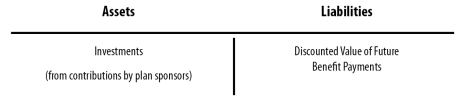
Figure A-1 depicts a typical DB pension plan's balance sheet. It consists of plan assets, which are the value of the investments made with accrued employer (and employee, if any) contributions to the plan, and plan liabilities, which are the value of participants' benefits earned under the terms of the plan. Plan assets are invested in equities (such as publicly traded stock), debt (such as the U.S. Treasury and corporate bonds), private equity, hedge funds, and real estate.
|
 |
|
Source: Congressional Research Service (CRS). |
Defined Benefit Plan Funding Ratio
The funding ratio measures the adequacy of a DB pension plan's ability to pay for promised benefits. The funding ratio is calculated as

A funding ratio of 100% indicates that the DB plan has set aside enough funds, if the invested funds grow at the expected rate of return or better, to pay all of the plan's benefit obligations. Funding ratios that are less than 100% indicate that the DB plan will not be able to meet all of its future benefit obligations. Because benefit obligations are paid out over a period of 20 years to 30 years, participants in an underfunded plan will likely receive their promised benefits in the near term. However, if the underfunding persists without additional contributions, plan participants might not receive 100% of their promised benefits in the future.
In response to strong investment returns in the 1990s, many multiemployer DB pension plans increased benefits to participants. Many of these plans then became underfunded during the early 2000s as financial markets weakened. Their financial position worsened as a result of (1) stricter funding rules put in place in the Pension Protection Act of 2006 (P.L. 109-280), (2) the decline in equity markets in 2008, (3) low interest rates as a result of weak economic conditions, and (4) the bankruptcy of some of the firms participating in the plans.
The Value of Plan Assets
a. Special Financial Assistance (SFA) provides grants to financially troubled multiemployer plans and was passed in Section 9704 in Title IX, Subtitle H, of the American Rescue Plan Act of 2021 (P.L. 117-2). SFA is discussed later in the report. From December 21, 2021, through May 15, 2026, 196 SFA applications from 161 plans covering 1.8 million participants have been approved for $77.9 billion in SFA.
Financial Condition of the Multiemployer System Prior to FY2021
Prior to FY2021, the multiemployer system and, relatedly, the PBGC's multiemployer insurance program were in poor financial condition. Figure 1 shows the financial condition of PBGC's multiemployer program from FY2014 through FY2025. The large increase in the deficit—reaching a peak of $65.2 billion in FY2019—was a result of the recognition of the likely insolvency of several large multiemployer plans. In FY2021, Special Financial Assistance (SFA) was passed in Section 9704 in Title IX, Subtitle H, of the American Rescue Plan Act of 2021 (P.L. 117-2) to provides grants to financially troubled multiemployer plans. SFA is discussed later in the report. As a result of the enactment of SFA, the multiemployer program has run a surplus since FY2021.
FY2015–FY2025 Notes: PV indicates present value. Congress had expressed concern about the multiemployer program for years leading up to the enactment of SF in FY2021 A. Prior to the enactment of SFA in FY2021, about 10% to 15% of multiemployer plan participants were in plans that PBGC expected to become insolvent. Two of the largest multiemployer plans, the Central States, Southeast and Southwest Areas Pension Plan (Central States) and the United Mine Workers of America (UMWA) 1974 Pension Plan, were both expected to become insolvent and, had that occurred, would have resulted in the insolvency of the PBGC's multiemployer insurance program. In its plan year 2021 filing, Central States, which covered over 350,000 participants and paid out annual benefits of $2.9 billion, indicated a projected insolvency date of 2025.32 In 2019 (prior to receiving federal financial assistance, as detailed later in this report), the UMWA plan, which covered about 90,000 participants and paid out over $500 billion in benefit payments that year, indicated an insolvency date of 2022 or 2023.33 Insolvent plans are eligible for traditional financial assistance from PBGC. However, while PBGC historically had sufficient assets from which to provide financial assistance to insolvent plans, PBGC's financial condition was such that the benefit obligations from plans that were likely to become insolvent between 2020 and 2030 would likely have resulted in PBGC having insufficient resources from which to pay guaranteed benefits owed to plan participants. At the time, PBGC indicated that once resources were exhausted in its multiemployer program, insolvent plans would be required to reduce benefits to levels that could be sustained through premium collections only. This would have meant that participants' benefits would have been cut to levels below the maximum benefit.34 PBGC estimated that most participants would have received less than $2,000 per year because PBGC would have only been able to provide annual financial assistance equal to its annual premium revenue, which averaged $365.6 million per year from FY2021 to FY2025.35 For participants' benefits to be paid at the guaranteed amount, either (1) premiums would have had to rise to levels that many plan sponsors, plan participants, and policymakers would have found unreasonable or (2) federal financial assistance to PBGC would have been required. In 2016, PBGC estimated that premium levels would have needed to increase in the range of 59% to 85% to ensure solvency over the subsequent 10 years and in the range of 363% to 552% to ensure solvency over the subsequent 20 years.36 After the 2007-2009 recession, some Members of Congress expressed interest in addressing the challenges faced by the sponsors of multiemployer DB pension plans and by PBGC's multiemployer insurance program.37 For example, the House Education and Workforce Committee (including the Health, Employment, Labor, and Pensions subcommittee) held six hearings in 2012 and 2013 addressing multiemployer pension policy issues.38 In 2014, Congress enacted the Multiemployer Pension Reform Act of 2014 (MPRA; P.L. 113-235) to address the projected increase in plan insolvencies and provide options to improve funding for multiemployer plans. Among other provisions, MPRA allows financially distressed plans that meet certain conditions to apply to the U.S. Treasury for permission to reduce participants' benefits to stave off insolvency. In 2015, one relatively large plan, the Central States plan, applied to reduce benefits. In 2016, its application was denied.39 As of the date of this report, 18 plans have been approved to reduce benefits under MPRA. The most recent approval occurred in 2020, and the most recent application to reduce benefits under MPRA was submitted on February 26, 2021, and was subsequently withdrawn.40 In addition, the Bipartisan Budget Act of 2018 (P.L. 115-123), enacted on February 9, 2018, created the Joint Select Committee on Solvency of Multiemployer Pension Plans to address the impending insolvencies of several large multiemployer DB pension plans and PBGC, but the committee did not provide legislative language by its November 30, 2018, deadline.41 In 2019, Congress enacted the Bipartisan American Miners Act of 2019 (enacted as Division M of The Further Consolidated Appropriations Act, 2020 [P.L. 116-94]), which authorized annual general fund payments to the UMWA 1974 Pension Plan to address the solvency of that plan. The act established a new cap of $750 million annually on the aggregate amount of General Fund payments to certified states and tribes, UMWA health benefit plans, and the UMWA pension plan combined.42 The cap serves as a mechanism to control federal direct spending from the U.S. Treasury. After in lieu payments to certified states and tribes and supplemental payments to the UMWA health benefit plans each fiscal year, the act authorizes any remaining amount within the $750 million annual cap to be transferred to the UMWA pension plan. The federal financial assistance to the UMWA plan is projected to prevent its insolvency. Section 9704 in Title IX, Subtitle H, of the American Rescue Plan Act of 2021 (P.L. 117-2) provided financial assistance in the form of grants to eligible financially troubled multiemployer DB plans. Specifically, it established a fund within the PBGC and appropriates from the general fund "such amounts as are necessary" to provide Special Financial Assistance (SFA) to certain multiemployer DB plans and necessary administrative and operating expenses. SFA does not have to be repaid. Following the enactment of SFA, the PBGC's financial assistance program for insolvent multiemployer plans not eligible for SFA began to be referred to as traditional financial assistance (and continues to operate alongside SFA). As of May 15, 2026, 196 SFA applications from 161 plans covering 1.8 million participants have been approved for SFA.43 The dollar amount of SFA for these approved plans is approximately $77.9 billion.44 PBGC maintains a list of plans that have submitted applications for SFA, been approved for SFA, been denied SFA, or withdrawn their SFA applications. This list includes the amount of SFA requested by each plan, and, if approved, the amount paid to each plan. PBGC updates this list on a weekly basis.46 Among the plans that were approved for SFA as of May 15, 2026, Additionally, 178 plans had submitted and subsequently withdrew their applications for SFA and all but 24 reapplied for SFA. Three plans were denied SFA: two based on their ineligibility for SFA and one for an incomplete application. The amount of SFA is the amount needed to pay participants' full plan benefits through the 2051 plan year. To determine the present value of benefits, the plan must use the interest rate from its most recent zone certification before January 1, 2021, subject to a maximum limit. The limit is the interest rate used by single-employer DB pension plans to discount their benefits to be paid 20 years or more in the future (referred to as the third segment rate in Title 26, Section 430(h)(2)(C)(iii), of the U.S. Code) prior to adjustment for the funding corridor in the month (or preceding three months) of the application, increased by two percentage points.47 In February 2021, the third segment rate was 3.59%, so the limit would have been 3.59% + 2.0% = 5.59%.48 The median interest rate multiemployer plans used to value benefit obligations in 2022 and 2023 was 7.0%.49 Using lower interest rates results in larger amounts of SFA. SFA is paid to the plan as a lump sum, is kept separate from other plan assets, and must be invested only in investment-grade bonds or other securities as determined by PBGC. Participants' benefits in plans receiving SFA are not to be reduced to the PBGC maximum guarantee. Section 9704 of the law imposes a number of conditions on plans that receive SFA regarding, among other things, participants' benefits, withdrawal liability, and PBGC premiums. A plan that had previously received approval for benefit suspensions under MPRA is required to (1) reinstate the benefits and (2) provide payments for benefits that participants and beneficiaries had not received because of the benefit suspensions. PBGC could impose reasonable conditions on plans receiving SFA relating to increases in future accrual rates, retroactive benefit improvements, allocation of plan assets, reductions in employer contribution rates, diversion of contributions to—and allocation of—expenses to other benefit plans, and withdrawal liability. PBGC could not impose conditions relating to prospective reductions in plan benefits, changes to plan governance, or funding rules relating to receiving SFA. Plans that receive SFA continue to pay PBGC premiums, are deemed to be in critical status through the plan year ending in 2051, and are ineligible to apply for MPRA benefit suspensions. Some proponents viewed federal financial assistance to multiemployer plans as fulfilling part of a promise made to workers.50 Opponents argued that it is inappropriate to provide federal financial assistance to private sector pension plans.51 Simulations by the Congressional Budget Office in February 2021 indicated that an average of 185 plans would receive $86 billion in special financial assistance.52 In a September 2022 letter, CBO indicated that SFA would total $90.4 billion from FY2022 to FY2032.53 CBO stated that the cost increase was a result of differences between the interim final rule which was the basis for CBO's 2021 estimate and the final rule adopted by PBGC in July 2022. An earlier estimate from CBO indicated that PBGC's multiemployer program would remain solvent through the mid-2040s.54 Because SFA allows plans to delay or prevent insolvency, CBO estimated that PBGC would spend $2 billion less in financial assistance to these plans. Retirees would pay $1.7 billion in federal income taxes on benefits that would not have been received in the absence of SFA. Participants in multiemployer plans that receive SFA do not have their benefits reduced to the PBGC maximum benefit level. Plans that became insolvent prior to December 14, 2014, reduced participants' benefits to PBGC maximum guarantee levels. These plans are ineligible for SFA. In addition, under current law, participants in plans that become insolvent in the future (beyond the application window for SFA) will have their benefits reduced to the PBGC maximum guarantee. The interest rate is an important component for determining the amount of SFA paid to qualifying plans. Because the law's specified interest rate limit is typically lower than the median interest rate used by plans when calculating the value of benefits for plan funding purposes, for most plans, the value of benefits for SFA purposes is larger than the actuarial value of these benefits. Certain employers (e.g., the United Parcel Service and Kroger) pledged to "top up" the benefits of some retired former employees in certain plans if they are reduced as a result of PBGC traditional financial assistance or MPRA. Because SFA does not require plans to reduce participants' benefits, these employers potentially benefited financially by not having to make the top-up payments for participants in plans that received SFA.55 The law did not impose any changes to the structure of multiemployer DB plans or plan funding rules to ensure that currently financially healthy plans do not need financial assistance in the future. It is possible that some plans, including some that received SFA, may need financial assistance in the future. Some stakeholders raised concerns over the assumption that plans make on the interest rates of their SFA assets.56 In determining the amount of SFA a plan needs, a plan sums the amount of benefits it expects to pay through 2051 and subtracts the amount of resources it expects to have available through 2051. The amount by which expected benefits exceeds expected resources is the amount of SFA a plan would receive. The amount of resources includes (1) a plan's assets, which are the accumulated contributions from employers participating in the plan, and (2) the investment returns on the plan assets. Because SFA is received as a lump-sum payment and is also invested, the expected investment returns on SFA assets are also included as part of a plan's resources. Plans must make assumptions about the expected interest rate (also called the expected rate of return) on plan investments to determine the projections. The provision authorizing SFA requires that SFA funds be (1) segregated from non-SFA assets and (2) invested conservatively.57 In general, the more conservative an investment portfolio, the lower the expected rate of return on those invested assets.58 As a result, one of the topics that PBGC addressed in regulations was the interest rate permitted for SFA and non-SFA assets.59 PBGC's Interim Final Regulation (IFR) called for the same interest rate to be used for projecting the rate of return on both SFA and non-SFA assets, while the final regulation indicated that plans could use separate (referred to as bifurcated) interest rates for the expected rates of return on SFA and non-SFA assets.60 In the IFR, PBGC wrote that it "does not have authority to provide a different rate or bifurcate the statutorily mandated interest rate."61 A number of comment letters on the IFR mentioned that using the same interest rates for SFA and non-SFA assets would cause plans to receive less SFA than would be needed to keep plans solvent through 2051. For example, a comment letter from seven Democratic Senators noted that possible results of requiring plans to use a single interest rate risks negative outcomes that "were not consistent with Congressional intent."62 PBGC's final regulation changed its position from the IFR, indicating that "after further review of the statute, PBGC observes that section 4262(e) of ERISA is general in its language regarding the determination of the amount of SFA and does not speak directly to the precise question of the use of an interest rate to project returns on SFA assets."63 On August 10, 2022, PBGC's Office of the Inspector General (OIG) requested an opinion from the U.S. Government Accountability Office (GAO) on the use of bifurcated interest rates, and on September 8, 2022, the PBGC OIG issued a Risk Advisory.64 The Risk Advisory noted that because PBGC had already approved SFA applications with bifurcated interest rates, then "if GAO's decision were to contradict PBGC's position in its Final Rule, SFA payments, made while the decision was pending, risk being deemed improper payments, and additionally raise a reputational risk for PBGC."65 On September 30, 2022, a Congressional Budget Office (CBO) letter indicated that as a result of changes to the Final Rule, the total amount of SFA was projected to increase from $85.9 billion to $90.4 billion.66 That same day, the House Education and Workforce Committee sent a letter to the PBGC director asking, among other things, the "specific Congressional authority for the July 2022 final rule's use of two separate interest rates for calculating SFA under ARPA."67 On August 9, 2023, GAO concluded that "PBGC used its ARPA appropriation for its stated purpose and as such, neither the purpose statute nor the Antideficiency Act are violated by PBGC's interest rate determinations."68 A March 2023 report by the PBGC's OIG indicated that it was likely that PBGC approved SFA applications in which some of the participant counts included deceased participants.69 As a result, PBGC may have made improper payments to these plans.70 PBGC's OIG conducted an audit of five plans and found that the deceased participants included in SFA counts were participants who were no longer active participants in the plan (i.e., they no longer worked for an employer participating in the plan) but were not yet receiving benefits from the plan (because they were not yet retired). These participants are referred to as terminated vested participants.71 Deceased participants were included in participant counts when some plans submitted their SFA applications based on the instructions in PBGC's IFR. The IFR did not require plans to conduct a death audit by cross-checking the participant census with death files. In addition, when applying for SFA, plans were required to use the assumptions in their most recent plan certification before January 1, 2021.72 In some cases, participants became deceased between the time of their plans' application submissions (using data as of the plan certification date) and their plans' approvals for SFA. The final regulation required documentation of a death audit.73 However, a subsequent PBGC OIG report from June 2023 noted that plan death audits might not be satisfactory in identifying deceased participants because they rely on private companies to verify participants' statuses and are prone to making errors.74 PBGC noted that the problem may be especially acute for separated, vested participants. In PBGC's single-employer and multiemployer insurance programs, PBGC checks participant censuses against Social Security's Death Master File (DMF), which is a file compiled by the Social Security Administration (SSA) that includes over 90% of all deaths in the United States. Only selected federal agencies have access to the full DMF.75 The June 2023 PBGC OIG white paper noted that PBGC indicated that it intended to request the plan census underlying an SFA request and perform an independent death search on the file. The OIG paper stated that it was its understanding "that PBGC will use the Full DMF" to conduct such searches.76 In November 2023, Senator Bill Cassidy sent a letter to Sean O'Brien, General President of the International Brotherhood of Teamsters (a union whose members constituted many of the Central States plan participants), that inquired how deceased participants were included in the SFA application and whether the Central States plan intended to return the $127 million attributable to them.77 At a Senate Health, Education, Labor, and Pensions (HELP) committee hearing, Senator Cassidy received a commitment from Mr. O'Brien that the plan would return the money.78 DOL issued a statement that indicated that while plans may have expressed concerns that returning excess payments could violate fiduciary obligations, DOL would not take any enforcement action against plans that return excess amounts of SFA.79 On March 15, 2024, PBGC issued a statement that it "supports the Department of Labor's (DOL) position that such repayments would not violate" ERISA or the Internal Revenue Code.80 In the 118th Congress, on January 30, 2024, Representative Virginia Foxx introduced H.R. 7135, and Senator Bill Cassidy introduced S. 3682, The GHOST Act, identical bills that would have required PBGC to audit plans that were approved for SFA to determine whether a plan had received any amounts of SFA on behalf of deceased participants. Plans would have been required to repay the PBGC for any SFA overpayments. On April 8, 2024, Central States entered into an agreement with the Department of Justice to repay the funds.81 Also on April 8, 2024, PBGC indicated that Central States had repaid the money.82 In the 119th Congress, some members continued to conduct oversight of this issue. For example, a February 20, 2025, letter from Representative Tim Walberg, Chairman of the House Committee on Education and Workforce, and Representative Rick Allen, Chairman of the Subcommittee on Health, Employment, Labor, and Pensions, to Attorney General Pamela Bondi, sought information "about the steps DOJ is taking to ensure that taxpayer money is recovered after the Biden-Harris administration made improper payments to multiemployer pension plans."83 The letter also noted that, "as of February 7, 2025, about 30 of these 60 plans have voluntarily repaid nearly $30 million."84 PBGC's updated list of plans that have been approved for SFA includes information about plans that repaid SFA, including the amount repaid and date of repayment.85 As of April 29, 2026, PBGC data indicated that 67 plans have repaid $261.0 million in overpayments.86 This appendix provides background on basic concepts related to the funding of DB pension plans. Defined Benefit Plan Balance Sheet
Source: Congressional Research Service (CRS). Defined Benefit Plan Funding Ratio The funding ratio measures the adequacy of a DB pension plan's ability to pay for promised benefits. The funding ratio is calculated as A funding ratio of 100% indicates that the DB plan has set aside enough funds, if the invested funds grow at the expected rate of return or better, to pay all of the plan's benefit obligations. Funding ratios that are less than 100% indicate that the DB plan will not be able to meet all of its future benefit obligations. Because benefit obligations are paid out over a period of 20 years to 30 years, participants in an underfunded plan will likely receive their promised benefits in the near term. However, if the underfunding persists without additional contributions, plan participants might not receive 100% of their promised benefits in the future. In response to strong investment returns in the 1990s, many multiemployer DB pension plans increased benefits to participants. Many of these plans then became underfunded during the early 2000s as financial markets weakened. Their financial position worsened as a result of (1) stricter funding rules put in place in the Pension Protection Act of 2006 (P.L. 109-280), (2) the decline in equity markets in 2008, (3) low interest rates as a result of weak economic conditions, and (4) the bankruptcy of some of the firms participating in the plans. The Value of Plan AssetsAmount of Special Financial Assistance
Greater Benefit to Certain Employers
No Structural Changes to Plans
Interest Rate on Plan Assets in SFA Applications
SFA Overpayments for Deceased Participants
Plan Liabilities
A pension plan's benefits are a plan liability spread out over many years in the future. These future benefits are calculated and reported as current dollar values (also called present value). Figure A-2 shows the process by which future benefits are discounted. Using a formula, benefits that are expected to be paid in a particular year in the future are calculated so they can be expressed as a current value. The process is called discounting, and it is the reverse of the process of compounding, which projects how much a dollar amount will be worth at a point in the future.
|
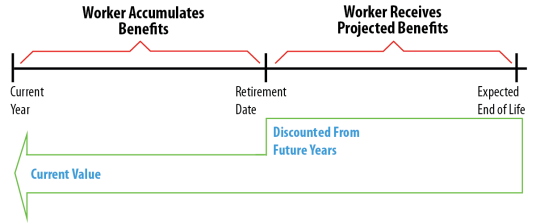 |
|
Source: CRS. |
Source: CRS.
The formula by which future values are calculated as current values is in Figure A-3.
|
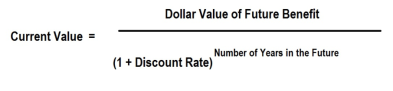 |
|
Source: CRS. |
Source: CRS.
For example, assuming a discount rate of 10%, $121 in two years' time is worth $121(1.1)2=$100 today. The present value of a dollar amount is inversely related to both the discount rate and the number of years in the future. As the discount rate or number of years in the future increases, present value decreases; as the discount rate or number of years decreases, present value increases. In the above example, if the discount rate is 15%, then $121 in two years' time is worth $121(1.15)2=$91.49 today, and $121 in three years' time is worth $121(1.1)3=$79.56.
Discount Rate Used to Value Future Benefits
In the context of DB pension plans, plan actuaries calculate the present value of future benefit obligations by estimating (1) the dollar amount of the benefits accrued by plan participants and (2) the years in the future in which the benefits are expected to be paid. The Internal Revenue Code does not require multiemployer pension plans to use a specific discount rate to value their future benefit obligations. The assumptions a plan uses must be reasonable and offer the best estimate of the plan's expected experience.6587 In practice, multiemployer plans generally discount plan liabilities using the expected rate of return on the plan's assets. However, multiemployer plans are required to value plan liabilities using rates of returns to bonds, as well. On Schedule MB of Form 5500, multiemployer plans report the present value of future benefits discounted by the expected return on plan assets (listed as the Accrued Liability Under Unit Credit Cost MethodAccrued Liability Under Unit Credit Cost Method) and by long-term bond yields (listed as the Current Liability under the "RPA '94" Information).6688 The RPA '94 discount rate is generally lower than a plan's expected return on assets.
Pension policy experts have several viewpoints on the appropriate discount rate that pension plans should use to value plan liabilities.6789 Broadly speaking, some actuaries recommend that pension plans discount future benefits using the expected rate of return on plan investments (the current practice for multiemployer DB pension plans). Some financial economists, by contrast, recommend that plans discount the liabilities using a discount rate that reflects the likelihood that the benefit obligation will be paid.
The rationale for the actuaries' approach is as follows: because funds are to be set aside to pay an obligation in the future, the amount that has to be set aside should consider the rate of the return on the investment. For example, given an expected return of 10%, a $100 obligation payable in one year would be valued at $90.91 in today's dollars ($100 ÷ 1.1 = $90.91), and $90.91 could be set aside today to pay the $100 future obligation.
The rationale for the approach favored by financial economists is that pension obligations should be discounted based on the likelihood that they will be received by plan participants. Because participants are very likely to receive most of their pension benefits (for examplee.g., because of vesting provisions in ERISA and PBGC guarantees), their pension benefits should be discounted using a discount rate close to the risk-free rate. Financial economists say that the actuaries' approach may make an inappropriate connection between the value of liabilities and the rate of return on assets. For example, the value of the obligation can be increased or decreased by changing the assumption on the rate of return, which suggests that a pension plan could eliminate some of its underfunding by investing the plan's assets in riskier investments.68
90
The approach suggested by some actuaries results in discount rates that are generally higher than the rates that result by using the approach suggested by some financial economists. One effect of this divergence of opinion is that the value of pension plan benefit obligations is higher (and funding ratios are lower) using the approach favored by some financial economists. For example, in March 2012, a Credit Suisse study estimated the underfunding of multiemployer DB pension plans at $101 billion under the actuaries' approach and $428 billion under the financial economists' approach.69
Appendix B.
Summary of the Provisions in the Multiemployer Pension Reform Act
The National Coordinating Committee for Multiemployer Plans (NCCMP) is an organization that represents a number of multiemployer pension plans. In 2013, it created a Retirement Security Review Commission (the commission) to gather input from a coalition of employers and labor groups for multiemployer DB pension reform proposals. Many of the commission proposals were included in the Multiemployer Pension Reform Act of 2014, enacted as Division O in the Consolidated and Further Continuing Appropriations Act, 2015 (MPRA; P.L. 113-235).
MPRA increased the premiums that the sponsors of multiemployer DB pension plans pay to PBGC. The premium increased from $12 per participant to $26 per participant. In addition, beginning in 2016, the premium is increased annually for changes in the average national wage.70
Sections 101 to 111 of MPRA made the following changes to the funding rules for multiemployer DB plans:
- Eliminates the sunset of provisions related to the zone certification status;
- Permits plans to enter critical status if they anticipate being in that status in the next five years. Under prior law, multiemployer plans were required to make changes to the plan structure when they entered critical status. However, plans could not make changes if they anticipated entering that status (they had to wait until they entered that status);
- Allows plans that emerge from critical status not to reenter critical status for at least one year following their emergence. Under prior law, because different criteria existed in the funding status tests for plans emerging from critical status, some plans emerged from and then immediately reentered critical status;
- Authorizes plans that meet the criteria for endangered status but have funding improvement plans that do not require additional contributions or benefit changes not to be certified as in endangered status. Some plans that entered endangered status did not have to make any changes to contributions or benefit levels to emerge from that status. Under prior law, these plans continued to be classified as being in endangered status;
- Permits plan actuaries for plans in endangered status, when developing funding improvement plans, to use the funding status as of the date of certification of the status rather than having to calculate the plan's funding status as of the beginning of the funding improvement plan. Under prior law, plan actuaries had to calculate the funding status at date of certification of endangered status and make a projection of the funding status at the beginning of the funding improvement period;
- Allows plans in endangered status to adopt some of the rules that previously had been available only to plans in critical status, including contribution decreases and the waiver of excise taxes. Some plans that were in endangered status actively sought to be placed in critical status because a number of the restrictions placed on plans in endangered status were more onerous than those placed on plans in critical status;
- Enables funding improvement plans and rehabilitation plans to specify the course of action if the collective bargaining agreement expires and the parties cannot agree on a schedule. Prior law provided no guidance as to the course of action a plan must take if a collective bargaining agreement expired when a plan was in endangered or critical status;
- Allows rules for plans in critical status to take priority over rules for plans in reorganization when both occur simultaneously. The Multiemployer Pension Plan Amendments Act of 1980 (P.L. 96-364) required plans in weak financial condition to undergo reorganization and established rules for plans in reorganization to improve funding. There potentially were conflicts between some of the rules for plans that were both in reorganization and in endangered or critical status;
- Permits contribution increases as part of a funding improvement plan or a rehabilitation plan to be disregarded in determining withdrawal liability. Plans that are in critical or endangered status could inadvertently make changes that could have increased plans' withdrawal liability; and
- Provides preretirement survivor annuities to plan participants who die after the date of plan insolvency or termination. Plan participants in multiemployer plans that are insolvent or that have been terminated were ineligible for preretirement survivor annuities. This provision is in contrast to participants in single-employer plans, who remain eligible for survivor annuities after plan termination.
Assistance for Deeply Troubled Plans
Some multiemployer DB pension plans are in very poor financial condition and are likely to become insolvent. If one or two of the largest plans become insolvent, PBGC would likely have insufficient resources from which to guarantee participants' benefits. If PBGC is unable to pay participants' guaranteed benefits, it is unclear whether PBGC would receive financial assistance from the federal government. PBGC was established to be self-financing, and ERISA states that the "United States is not liable for any obligation or liability incurred by the corporation."71 Some Members of Congress have expressed a reluctance to consider providing financial assistance to PBGC.72
Deeply troubled multiemployer DB plans have limited options to avoid insolvency. Increased contributions and cuts to adjustable benefits to active plan participants are likely to be insufficient to return these plans to solvency. Participants' benefits in insolvent plans would be reduced to the PBGC guaranteed levels, or possibly lower, if PBGC has insufficient resources from which to pay 100% of the benefits guaranteed to participants.
Facilitate Mergers and Partitions
Sections 121 and 122 of MPRA provide PBGC with greater authority to facilitate mergers and partitions of multiemployer pension plans.
In a plan merger, the assets and liabilities of one plan are transferred to another plan. MPRA allows PBGC to promote and facilitate mergers between multiemployer plans, provided the merger is in the interests of the participants of at least one of the plans and is not reasonably expected to be adverse to the overall interests of the participants in any of the plans. Actions by PBGC to facilitate mergers include providing training and technical assistance, mediation, and communication with stakeholders. PBGC also may provide financial assistance to the merged plan if, among other provisions, (1) one of the plans in the merger is in critical and declining status, (2) financial assistance will reduce PBGC's expected long-term loss, and (3) financial assistance is necessary for the merged plan to remain solvent.
In a partition, PBGC gives approval to divide a plan that meets specified criteria into two plans.73 The goal of the partition is to restore the original plan to financial health. Some key features of the plan partition process include the following:
- The original plan must be in critical and declining status and must have taken all reasonable measures to avoid insolvency, including reducing participants' benefits to 110% of PBGC maximum guarantee benefit level;
- PBGC must expect that a partition of the plan would reduce PBGC's long-term loss with respect to the plan and that the partition would not impair PBGC's ability to provide financial assistance to other plans;
- Some or all orphan participants and their liabilities from the original plan are transferred to a newly created plan (also called a successor plan);
- The successor plan is administered by the original plan;
- No assets from the original plan are transferred to the successor plan. The successor plan receives financial assistance from PBGC to pay benefits to the participants in that plan; and
- Participants' benefits in the successor plan are reduced to PBGC maximum benefit levels; the original plan provides participants the difference between (1) the reduced benefit in the original plan and (2) the PBGC maximum benefit provided in the successor plan.
Benefit Reductions
Section 201 of MPRA allows certain multiemployer DB plans to reduce benefits for participants. The following are features of the provisions for benefit reductions:
- Only plans that are in critical and declining status may cut benefits.
- The Treasury Secretary, in consultation with the PBGC and the Labor Secretary, may reject a plan's application to reduce benefits if the plan sponsor's determination of the need for benefit reductions is "clearly erroneous."
- Participants in most plans are able to reject the reduction of benefits, if a majority of all participants and beneficiaries vote to do so. However, plans deemed to be systematically important are able to reduce participants' benefits without a vote. A systemically important plan is one in which PBGC would pay $1 billion or more in benefit payments if the benefit reductions were not implemented. There are likely a handful of plans that are systematically important.
- Individuals cannot have their benefits cut below 110% of the PBGC maximum guarantee. Because the maximum guarantee in 2015 is $12,870 per year, a participant whose benefit is suspended would have to receive a benefit of at least $14,157.
- Disabled individuals and retirees aged 80 or older may not have their benefits reduced. Individuals between the ages of 75 and 80 may not receive the maximum benefit reduction.
- Benefit reductions must be distributed equitably. MPRA lists a number of factors that a plan sponsor may consider in making determinations. These factors include the age and life expectancy of participants; the length of time an individual has been receiving benefits from the plan; and the years to retirement for participants who are currently working.
- Benefit reductions in certain plans are to be ordered, first, among participants who worked for an employer that withdrew and failed to pay, in full, the required payments to exit the plan (known as withdrawal liability); and second, among other participants except those who worked for an employer that (1) withdrew from the plan, (2) fully paid its withdrawal liability, and (3) established a separate plan to provide benefits in an amount equal to benefits reduced as a result of the financial condition of the original plan. For example, this third exclusion applies to participants who worked for United Parcel Service and are in a trucking industry multiemployer plan.
Reducing retirees' benefits was a contentious issue.74 For example, some feared that retirees could be asked to shoulder a burden that otherwise could be fixed by increased employer contributions. Another concern was that retirees, particularly the most vulnerable, might not have adequate representation in discussions of changes to deeply troubled multiemployer DB pensions.75 MPRA addressed some of these issues. For example, individuals who are disabled or who are aged 80 and older may not have their benefits reduced and, except for several systematically important multiemployer plans, plan participants must vote on whether to reject any proposed benefit suspensions.
Recommendations Not Included in MPRA
The following 4 of the 13 recommendations from the Retirement Security Commission for changes to the funding rules for multiemployer DB pensions were not in MPRA. These changes would have
- provided for automatic triggers for funding relief when dramatic declines occur in financial markets. Under current law, changes in funding rules must be authorized in statute, which can result in a delay between the onset of financial difficulties for pension plans and the implementation of funding relief;
- allowed plans to pay certain additional benefits (a 13th check) that would not have been considered a part of a participant's accrued benefit. Plans that experience favorable investment returns sometimes provide participants an additional benefit. If the 13th check is offered on a regular basis, then the benefit is considered a regular benefit, which cannot be reduced or eliminated;
- eliminated the potential exposure to an Internal Revenue Service (IRS) excise tax for plans that were granted amortization extensions under PPA. Prior to PPA, in exchange for a schedule of funding improvements, the IRS allowed some plans to extend the length of time to make up for investment losses. As a result of the 2008 market downturn, many plans failed to meet the requirements for the schedule of funding improvements and potentially are subject to an IRS excise tax. PPA provided for amortization extensions that made the pre-PPA extensions unnecessary; and
- permitted plan participants to convert DC accounts into annuities payable from their DB pension plans, which would have allowed participants who have DC accounts to receive lifetime income from their DC plans.
Author Contact Information
Acknowledgments
Emma Sifre provided research assistance for this report.
Footnotes
| 1. |
See U.S. Department of Labor (DOL), National Compensation Survey: Employee Benefits in the United States, March 2019, September, 2019, at https://www.bls.gov/ncs/ebs/benefits/2019/employee-benefits-in-the-united-states-march-2019.pdf. Sixty-six percent of full-time workers (including state and local government workers) in the United States participated in a retirement plan sponsored by their employers. |
|||||||||||||||||||||||||||||||||||||||||||||||||||||||||||||||||||||||||||||||||||||||||||||||||||||||
| 2. |
In some defined contribution (DC) plans, plan participants have the option to purchase annuities (a monthly payment for life) with some or all of their account balances. In some defined benefit (DB) plans, plan participants have the option to receive a lump-sum payment at retirement in lieu of the annuity. |
|||||||||||||||||||||||||||||||||||||||||||||||||||||||||||||||||||||||||||||||||||||||||||||||||||||||
| 3. |
The Government Accountability Office (GAO) indicated that about 0.7% of pension plans were multiple-employer pension plans. See GAO, Federal Agencies Should Collect Data and Coordinate Oversight of Multiple Employer Plans, GAO-12-665, September 13, 2012, p. 10, http://www.gao.gov/assets/650/648285.pdf. |
|||||||||||||||||||||||||||||||||||||||||||||||||||||||||||||||||||||||||||||||||||||||||||||||||||||||
| 4. |
The Pension Benefit Guaranty Corporation (PBGC) was created in the Employee Retirement Income Security Act of 1974 (ERISA) to insure private-sector DB pension plans. For more information on PBGC, see CRS Report 95-118, Pension Benefit Guaranty Corporation (PBGC): A Primer. |
|||||||||||||||||||||||||||||||||||||||||||||||||||||||||||||||||||||||||||||||||||||||||||||||||||||||
| 5. |
See Table 2 in CRS Report R45187, Data on Multiemployer Defined Benefit (DB) Pension Plans. |
|||||||||||||||||||||||||||||||||||||||||||||||||||||||||||||||||||||||||||||||||||||||||||||||||||||||
| 6. |
See PBGC, FY2017 Projections Report, https://www.pbgc.gov/sites/default/files/fy-2017-projections-report.pdf. |
|||||||||||||||||||||||||||||||||||||||||||||||||||||||||||||||||||||||||||||||||||||||||||||||||||||||
| 7. |
The Central States, Southeast and Southwest Areas Pension Plan (Central States) has about 400,000 participants. U.S. Treasury found that benefit reductions under the Multiemployer Pension Reform Act of 2014 (MPRA) would not allow the plan to return to solvency. Central States indicated that it would not submit a reapplication. |
|||||||||||||||||||||||||||||||||||||||||||||||||||||||||||||||||||||||||||||||||||||||||||||||||||||||
| 8. |
Although participants' benefits will be paid in the future, the sponsors of qualified DB pension plans are generally required to make contributions to the plan each year for benefits earned in that year. |
|||||||||||||||||||||||||||||||||||||||||||||||||||||||||||||||||||||||||||||||||||||||||||||||||||||||
| 9. |
See DOL, Employee Benefits Security Administration, Private Pension Plan Bulletin Historical Tables and Graphs: 1975-2017, September 2019, https://www.dol.gov/sites/default/files/ebsa/researchers/statistics/retirement-bulletins/private-pension-plan-bulletin-historical-tables-and-graphs.pdf. |
|||||||||||||||||||||||||||||||||||||||||||||||||||||||||||||||||||||||||||||||||||||||||||||||||||||||
| 10. | as noted above, the RPA '94 rate is typically lower than the expected rate of return; as a result, the measurement of multiemployer plan liabilities is higher using the RPA '94 interest rate than the expected rate of return.91 The funding of state and local pension plans is another area where there are differences of opinion regarding the appropriate discount rate. Like multiemployer DB plans, state and local pension plans typically use the expected rate of return on assets as the interest rate for discounting liabilities. However, some argue that state and local plans should use an interest rate that is close to the risk-free interest rate to value liabilities.92 One study estimated the pension liabilities for 646 state and local pension plans and found that at the end of 2022 the unfunded liabilities of the plans as measured by the expected return on assets was $1.6 trillion, and as measured by the risk-free rate was $5.1 trillion.93
See U.S. Department of Labor (DOL), National Compensation Survey: Employee Benefits in the United States, March 2025, September 25, 2025, https://www.bls.gov/news.release/pdf/ebs2.pdf. In some defined contribution (DC) plans, plan participants have the option to purchase annuities (a monthly payment for life) with some or all of their account balances. In some defined benefit (DB) plans, plan participants have the option to receive a lump-sum payment at retirement in lieu of the annuity. ERISA covers only private-sector pension plans and plans run by nonprofit organizations; pension plans established by the federal, state, and local governments and by churches are exempt from ERISA's coverage. The Pension Benefit Guaranty Corporation (PBGC) was created in the Employee Retirement Income Security Act of 1974 (ERISA) to insure private-sector DB pension plans. For more information on PBGC, see CRS Report 95-118, Pension Benefit Guaranty Corporation (PBGC): A Primer. PBGC regularly updates the list of SFA applications. They are available at https://www.pbgc.gov/arp-sfa/applications. Some plans are listed twice in the dataset because they submitted initial and supplemental applications. Revised applications may be submitted through December 31, 2026. If a plan were fully funded, there would be no withdrawal liability for an employer that exits a plan. For more information, see PBGC, Withdrawal Liability, available at http://www.pbgc.gov/prac/multiemployer/withdrawal-liability.html, or Keith R. McMurdy, Esq., Multiemployer Withdrawal Liability: Understanding the Basics, Fox Rothschild LLP, at http://documents.jdsupra.com/ac470c58-3493-4f12-9294-4b37fc49046c.pdf. Because some participants could have worked for both an inactive employer and an active employer, some stakeholders refer to orphan liabilities, rather than orphan participants. For more information, see PBGC, Orphan and Inactive Participants in Multiemployer Plans, 2015 Plan Year Reporting, available at https://www.pbgc.gov/sites/default/files/orphan-and-inactive-participant-report-final.pdf. Withdrawing employers might not pay their full share of unfunded benefits because of bankruptcy or withdrawal liability rules. See, for example, U.S. Congress, Joint Select Committee On Solvency Of Multiemployer Pension Plans, The History And Structure Of The Multiemployer Pension System, 115th Cong., 2nd sess., April 18, 2018. CRS analyzed DOL's Form 5500 data for the 2023 plan year (the most recent year for which complete information is available). Nearly all private-sector pension plans (including multiemployer DB plans) are required to file Form 5500 with the Internal Revenue Service (IRS), the Department of Labor (DOL), and PBGC. The Form 5500 information includes breakdowns on the number of plan participants, financial information about the plan, and details of companies providing services to the plan. A beneficiary is an individual, typically a spouse, who is entitled to receive a pension benefit from a plan after a participant dies. Plans may permit employees to instead receive a lump-sum payment. | |||||||||||||||||||||||||||||||||||||||||||||||||||||||||||||||||||||||||||||||||||||||||||||||||||||||
See Pension Benefit Guaranty Corporation, Introduction to Multiemployer Plans, available at https://www.pbgc.gov/prac/multiemployer/introduction-to-multiemployer-plans. | ||||||||||||||||||||||||||||||||||||||||||||||||||||||||||||||||||||||||||||||||||||||||||||||||||||||||
| 12. |
See DOL, Bureau of Labor Statistics (BLS), "National Compensation Survey: Employee Benefits in the United States, March 2011," available at https://www.bls.gov/news.release/archives/ebs2_07262011.pdf. |
|||||||||||||||||||||||||||||||||||||||||||||||||||||||||||||||||||||||||||||||||||||||||||||||||||||||
| 13. |
See DOL, BLS, "Table 4. Defined benefit retirement plans: Employee contribution requirement and method of contribution, State and local government workers, March 2019," at https://www.bls.gov/ncs/ebs/benefits/2019/ownership/govt/table04a.pdf |
|||||||||||||||||||||||||||||||||||||||||||||||||||||||||||||||||||||||||||||||||||||||||||||||||||||||
| 14. |
The plans, apart from the Thrift Savings Plan (TSP), are named for the section of the tax code that authorized them. Private-sector employers establish 401(k) plans, public school systems and nonprofits establish 403(b) plans, and state and local governments and nonprofits establish 457(b) plans. TSP is a DC plan for most federal employees. |
|||||||||||||||||||||||||||||||||||||||||||||||||||||||||||||||||||||||||||||||||||||||||||||||||||||||
| 15. |
See DOL, Employee Benefits Security Administration, Private Pension Plan Bulletin Abstract of 2017 Form 5500 Annual Reports, Table A6, September 2019, https://www.dol.gov/sites/dolgov/files/EBSA/researchers/statistics/retirement-bulletins/private-pension-plan-bulletins-abstract-2017.pdf. Single-employer plans include multiple-employer plans. |
|||||||||||||||||||||||||||||||||||||||||||||||||||||||||||||||||||||||||||||||||||||||||||||||||||||||
| 16. |
The annual maximum benefit is $69,750 for individuals who begin receiving their benefits at the age of 65 as a single-life annuity and whose plan is terminated in 2020. For more information on the termination of single-employer DB pension plans, see CRS Report RS22624, The Pension Benefit Guaranty Corporation and Single-Employer Plan Terminations. |
|||||||||||||||||||||||||||||||||||||||||||||||||||||||||||||||||||||||||||||||||||||||||||||||||||||||
| 17. |
Withdrawing employers might not pay their full share of unfunded benefits because of bankruptcy or withdrawal liability rules. |
|||||||||||||||||||||||||||||||||||||||||||||||||||||||||||||||||||||||||||||||||||||||||||||||||||||||
| 18. |
Participant data and insolvency projections are based on 2017 plan year data. Plans may have updated their insolvency projections in more recent years. See Table 3 in CRS Report R45187, Data on Multiemployer Defined Benefit (DB) Pension Plans. |
|||||||||||||||||||||||||||||||||||||||||||||||||||||||||||||||||||||||||||||||||||||||||||||||||||||||
| 19. |
The funding rules for multiemployer DB pension plans are found at 26 U.S.C. §431. |
|||||||||||||||||||||||||||||||||||||||||||||||||||||||||||||||||||||||||||||||||||||||||||||||||||||||
| 20. |
The funding rules for multiemployer DB pension plans are found at 26 U.S.C. §431. For an explanation of DB pension plan funding, see https://www.crs.gov/Reports/r46366#_Toc135315674. | |||||||||||||||||||||||||||||||||||||||||||||||||||||||||||||||||||||||||||||||||||||||||||||||||||||||
Pension plans are able to amortize experience gains and losses and changes in benefits as a result of changes to actuarial assumptions. Amortization means that plans can spread out the effect of these events over a specified number of years. For example, funding shortfalls as a result of investment losses are generally required to be made up over a period of 15 years, although a provision in the Preservation of Access to Care for Medicare Beneficiaries and Pension Relief Act of 2010 (P.L. 111-192) allowed investment losses from 2008 or 2009 to be amortized over a period of 30 years. For more information on this amortization of experience gains and losses, see U.S. Congress, Joint Committee on Taxation, General Explanation Of Tax Legislation Enacted In The 111th Congress, committee print, 111th Cong., 2nd sess., March 2011, JCS-1-11 (Washington: GPO, 2011). | ||||||||||||||||||||||||||||||||||||||||||||||||||||||||||||||||||||||||||||||||||||||||||||||||||||||||
| 22. |
If a plan were fully funded, there would be no withdrawal liability for an employer that exits a plan. For more information, see PBGC, Withdrawal Liability, available at http://www.pbgc.gov/prac/multiemployer/withdrawal-liability.html or Keith R. McMurdy, Esq., Multiemployer Withdrawal Liability: Understanding the Basics, Fox Rothschild LLP, at http://documents.jdsupra.com/ac470c58-3493-4f12-9294-4b37fc49046c.pdf. |
|||||||||||||||||||||||||||||||||||||||||||||||||||||||||||||||||||||||||||||||||||||||||||||||||||||||
| 23. |
Because some participants could have worked for both an inactive employer and an active employer, some stakeholders refer to orphan liabilities, rather than participants. For more information, see PBGC, Orphan and Inactive Participants in Multiemployer Plans, 2015 Plan Year Reporting, available at https://www.pbgc.gov/sites/default/files/orphan-and-inactive-participant-report-final.pdf. |
|||||||||||||||||||||||||||||||||||||||||||||||||||||||||||||||||||||||||||||||||||||||||||||||||||||||
| 24. |
A present value is calculated as (Dollar Value of Future Benefit / (1 + Interest Rate)Number of Years in the Future). For example, using an interest rate of 10%, a $100 payment two years in the future has a present value of ($100/(1.1))2 = $82.64. Note that discount rate and interest rate are often used interchangeably in the context of calculating present values. The actuarial or smoothed values of assets uses an average of past, and sometimes expected future, market values of each asset. The smoothing of asset values prevents large swings in asset values and creates a more predictable funding environment for plan sponsors. See https://www.pbgc.gov/documents/pbgc-five-year-report-on-multiemployer-pension-plans.pdf#page=5. | |||||||||||||||||||||||||||||||||||||||||||||||||||||||||||||||||||||||||||||||||||||||||||||||||||||||
A plan's underfunding is the amount by which the plan's liabilities exceed the plan's assets. | ||||||||||||||||||||||||||||||||||||||||||||||||||||||||||||||||||||||||||||||||||||||||||||||||||||||||
The funding statuses are available at https://www.dol.gov/agencies/ebsa/about-ebsa/our-activities/public-disclosure/critical-status-notices. | ||||||||||||||||||||||||||||||||||||||||||||||||||||||||||||||||||||||||||||||||||||||||||||||||||||||||
The funding statuses are available at https://www.dol.gov/agencies/ebsa/about-ebsa/our-activities/public-disclosure/critical-status-notices. | ||||||||||||||||||||||||||||||||||||||||||||||||||||||||||||||||||||||||||||||||||||||||||||||||||||||||
The funding statuses are available at https://www.dol.gov/agencies/ebsa/about-ebsa/our-activities/public-disclosure/critical-status-notices. | ||||||||||||||||||||||||||||||||||||||||||||||||||||||||||||||||||||||||||||||||||||||||||||||||||||||||
This monthly maximum benefit is calculated as follows: [($11 x 30) + (.75 x $33 x 30)]. For reference, the maximum benefit payable to participants in single-employer DB pension plans that are trusteed by PBGC is higher than the multiemployer program maximum benefit. It depends on the year of plan termination, the age at which the participant begins to receive the benefit, and the form of the benefit. For example, the single-employer maximum annual benefit is $ | ||||||||||||||||||||||||||||||||||||||||||||||||||||||||||||||||||||||||||||||||||||||||||||||||||||||||
| 30. | workers-retirees/learn/guaranteed-benefits/monthly-maximum.
| |||||||||||||||||||||||||||||||||||||||||||||||||||||||||||||||||||||||||||||||||||||||||||||||||||||||
See PBGC, | ||||||||||||||||||||||||||||||||||||||||||||||||||||||||||||||||||||||||||||||||||||||||||||||||||||||||
PBGC premiums are set in legislation and were most recently increased for multiemployer plans by MPRA. See PBGC, "Premium Rates," https://www.pbgc.gov/prac/prem/premium-rates. | ||||||||||||||||||||||||||||||||||||||||||||||||||||||||||||||||||||||||||||||||||||||||||||||||||||||||
See PBGC, | ||||||||||||||||||||||||||||||||||||||||||||||||||||||||||||||||||||||||||||||||||||||||||||||||||||||||
See 2021 Form 5500 filing from the Central States, Southeast & Southwest Areas Pension Plan, at https://www.efast.dol.gov/5500Search/.
See GAO, Multiemployer Plans and PBGC Face Urgent Challenges, GAO-13-428T, March 5, 2013, http://www.gao.gov/assets/660/652687.pdf. See PBGC, "PBGC Projections: Multiemployer Program Likely Insolvent by the End of 2025; Single employer Program Likely to Eliminate Deficit by 2022," press release, August 3, 2017, at https://www.pbgc.gov/news/press/releases/pr17-04. Additionally, the National Coordinating Committee for Multiemployer Plans (NCCMP) estimated that participants in 12 plans that applied for benefit reductions under MPRA would see a 53% reduction in benefits as a result of the PBGC maximum guarantee were these plans to become insolvent and receive PBGC financial assistance. The presentation did not indicate what percentage of participants in those plans would see benefit reductions. See National Coordinating Committee on Multiemployer Pensions, Multiemployer Pension Facts and the National Economic Impact, January 5, 2018, at http://nccmp.org/wp-content/uploads/2018/01/Multiemployer-Pension-Facts-and-the-National-Economic-Impact-Jan-5-2018.pdf. See PBGC, PBGC MPRA Report, June 17, 2016, https://www.pbgc.gov/sites/default/files/legacy/docs/MPRA-Report.pdf. | ||||||||||||||||||||||||||||||||||||||||||||||||||||||||||||||||||||||||||||||||||||||||||||||||||||||||
| 35. |
Terminated, underfunded multiemployer plans are classified as probable. |
|||||||||||||||||||||||||||||||||||||||||||||||||||||||||||||||||||||||||||||||||||||||||||||||||||||||
| 36. |
See PBGC, FY2019 Annual Report, p. 88. |
|||||||||||||||||||||||||||||||||||||||||||||||||||||||||||||||||||||||||||||||||||||||||||||||||||||||
| 37. |
PBGC, FY2019 Annual Report, p. 23. |
|||||||||||||||||||||||||||||||||||||||||||||||||||||||||||||||||||||||||||||||||||||||||||||||||||||||
| 38. |
PBGC, FY2019 Annual Report, p. 52. |
|||||||||||||||||||||||||||||||||||||||||||||||||||||||||||||||||||||||||||||||||||||||||||||||||||||||
| 39. |
PBGC, FY2019 Annual Report, p. 23. |
|||||||||||||||||||||||||||||||||||||||||||||||||||||||||||||||||||||||||||||||||||||||||||||||||||||||
| 40. |
See PBGC, FY2018 Projections Report, p. 10, at https://www.pbgc.gov/sites/default/files/fy-2018-projections-report.pdf (hereafter PBGC, FY2018 Projections Report). FY2018 data is provided because the FY2019 Projections Report was not available as of February 10, 2020. |
|||||||||||||||||||||||||||||||||||||||||||||||||||||||||||||||||||||||||||||||||||||||||||||||||||||||
| 41. |
PBGC, FY2018 Projections Report, p. 16. Present value is the current value of a future sum of money. For an explanation of present value in the context of a pension plan, see Appendix A in CRS Report R43305, Multiemployer Defined Benefit (DB) Pension Plans: A Primer. |
|||||||||||||||||||||||||||||||||||||||||||||||||||||||||||||||||||||||||||||||||||||||||||||||||||||||
| 42. |
PBGC, FY2018 Projections Report. PBGC's projections of the present value of future financial assistance from FY2019 to FY2028 ranged from $11.7 billion to $17.0 billion. |
|||||||||||||||||||||||||||||||||||||||||||||||||||||||||||||||||||||||||||||||||||||||||||||||||||||||
| 43. |
The $11.7 billion to $17 billion amount represents the present value of financial assistance that PBGC could be expected to pay FY2019 through FY2028. The $67.3 billion amount represents the present value of financial assistance of plans that are expected to become insolvent within 10 years. However, a considerable amount of financial assistance to these plans will be paid after FY2027. |
|||||||||||||||||||||||||||||||||||||||||||||||||||||||||||||||||||||||||||||||||||||||||||||||||||||||
| 44. |
See PBGC, FY2018 Projections Report, p. 18. |
|||||||||||||||||||||||||||||||||||||||||||||||||||||||||||||||||||||||||||||||||||||||||||||||||||||||
| 45. |
Congressional Budget Office (CBO), Options to Improve the Financial Condition of the Pension Benefit Guaranty Corporation's Multiemployer Program, 51356, August 2016, https://www.cbo.gov/publication/51536. |
|||||||||||||||||||||||||||||||||||||||||||||||||||||||||||||||||||||||||||||||||||||||||||||||||||||||
| 46. | For example, in 2012, Representative Phil Roe, then-chairman of the Subcommittee on Health, Employment, Labor, and Pensions in the House Education and Workforce Committee said that "[m]aintaining the status quo is no longer possible. Provisions in the law governing multiemployer pensions will expire in two years, which means Congress has an important opportunity to study the system, assess its strengths and weaknesses, and pursue solutions that support workers without discouraging participation in the voluntary pension system." See U.S. Congress, House Committee on Education and the Workforce, Subcommittee on Health, Employment, Labor, and Pensions, Challenges Facing Multiemployer Pension Plans: Evaluating PBGC's Insurance Program and Financial Outlook | |||||||||||||||||||||||||||||||||||||||||||||||||||||||||||||||||||||||||||||||||||||||||||||||||||||||
| 47. |
See, for example, U.S. Congress, House Committee on Education and the Workforce, Subcommittee on Health, Employment, Labor, and Pensions, Examining Reforms to Modernize the Multiemployer Pension System, 114th Cong., 1st sess., April 30, 2015. |
|||||||||||||||||||||||||||||||||||||||||||||||||||||||||||||||||||||||||||||||||||||||||||||||||||||||
| 48. |
For example, 113 multiemployer plans in 2017 (9.2% of all multiemployer DB pension plans covering 11.8% of all participants in multiemployer DB plans) notified DOL that they are in critical and declining status and are likely to become insolvent within 14 years or 19 years as specified in law. See Table 2 in CRS Report R45187, Data on Multiemployer Defined Benefit (DB) Pension Plans. |
|||||||||||||||||||||||||||||||||||||||||||||||||||||||||||||||||||||||||||||||||||||||||||||||||||||||
| 49. |
See GAO, Multiemployer Plans and PBGC Face Urgent Challenges, GAO-13-428T, March 5, 2013, http://www.gao.gov/assets/660/652687.pdf. |
|||||||||||||||||||||||||||||||||||||||||||||||||||||||||||||||||||||||||||||||||||||||||||||||||||||||
| 50. |
See PBGC, "PBGC Projections: Multiemployer Program Likely Insolvent by the End of 2025; Single-Employer Program Likely to Eliminate Deficit by 2022," press release, August 3, 2017, at https://www.pbgc.gov/news/press/releases/pr17-04. Additionally, the National Coordinating Committee for Multiemployer Plans (NCCMP) estimated that participants in 12 plans that applied for benefit reductions under MPRA would see a 53% reduction in benefits as a result of the PBGC maximum guarantee were these plans to become insolvent and receive PBGC financial assistance. The presentation did not indicate what percentage of participants in those plans would see benefit reductions. See National Coordinating Committee on Multiemployer Pensions, Multiemployer Pension Facts and the National Economic Impact, January 5, 2018, at http://nccmp.org/wp-content/uploads/2018/01/Multiemployer-Pension-Facts-and-the-National-Economic-Impact-Jan-5-2018.pdf. |
|||||||||||||||||||||||||||||||||||||||||||||||||||||||||||||||||||||||||||||||||||||||||||||||||||||||
| 51. |
See PBGC, PBGC MPRA Report, June 17, 2016, https://www.pbgc.gov/sites/default/files/legacy/docs/MPRA-Report.pdf. |
|||||||||||||||||||||||||||||||||||||||||||||||||||||||||||||||||||||||||||||||||||||||||||||||||||||||
| 52. |
The website of the NCCMP is http://www.nccmp.org. |
|||||||||||||||||||||||||||||||||||||||||||||||||||||||||||||||||||||||||||||||||||||||||||||||||||||||
| 53. |
The proposal, Solutions Not Bailouts, is available at http://www.solutionsnotbailouts.com. |
|||||||||||||||||||||||||||||||||||||||||||||||||||||||||||||||||||||||||||||||||||||||||||||||||||||||
| 54. |
The proposal for new plan designs, referred to as a composite plan, has been introduced as H.R. 4997, the Giving Retirement Options to Workers Act of 2018 (or "GROW Act"). For more information on composite plans, see CRS Report R44722, Proposed Multiemployer Composite Plans: Background and Analysis. |
|||||||||||||||||||||||||||||||||||||||||||||||||||||||||||||||||||||||||||||||||||||||||||||||||||||||
| 55. |
See U.S. Department of the Treasury, "Applications for Benefit Suspension," at https://www.treasury.gov/services/Pages/Plan-Applications.aspx (hereafter Treasury, "Applications for Benefit Suspension"). |
|||||||||||||||||||||||||||||||||||||||||||||||||||||||||||||||||||||||||||||||||||||||||||||||||||||||
| 56. |
Treasury, "Applications for Benefit Suspension." The following plans' applications have been approved: Alaska Ironworkers Pension Plan, Second Application; Composition Roofers 42 Pension Plan; IBEW Local 237 Pension Fund, Second Application; International Association of Machinists Motor City Pension Fund; Iron Workers Local 17 Pension Fund; Ironworkers Local 16 Pension Fund, Second Application; Local 805 IBT Pension and Retirement Plan, Second Application; Mid-Jersey Trucking Industry and Local 701 Pension Fund; New York State Teamsters Conference Pension & Retirement Fund; Plasterers & Cement Masons Local 94 & Pension Fund; Plasterers Local #82 Pension Plan; Sheet Metal Workers Local Pension Fund (OH), Second Application; Southwest Ohio Regional Council of Carpenters, Second Application; Toledo Roofers Local No 134 Pension Plan; United Furniture Workers Pension Fund A; Western Pa Teamsters & Employers Pension Plan; and Western States Office & Professional Employees Pension Fund, Third Application. The following plans' applications have been denied: Automotive Industries Pension Fund, Central States, Southeast and Southwest Areas Pension Plan, Ironworkers Local 16 Pension Fund, Road Carriers Local 707 Pension Fund, and Teamsters Local 469 Pension Plan. |
|||||||||||||||||||||||||||||||||||||||||||||||||||||||||||||||||||||||||||||||||||||||||||||||||||||||
| 57. |
Central States submitted its application on September 25, 2015. |
|||||||||||||||||||||||||||||||||||||||||||||||||||||||||||||||||||||||||||||||||||||||||||||||||||||||
| 58. |
The U.S. Treasury's notification is available at https://www.treasury.gov/services/Responses2/Central%20States%20Notification%20Letter.pdf. |
|||||||||||||||||||||||||||||||||||||||||||||||||||||||||||||||||||||||||||||||||||||||||||||||||||||||
| 59. |
See Hazel Bradford, Central States will not resubmit application to reduce pension benefits, Pensions and Investments, May 17, 2015, at http://www.pionline.com/article/20160519/ONLINE/160519845/central-states-will-not-resubmit-application-to-reduce-pension-benefits. |
|||||||||||||||||||||||||||||||||||||||||||||||||||||||||||||||||||||||||||||||||||||||||||||||||||||||
| 60. |
| |||||||||||||||||||||||||||||||||||||||||||||||||||||||||||||||||||||||||||||||||||||||||||||||||||||||
| 61. |
The members of the committee from the House were Virginia Foxx (NC-05), Phil Roe (TN-01), Vern Buchanan (FL-16), David Schweikert (AZ-06), Richard Neal (MA-01), Bobby Scott (VA-03), Donald Norcross (NJ-01), and Debbie Dingell (MI-12). The members of the committee from the Senate are Orrin Hatch (UT), co-chair; Lamar Alexander (TN); Michael Crapo (ID); Rob Portman (OH); Sherrod Brown (OH), co-chair; Joe Manchin (WV); Heidi Heitkamp (ND); and Tina Smith (MN). |
|||||||||||||||||||||||||||||||||||||||||||||||||||||||||||||||||||||||||||||||||||||||||||||||||||||||
| 62. |
Hearings are available online at https://www.pensions.senate.gov/hearings. |
|||||||||||||||||||||||||||||||||||||||||||||||||||||||||||||||||||||||||||||||||||||||||||||||||||||||
| 63. |
U.S. Senate and U.S. House, Joint Committee on Solvency of Multiemployer Pension Plans, "Hatch, Brown Commit to Continued Work on Pension Crisis Past Nov. 30," November 29, 2018, https://www.pensions.senate.gov/content/hatch-brown-commit-continued-work-pension-crisis-past-nov-30. |
|||||||||||||||||||||||||||||||||||||||||||||||||||||||||||||||||||||||||||||||||||||||||||||||||||||||
| 64. |
Pension plan data are available by search at https://www.efast.dol.gov/portal/app/disseminate?execution=e1s1. Underfunding is calculated by subtracting the RPA '94 current liability [named for the Retirement Protection Act of 1994, found on Schedule MB, Line 2b(4)(2)] from the current value of assets (Schedule MB, Line 2a). Plans report two values of assets and two values of liabilities: the actuarial value and current value of assets, and the actuarial value and the current value (RPA '94) of liabilities. The two values of assets are generally similar, while the two values of liabilities often differ. The main difference is the value of the discount rate used to value plan liabilities. The actuarial valuation of liabilities typically discounts them using the expected return on assets. The RPA '94 current liability uses a lower discount rate, based on interest rates on 30-year Treasury securities. The RPA '94 valuation method results in a higher valuation of plan liabilities compared to the actuarial valuation method. |
|||||||||||||||||||||||||||||||||||||||||||||||||||||||||||||||||||||||||||||||||||||||||||||||||||||||
| 65. |
See 26 U.S.C. §431. |
|||||||||||||||||||||||||||||||||||||||||||||||||||||||||||||||||||||||||||||||||||||||||||||||||||||||
| 66. |
Most private-sector pension plans are required to annually report to the Internal Revenue Service (IRS) information about the plan, such as the number of participants, financial information, and the companies that provide services to the plan. This information is reported on Form 5500. |
|||||||||||||||||||||||||||||||||||||||||||||||||||||||||||||||||||||||||||||||||||||||||||||||||||||||
| 67. | , 112th Cong., 2nd sess., December 19, 2012.
The Central States, Southeast and Southwest Areas Pension Plan (Central States) has about 400,000 participants. U.S. Treasury found that benefit reductions under the Multiemployer Pension Reform Act of 2014 (MPRA) would not allow the plan to return to solvency. Central States indicated that it would not submit a reapplication. See U.S. Treasury, Applications for Benefit Suspension, at https://home.treasury.gov/services/the-multiemployer-pension-reform-act-of-2014/applications-for-benefit-suspension. For transcripts of hearings, see "Joint Select Committee on Solvency of Multiemployer Plans," at https://www.congress.gov/committee/joint-select-committee-on-solvency-of-multiemployer-pension-plans/jspp00. 30 U.S.C. §1232(i)(3)(A). For more information, see the section titled "Federal Financial Assistance for UMWA Health and Pension Benefit Plans," in CRS Report R46266, The Abandoned Mine Reclamation Fund: Reauthorization Issues in the 116th Congress. Information on SFA applications is available at https://www.pbgc.gov/arp-sfa/sfa-applications. PBGC regularly updates the list of SFA applications. They are available at https://www.pbgc.gov/arp-sfa/applications. Some plans are listed twice in the dataset because they submitted initial and supplemental applications. The dollar amount reflects an estimate of the final SFA amount approved and includes interest and FA loan repayments. PBGC issued an interim final rule on July 12, 2021, and a final rule on July 8, 2022, establishing priority periods for applications. See Pension Benefit Guaranty Corporation, "Special Financial Assistance by PBGC," 86 Federal Register 36598-36631, July 12, 2021, https://www.govinfo.gov/content/pkg/FR-2021-07-12/pdf/2021-14696.pdf, and Pension Benefit Guaranty Corporation, "Special Financial Assistance by PBGC," 87 Federal Register 40968-41024, July 8, 2022, https://www.govinfo.gov/content/pkg/FR-2022-07-08/pdf/2022-14349.pdf. See PBGC, Special Financial Assistance applications, at https://www.pbgc.gov/arp-sfa/applications. The funding corridor is a range above and below a baseline interest rate to which interest rates are adjusted if they fall outside the corridor. For more information, see CRS Report R46366, Single-Employer Defined Benefit Pension Plans: Funding Relief and Modifications to Funding Rules, https://www.crs.gov/Reports/r46366#_Toc135315695. See IRS, Pension plan funding segment rates, "Funding table 3A for 2021," at https://www.irs.gov/retirement-plans/pension-plan-funding-segment-rates#table-3a-2021. CRS analysis of the Valuation Liability Interest Rate on Schedule MB of the Form 5500 for the 2022 and 2023 plan years. See, for example, Statement of Martin J. Walsh Secretary of Labor Before the Subcommittee on Labor, Health And Human Services, Education, And Related Agencies Committee On Appropriations United States House Of Representatives, April 27, 2022, at https://docs.house.gov/meetings/AP/AP07/20220517/114647/HHRG-117-AP07-Wstate-WalshM-20220517.pdf. See, for example, "Biden Celebrates $90 Billion Bailout of Private Union Pension Plans," July 7, 2022, at https://allen.house.gov/news/documentsingle.aspx?DocumentID=5120 Congressional Budget Office, Reconciliation Recommendations of the House Committee on Ways and Means As ordered reported on February 10 and 11, 2021, February 17, 2021, p. 17, https://www.cbo.gov/system/files/2021-02/hwaysandmeansreconciliation.pdf#page=17. See Phillip L. Swagel, Effect of the Pension Benefit Guaranty Corporation's Final Rule on Special Financial Assistance, Congressional Budget Office, September 30, 2022, https://www.cbo.gov/system/files/2022-09/58540-PBGC.pdf. See Congressional Budget Office, Reconciliation Recommendations of the House Committee on Ways and Means (February 15, 2021), http://www.cbo.gov/publication/57005. UPS indicated that it would not have to pay $5.5 billion in "coordinating benefits" to the Central States plan as a result of SFA. See https://investors.ups.com/sec-filings/all-sec-filings/content/0001090727-22-000007/0001090727-22-000007.pdf#page=81. As part of its withdrawal from Central States in 2017, Kroger established a new pension fund that it indicated would restore benefit reductions above the level guaranteed by the Pension Benefit Guaranty Corporation (PBGC) if the Central States pension fund became insolvent and were reduced. See Kroger, "Kroger and International Brotherhood of Teamsters Protect Pensions," press release, December 13, 2017, https://ir.kroger.com/news/news-details/2017/Kroger-and-International-Brotherhood-of-Teamsters-Protect-Pensions/default.aspx#:~:text=Kroger's%20withdrawal%20from%20Central%20States,current%20associates%20and%20our%20company. CRS is not aware of other companies that had similar top-up arrangements with their unionized employees. In general, interest rate and rate of return can often be used interchangeably. SFA legislative text, the PBGC Interim Final Rule, and PBGC Final Rule refer to interest rates. See 29 U.S.C. §1432(l), which requires that "special financial assistance shall be invested by plans in investment-grade bonds or other investments as permitted by the corporation." PBGC's final rule requires 67% of SFA funds to be invested in investment grade bonds; the remainder may be invested in Return Seeking Assets, such as publicly traded stock, mutual funds, and Exchange Traded Funds (ETFs). See PBGC, "Special Financial Assistance by PBGC," 87 Federal Register 40968-41024, p. 40989, July 8, 2022, available at https://www.govinfo.gov/content/pkg/FR-2022-07-08/pdf/2022-14349.pdf. See, for example, Risk and return, https://www.investor.gov/additional-resources/information/youth/teachers-classroom-resources/risk-and-return. See 29 U.S.C §1432(e)(3), which says, "''(i) IN GENERAL.—In determining the amount of special financial assistance to be specified in its application, an eligible multiemployer plan shall—''(I) use the interest rate used by the plan in its most recently completed certification of plan status before January 1, 2021, provided that such interest rate does not exceed the interest rate limit...." The cap is the interest rate used by single-employer DB plans for valuing their long-term benefit obligations, referred to as the third segment rate. For more information on the interest rates used by single-employer plans, see CRS Report R46366, Single-Employer Defined Benefit Pension Plans: Funding Relief and Modifications to Funding Rules, https://www.crs.gov/Reports/r46366#_Toc135315684. See Pension Benefit Guaranty Corporation, "Special Financial Assistance by PBGC," 86 Federal Register 36603, July 12, 2021, available at https://www.govinfo.gov/content/pkg/FR-2022-07-08/pdf/2022-14349.pdf. See, "United States Senators Sherrod Brown, Tina Smith, Charles E. Schumer, Tammy Baldwin, Gary C. Peters, Debbie Stabenow, and Robert P. Casey Jr.," press release, August 11, 2021, https://www.pbgc.gov/sites/default/files/sfa-ifr-comment-senators.pdf. See PBGC, "Special Financial Assistance by PBGC," 87 Federal Register 40968-41024, p. 40989, July 8, 2022, available at https://www.govinfo.gov/content/pkg/FR-2022-07-08/pdf/2022-14349.pdf. See Nicholas J. Novak, Risk Advisory, PBGC Office of Inspector General, September 8, 2022, https://oig.pbgc.gov/pdfs/SR-2022-12.pdf. See Novak, Risk Advisory, p. 3. See Phillip L. Swagel, Re: Effect of the Pension Benefit Guaranty Corporation's Final Rule on Special Financial Assistance, Congressional Budget Office, Letter, September 30, 2022, https://edworkforce.house.gov/uploadedfiles/foxx-smith-sfaletter.pdf. See House Education and Labor (Workforce) Committee, Letter to PBGC Director Gordon Hartogensis, September 30, 2022, https://edworkforce.house.gov/uploadedfiles/09.30.22_-_letter_to_hartogensis_re_wv_vs_epa.pdf. See U.S. Government Accountability Office, Pension Benefit Guaranty Corporation—Use of Appropriations Provided in the American Rescue Plan Act of 2021 for Special Financial Assistance, B-334541, August 9, 2023, https://www.gao.gov/assets/830/828163.pdf. See PBGC OIG, PBGC Should Exclude Deceased Terminated Vested Participants from Special Financial Assistance Calculation Report, March 22, 2023, at https://oig.pbgc.gov/pdfs/EVAL-2023-05.pdf. Improper payments are those that should not have been made or that were made for the wrong amount. For more information, see CRS Report R48296, Improper Payments: Ongoing Challenges and Recent Legislative Proposals. A PBGC white paper noted the difficulties that plans face when trying to account for the death of separated, vested participants. See PBGC OIG, White Paper: Searching Plan Records for Deceased Participants, June 12, 2023, https://oig.pbgc.gov/pdfs/SR-2023-10.pdf. See 29 U.S.C.§1432(e)(2). See page 41013. (11) Documentation of a death audit to identify deceased participants that was completed no earlier than one year before the plan's SFA measurement date, including identification of the service provider conducting the audit and a copy of the results of the audit provided to the plan administrator by the service provider. See PBGC OIG, White Paper: Searching Plan Records for Deceased Participants. For more information on the DMF, see CRS Report R46640, The Social Security Administration's Death Data: In Brief, and the appendix of PBGC OIG, White Paper: Searching Plan Records for Deceased Participants. See PBGC OIG, White Paper: Searching Plan Records for Deceased Participants, p. 8. See letter from Senator Cassidy to Sean O'Brien, November 14, 2023, at https://www.help.senate.gov/imo/media/doc/sob_pensions_bailout_letter.pdf. See U.S. Senate Committee on Health, Education, Labor, and Pensions, "Ranking Member Cassidy Secures Commitment from Teamsters President to Return $127 Million in Taxpayers Funds Wrongfully Obtained in Democrats' Pension Bailout," November 14, 2023, at https://www.help.senate.gov/rep/newsroom/press/ranking-member-cassidy-secures-commitment-from-teamsters-president-to-return-127-million-in-taxpayer-funds-wrongfully-obtained-in-democrats-pension-bailout. See DOL, Statement of Enforcement Policy Regarding Return of Excess Special Financial Assistance Payments, https://www.dol.gov/sites/dolgov/files/ebsa/employers-and-advisers/plan-administration-and-compliance/retirement/statement-of-enforcement-policy-regarding-return-of-excess-sfa-payments.pdf. See PBGC, PBGC Statement on Department of Labor's Statement of Enforcement Policy Regarding Return of Excess Special Financial Assistance Payments, March 15, 2024, https://www.pbgc.gov/news/statements/st11. See U.S Department of Justice, "Press Release: Central States Pension Plan Agrees to Repay Excess Special Financial Assistance Funds," April 8, 2024, at https://www.justice.gov/archives/opa/pr/central-states-pension-plan-agrees-repay-excess-special-financial-assistance-funds. See PBGC, PBGC Statement on Central States' Repayment of $126.5 Million in Special Financial Assistance, April 8, 2024, at https://www.pbgc.gov/news/statements/st12. See letter from Representatives Tim Walberg and Rick Allen to Attorney General Pamela Bondi, February 20, 2025, at https://edworkforce.house.gov/uploadedfiles/02.19.25_letter_to_doj_re_sfa.pdf. This letter indicated that the committee had sent two previous letters in 2024 to then-Attorney General Merrick Garland but had not received responses. See Letter from Chairwoman Virginia Foxx & Chairman Bob Good to Attorney General Merrick B. Garland, August 7, 2024, at https://edworkforce.house.gov/uploadedfiles/08.07.24_garland_letter_on_sfa.pdf; and Letter from Chairwoman Virginia Foxx & Chairman Bob Good to Attorney General Merrick B. Garland, December 16, 2024, at https://edworkforce.house.gov/uploadedfiles/12.16.24_letter_to_doj.pdf. See PBGC, Special Financial Assistance applications, at https://www.pbgc.gov/arp-sfa/applications. See SFA Applications Status, SFA Repaid-Census Adjustments tab, https://www.pbgc.gov/sites/default/files/documents/sfa-application-status-current.xlsx. See 26 U.S.C. §431. Most private sector pension plans are required to annually report to the Internal Revenue Service (IRS) information about the plan, such as the number of participants, financial information, and the companies that provide services to the plan. This information is reported on Form 5500. | |||||||||||||||||||||||||||||||||||||||||||||||||||||||||||||||||||||||||||||||||||||||||||||||||||||||
However, CRS is not aware of any reports of pension plans using this hypothetical strategy to lower the plan's underfunding. | ||||||||||||||||||||||||||||||||||||||||||||||||||||||||||||||||||||||||||||||||||||||||||||||||||||||||
|
See David Zion, Amit Varshney, and Nichole Burnap, Crawling Out of the Shadows, Credit Suisse, Shining a Light on Multiemployer Pension, March 26, 2012, https://research-doc.credit-suisse.com/docView?language=ENG&format=PDF&source_id=csplusresearchcp&document_id=957405261&serialid=oe2EIsCzrA2IIIQ%2BXSl2YEuKs0oEowBm8HjSTwq%2FkMI%3D. |
||||||||||||||||||||||||||||||||||||||||||||||||||||||||||||||||||||||||||||||||||||||||||||||||||||||||
| 70. |
The Social Security Administration calculates the average national wage. See https://www.ssa.gov/oact/cola/AWI.html. |
|||||||||||||||||||||||||||||||||||||||||||||||||||||||||||||||||||||||||||||||||||||||||||||||||||||||
| 71. |
See ERISA 4002 §1302(g)(2) and 29 U.S.C. 1302 §(g)(2). |
|||||||||||||||||||||||||||||||||||||||||||||||||||||||||||||||||||||||||||||||||||||||||||||||||||||||
| 72. |
For example, Representatives Phil Roe and Robert Andrews, then Chairman and Ranking Member, respectively, of the Subcommittee on Health, Employment, Labor, and Pensions in the House Education and Workforce Committee both expressed reservations about providing government financial assistance for PBGC. See U.S. Congress, House Committee on Education and the Workforce, Subcommittee on Health, Employment, Labor, and Pensions, Examining the Challenges Facing PBGC and Defined Benefit Pension Plans, 112th Cong., 2nd sess., February 2, 2012, 112-50 (Washington: GPO, 2012) and U.S. Congress, House Committee on Education and the Workforce, Subcommittee on Health, Employment, Labor, and Pensions, Strengthening the Multiemployer Pension System: What Reforms Should Policymakers Consider?, 113th Cong., 1st sess., June 12, 2013. |
|||||||||||||||||||||||||||||||||||||||||||||||||||||||||||||||||||||||||||||||||||||||||||||||||||||||
| 73. |
More information on plan partitions is available at http://www.pbgc.gov/prac/pg/mpra/partition-regulation-faqs.html. |
|||||||||||||||||||||||||||||||||||||||||||||||||||||||||||||||||||||||||||||||||||||||||||||||||||||||
| 74. |
See, for example, the following: testimony of Teresa Ghilarducci before the U.S. Congress, House Education and Workforce, Subcommittee on Health, Employment, Labor, and Pensions, Strengthening the Multiemployer Pension System: What Reforms Should Policymakers Consider?, 113th Cong., 1st sess., June 12, 2013; statement by the Pension Rights Center, "Statement of the Pension Rights Center the Subcommittee on Health, Education, Labor and Pensions Committee on Education and Workforce U.S. House of Representatives For [sic] a hearing on 'Strengthening the Multiemployer Pension System: What Reforms Should Policymakers Consider?'," press release, June 12, 2013, http://www.pensionrights.org/publications/fact-sheet/benefit-cutbacks-multiemployer-plans; statement by the National Electrical Contractors Association, "Statement of the National Electrical Contractors Association to the Subcommittee on Health, Education, Labor and Pensions Committee on Education and Workforce U.S. House of Representatives for a hearing on "Strengthening the Multiemployer Pension System: What Reforms Should Policymakers Consider?"," press release, June 12, 2013, http://www.necanet.org/docs/default-source/attachments/20130612_neca-statement-pension-hearing.pdf?sfvrsn=2; and the testimony of David Certner, legislative policy director for the American Association of Retired Persons (AARP), before the U.S. Congress, House Education and Workforce, Subcommittee on Health, Employment, Labor, and Pensions, "Strengthening the Multiemployer Pension System: How Will Proposed Reforms Affect Employers, Workers, and Retirees?" 113th Cong., 1st sess., October 29, 2013. |
|||||||||||||||||||||||||||||||||||||||||||||||||||||||||||||||||||||||||||||||||||||||||||||||||||||||
| 75. |
For example, typically a multiemployer pension plan's board of trustees has equal representation from labor and management, which may or may not adequately represent retirees' concerns. |
See also Lisa Schilling and Patrick Wiese, U.S. Multiemployer Pension Plan Contribution Indices, Society of Actuaries, January 2018, https://www.soa.org/493469/globalassets/assets/files/resources/research-report/2018/2018-01-multi-emp-pen-cont-indices.pdf, which noted that multiemployer plan liabilities in 2015 were four times larger when measured on a current liability basis ($535 billion) compared with an actuarial basis ($133 billion).
The risk-free rate of interest is an interest-rate in which there is no risk of financial loss. Because there is no risk of financial loss, the interest rate is typically lower than when there is an amount of default risk. The interest rates on short-term U.S. Treasury securities are considered to be examples of a risk-free rates. For more information, see https://corporatefinanceinstitute.com/resources/valuation/risk-free-rate and Jules H. van Binsbergen, William F. Diamond, and Marco Grotteria, Risk-free Interest Rates, National Bureau of Economic Research, Working Paper 26138, August 2019, https://www.nber.org/system/files/working_papers/w26138/w26138.pdf.
See Stanford Institute for Economic Policy Research (SIEPR), Public pensions are mixing risky investments with unrealistic predictions, February 5, 2024, https://siepr.stanford.edu/news/public-pensions-are-mixing-risky-investments-unrealistic-predictions.