Federal Support for Drug Courts: In Brief
Changes from March 20, 2018 to September 11, 2026
This page shows textual changes in the document between the two versions indicated in the dates above. Textual matter removed in the later version is indicated with red strikethrough and textual matter added in the later version is indicated with blue.
Federal Support for Drug Courts: In Brief
Contents
-
Contents
Introduction - What are Drug Courts?
- Expansion and Evolution of Drug Courts
- Federal Drug Courts
- Federal Drug Courts and the 21st Century Cures Act
- Veterans Treatment Courts
- Federal Support for Drug Courts
Drug Court DiscretionaryAdult Treatment Court Grant Program- Grants for Veterans Treatment Courts
-
- Other DOJ Grants
- Grants in Other Federal Agencies
Other Grant Support - Impact of Drug Courts
- Selected Issues for Congress
- The Opioid Epidemic
- Inclusion of Violent Offenders
Figures
-
- Support for Drug Courts and Drug Court Research
- Drug Court Inclusion of Violent Offenders
Figures
Figure 1. Deferred-Prosecution Drug Court Model - Figure 2. Postadjudication Drug Court Model
Tables
-
Tables
Table 1. Enacted Fundingunder DOJ for thefor DOJ Drug CourtDiscretionary Grant ProgramGrant Programs and Veterans TreatmentCourts, FY2013-FY2017 - Table 2. SAMHSA Funding for Drug Court Grants, FY2013-FY2017
Summary
The United States has gradually shifted its Court Grants, FY2022-FY2026
Summary
Over the last several decades, the United States has shifted its formal drug policy from a punishment-focused model toward a more comprehensive approach—one that focuses on prevention, treatment, and enforcement. The proliferation of drug courts in the American criminal justice fitssystem is a response to this more comprehensive modelapproach. These specialized court programs are designed to divert certain defendants and offenders away from traditional criminal justice sanctions such as incarceration while reducing overall costs and helping these defendants and offenders with substance abuse issues.
individuals with substance use or misuse issues.
Drug courts present an alternative to the traditional court process for some criminal defendants and offenders—namely those who are considered nonviolent and are known to abusemisuse drugs and/or alcohol. While there are additional specialized goals for certain types of drug courts, the overall goals of adult and juvenile drug courts are typically to reduce recidivism and substance abusemisuse among nonviolent offenders. Drug court programs may exist at various points in the justice system, but they are most often employed postarrest as an alternative to traditional criminal justice processing.
The federal government has demonstrated growingdemonstrates support for the drug court model primarily through financial support of drug court programs, federal drug courts, research, and various drug court initiatives. For example, each year, the BureauU.S. Department of Justice Assistance (BJA) and (DOJ) and the U.S. Department of Health and Human Services (HHS), Substance Abuse and Mental Health Administration (SAMHSA) distribute grants to states and localities to support the creation and enhancement of drug courts. In FY2017, over $100 million in federal funding was appropriated for drug courts.
As the opioid epidemic continues, policymakersFY2026, federal funding for drug court grants was approximately $196 million.
Policymakers may debate whether drug courts could beare an effective tool in efforts to address opioid abusefor addressing substance misuse among the justice-involved population. Policy options include, but are not limited to, increasingadjusting federal funding for drug courts and reauthorizing (with or without amendments) the Drug Court Discretionary Grant Program (Drug Courts Program)research on these programs. Further, Congress may wishconsider whether to maintain the exclusion of violent offenders from the Drug Courts Program, or, converselymost drug court programs, or, alternatively, broaden the pool of eligible offenders that may participate in BJADOJ-funded drug court programs to include some violent offenders.
Introduction
The United States has gradually Congress made an exception to this exclusion for veteran treatment court programs.
Introduction
Over the last several decades, the United States has shifted its formal drug policy from a punishment-focused model1 toward a more comprehensive approach—it is now one that focuses on prevention, treatment, and enforcement. The Obama Administration stated that it coordinated "an unprecedented government-wide public health and public safety approach to reduce drug use and its consequences."2 In its FY2018 budget request, the Trump Administration requested funds for both public health and public safety efforts to combat the opioid epidemic.3
In short, legalizing drugs would be an unqualified national disaster. In fact, any significant relaxation of drug enforcement—for whatever reason, however well-intentioned—would promise more use, more crime, and more trouble for desperately needed treatment and education efforts.1 The Bush Administration's Strategy stated that effective street-level enforcement meant "dramatically increasing the number of drug offenders arrested."2 The year the Strategy was released (1989) was also the year the first drug court was created in Florida, and these alternative justice programs have since expanded across the country. The most recent Strategy, issued by the Trump Administration in 2026, describes a comprehensive, "whole-of-government" approach to the nation's drug issues and devotes equal focus to public safety and public health objectives.3 This comprehensive model is similar to those issued by the past several Administrations as the country has confronted major drug issues, including an opioid epidemic.The proliferation of drug courts in American criminal justice fits this new comprehensive modelIn issuing the first National Drug Control Strategy (hereinafter, "Strategy"), the George H.W. Bush Administration recognized prevention and treatment efforts, and also emphasized drug enforcement:
According to some research,Published research suggests that these courts may help save on overall criminal justice costs, provide treatment for defendants/offenders with substance abuse issuesdisorders, and help offenders avoid rearrest.4
This report will explainexplains (1) the concept of a "drug court," (2) how the term and programs have expanded to include wider meanings and serve additional subgroups, (3) how the federal government supports drug courts, and (4) research on the impact of drug courts on offenders and court systems. In addition, it briefly discusses how drug courts might provide an avenue for addressing the opioid epidemic and other emerging drug issues that Congress may consider.
What are Drug Courts?
The term "drug courts"Congress might refine the federal government's approach to supporting drug courts and whether they provide an effective avenue for addressing existing and emerging drug issues.
What are Drug Courts?
The term drug courts refers to specialized court programs that present an alternative to the traditional court process for certain criminal defendants5 and offenders.6 Traditionally, these individuals are first-time, nonviolent offenders who are known to abusemisuse drugs and/or alcohol. While there are additional specialized goals for different types of drug courts (e.g., veterans drug courts, tribal drug courts, and family drug courts), the overall goals of adult and juvenile drug courts are to reduce recidivism and substance abuse.
misuse.7 Drug court programs may exist at various points in the justice system, but they are often employed postarrest as an alternative to traditional criminal justice processing. Figure 1 illustrates a deferred prosecution, pretrial drug court model where defendants are diverted into drug court prior to pleading to a criminal charge. In many drug court programs, participants have the option to participate in the program.
|
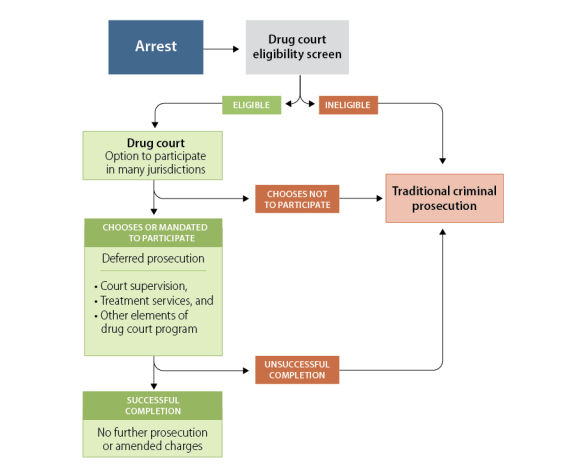 |
Source: CRS illustration of pretrial, deferred-prosecution drug court model.
Notes: The defendant does not have to enter a plea to charges under this drug court model. For an example of a pretrial model involving a deferred prosecution drug court program, see the |
2025 Florida Statutes, Title 48, Section 948.08 and Title 29, Section 397.334. Of note, counties in Florida also offer post-adjudication options. Figure 2 illustrates a postadjudication model where defendants must plead guilty to charges (as part of a plea deal) in order to participate in the drug court program. Upon completion of this type of program, their sentences may be amended or waived, and in some jurisdictions, their offenses may be expunged.
|
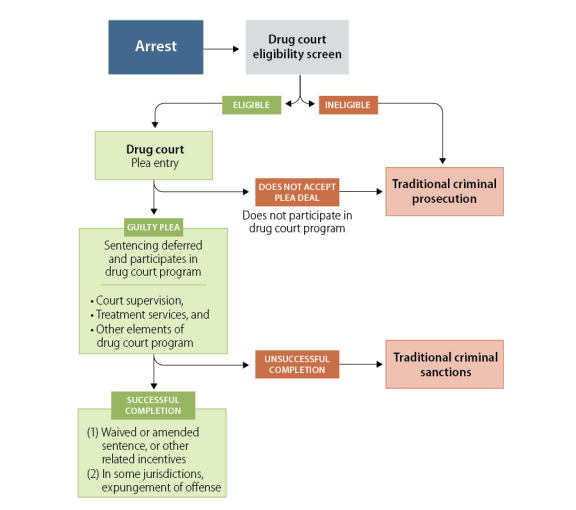 |
Source: CRS illustration of postadjudication drug court model.
Notes: For an example of a postadjudication model involving a guilty plea |
Ada County (ID) Drug Court Program, https://adacounty.id.gov/judicial-court/district-court/drug-courts/.
These diagrams illustrate two common models of drug courts, but other models (or variations on the above) have been developed around the country. For example, some drug court referrals may come as a condition of probation. Many drug courts, including some federal drug court programs, are actually reentry programs that assist a drug-addicted prisonerrecently released prisoners with substance misuse disorders with reentering the community while receiving treatment for substance abuse.
.
While drug courts vary in compositiontheir operations and target population, they generally have a comprehensive model involving
- offender screening and assessment of risks and needs,
- judicial interaction,
- monitoring (e.g., drug and alcohol testing) and community supervision,
- graduated sanctions and incentives, and
-
treatment and rehabilitation services.
6
8Drug courts are usually managed by a multidisciplinary team of individuals from (1) criminal justice,7 (2) social work, and (3) treatment service.8
including judges, prosecutors, defense attorneys, community corrections officers, social workers, and substance treatment professionals.9
Drug courts typically utilize a multiphase treatment approach including a stabilization phase, an intensive treatment phase, and a phases, treatment, and transition phase. The stabilization phasephases. Stabilization phases may include a period of detoxificationcrisis intervention, initial treatment assessment, and education, as well as and planning, and additional screening for other needs. The intensive treatment phase such as housing. Treatment typically involves counseling and other therapy. Finally, the transition phase could, and may involve prosocial and life skills learning. The transition phases and recovery management may emphasize a variety of reintegration components including social integration (e.g., peer support groups), employment, education, and housing.9
Expansion10
Expansion and Evolution of Drug Courts
A group of criminal justice professionals established the first drug court in Florida in 1989; they are credited with sparking a national movement of problem-solving courts that address specific needs and concerns of certain types of offenders.1011 There are around 3nearly 4,000 drug courts (of various types) operating in the United States.1112 Drug courts have diversified to serveevolved over time and some focus on specialized groups including veterans, juveniles, and college students. Many other drug courts are hybrid courts and address issues beyond drug abusemisuse including mental health and alcohol-impaired driving. In some ways, the term "drug courts" appears to be used as a catch-all phrase for specialized programs for addicted defendants and offenders with substance use disorders (as well as co-occurring mental health disorders) at various points in the criminal justice process.
Federal Drug Courts
While the Judicial Conference of the United States has long opposed the creation of specialized federal courts,1213 there has been growing support within the federal court system and the U.S. Department of Justice (DOJ) for reentry programs that incorporate some features of drug courts.1314 While some federal district courts have created special programs for drug-involved offenders—these programs that are sometimes referred to as "drug courts"—," they are largely reentry programs that manage an inmate's reintegration to the community. A few federal drug court programs, however, manageprovide offenders with "front end" diversion options.programs.15 There have been questions about the effectiveness of drug court programs at the federal level due to the nature of federal crimes and the individuals who are arrested for allegedly committing them.
16
Federal district courts fund these specialized programs from decentralized allotments1417 given to the districts for general treatment and supervision of offenders.1518 As federal districtsdistrict courts have budget autonomy, they may elect to establish these specialized court programs.16
19
Of note, in 2017 the President's Commission on Combating Drug Addiction and the Opioid Crisis recommended that DOJ establish a federal drug court in every federal judicial district.17
20 As described above, it is up to judges and the courts to decide whether to create and operate a drug court program. Neither the Administrative Office of the United States Courts nor DOJ has published an official count of the number of federal drug court programs. Federal Drug Courts and the 21st Century Cures Act
Enacted in 2016, Section 14003 of the 21st Century Cures Act (the Cures Act; P.L. 114-255) required DOJ to establish a pilot program to determineestablish and assess the effectiveness of federal drug and mental health courts. Within one year of enactment, DOJ, with assistance from the Administrative Office of the United States Courts and the United States Probation Offices, mustwas required to establish a pilot program in at least one U.S. judicial district1821 that will divert certain offenders with mental illness or intellectual disabilities from federal prosecution, probation, or prison and place the offenders in these specialized courts. As of January 2018, this pilot program is still in the planning stages.19
22 Veterans Treatment Courts
Postdeployment, many veterans face unique challenges in readjusting to civilian life,23 and these challenges may contribute to involvement with the criminal justice system. According to the Bureau of Justice Statistics' (BJS's) National Inmate Survey from 2011 to 2012, approximately 8% (181,500) of the total incarcerated) 2016 Survey of Prison Inmates, approximately 7.9% (107,400) of the total imprisoned population in the United States2024 are veterans.2125 For approximately 14% (25,300) of these incarcerated veterans, the most serious offense that led to their incarceration10.6% (11,131) of incarcerated male veterans, the controlling offense26 that led to their imprisonment was a drug offense, and for approximately 2.4% (2,5504% (7,100), their most serious offense was driving while intoxicated or impaired.2227 Older BJS survey data indicate that 43% of veteran state prisoners and 46% of veteran federal prisoners had met the criteria for drug dependence or abuse in 2004, as opposed to 55% of nonveteran state prisoners and 45% of nonveteran federal prisoners.2328 While veterans in state prisonprisons reported lower levels of past drug use than nonveterans, a larger percentage of veterans (30%) than nonveterans (24%) reported a "recent history of mental health services."24
29
In 2008, the first veterans court was created in Buffalo, NY, in response to the combined mental health and substance abusemisuse treatment needs of justice system-involved veterans.2530 These court programs are a hybrid model of drug treatment and mental health treatment courts, and since FY2013 have had a federal grant program focused on their establishment and development.31.26 As of June 2015May 2025, there were approximately 306582 veterans treatment courts and 6 federal veterans courts.27
. Most of these programs are locally operated court programs, but there are several federal veterans court programs as well.32
Federal Support for Drug Courts
DOJ, SAMHSA, and the Office on National Drug Control Policy (ONDCP) supportFederal Support for Drug Courts
The federal government has demonstrated growing support for the drug court model primarily through financial support of drug court programs, research on drug courts, and various drug court initiatives. As discussed, some federal district courts also elect to run federal drug court programs.
Adult Treatment Court Grant Program
, and various drug court initiatives.
Drug Court Discretionary Grant Program
The Department of Justice (DOJ) supports research on drug courts,28 training and technical assistance for drug courts, and grants for their development and enhancement. The primary federal grant program that supports them is the Drug Court Discretionary Grant Program (Drug Courts Program).29 DOJ's Office of Justice Programs (OJP), Bureau of Justice Assistance (BJA) jointly administers this competitive grant program along with the Substance Abuse and Mental Health Administration (SAMHSA) within the Department of Health and Human Services (HHS). Grants are distributed to state, local, and tribal governments as well as state and local courts themselvesdrug courts is the Adult Treatment Court Grant Program (formerly called the Drug Court Discretionary Grant Program),33 a competitive grant program administered by DOJ's Office of Justice Programs (OJP), Bureau of Justice Assistance (BJA). State, local, and tribal governments, as well as state and local courts themselves, are eligible for these grants to establish and enhance drug courts for nonviolent offenders with substance abusemisuse issues.3034 See Table 1 for a five-year history of DOJ appropriations for the Drug Courts Program.
DOJ drug court grants35 and Veterans Treatment Court Grant Programs.
Table 1. Enacted Funding under DOJ for thefor DOJ Drug Court Discretionary Grant ProgramGrant Programs and Veterans Treatment Courts, FY2013-FY2017
(dollars in millions) FY2022 FY2023 FY2024 FY2025 FY2026 DOJ Drug Court Grants $88.0 $95.0 $89.0 $89.0 $86.0 Veterans Treatment Court Grants $29.0 $35.0 $32.0 $32.0 $32.0 Source: Amounts taken from the following appropriations laws enacted for FY2022–F2024 and FY2026: P.L. 117-103, P.L. 117-328, P.L. 118-42, and P.L. 119-74. The FY2025 amount reflects full-year continuing resolution amounts for these programs (see P.L. 119-4). Notes: Amounts for drug court grant programs and veterans treatment court programs are itemized under "comprehensive opioid abuse reduction activities" in appropriations laws. DOJ drug court grant programs funding includes funding for the Adult Treatment Court, Juvenile Drug Treatment Court, and Family Treatment Court grant programs.(DollarsCourt Grants, FY2022-FY2026
in millions)
|
FY2013 |
FY2014 |
FY2015 |
FY2016 |
FY2017 |
|
|
Drug Court Discretionary Grant Program |
|
$40.5 |
$41.0 |
$42.0 |
|
|
Veterans Treatment Courts |
|
$4.0 |
$5.0 |
$6.0 |
|
Source: FY2013 postsequestration amounts were provided by the Department of Justice. FY2014 enacted amounts were taken from the joint explanatory statement to accompany P.L. 113-76. FY2015 enacted amounts were taken from the joint explanatory statement to accompany P.L. 113-235. FY2016 enacted amounts were taken from the joint explanatory statement to accompany P.L. 114-113. FY2017 enacted amounts were taken from the joint explanatory statement to accompany P.L. 115-31.
a. The FY2013 amounts include rescissions of FY2013 budget authority and the amount sequestered per the Budget Control Act of 2011 (P.L. 112-25).
b. For FY2017, funding for this program was provided under the Opioid Initiative, which included other drug control-related activities.
Drug courts funded through this program may not use federal funding and matched funding to serve violent offenders. Offenders may be characterized as "violent" according to current or past convictions as well as current charges.3136 Of note, an exception to the violent offender restriction is made for veterans treatment courts that are funded through the Drug Courts Program.
Adult Treatment Court Grant Program. Grants for Veterans Treatment Courts
Since FY2013, BJA has funded
BJA administers the Veterans Treatment Court Program32 through the Drug Courts Program 37 using funds specifically appropriated for this purpose (see amounts in Table 1). As mentioned, these amounts are not subject to the violent offender exclusion according to BJA.33.38 The purpose of the Veterans Treatment Court Program is "to serve veterans struggling with addiction, serious mental illness, and/or co-occurring disorders."34reduce the use of opioids, stimulants, and other substances, including alcohol, by high-risk/high-need veterans involved in the criminal justice system."39 Grants are awarded to state, local, and tribal governments to fund the establishment and development of veterans treatment courts. While veterans treatment court grants havethe Veterans Treatment Court Program had already been part of OJP's Drug CourtsAdult Treatment Court Grant Program for several years, the Comprehensive Addiction and Recovery Act of 2016 (CARA; P.L. 114-198), specifically authorized DOJ to award grants to state, local, and tribal governments to establish or expand programs for qualified veterans,3540 including veterans treatment courts, peer-to-peer services, and treatment, rehabilitation, legal, or transitional services for incarcerated veterans.
FY2026 funding for veterans treatment courts also included $4 million for a "national center for veterans justice."41
Based on a review of program activity at the Department of Veterans Affairs (VA), the VA does not offer funding for veterans treatment courts; however, the VA operates a Veterans Justice Outreach (VJO) program,3642 which provides outreach and linkage to VA services for justice system-involved veterans, including those involved with veterans courts or drug courts.
Other DOJ Grants
Other Grant Support
Other DOJ grants, including the Edward Byrne Memorial Justice Assistance Grants (JAG)37 and Juvenile Accountability Block Grants (JABG),38 are specifically designed, or may be used, for drug court purposes as well. The Office of Juvenile Justice and Delinquency Prevention (OJJDP) administers both the Family Treatment Court Program and Juvenile Treatment Court Program. According to BJA, family treatment courts "serve parents who require treatment for a substance use disorder and who are involved with the child welfare system because of child abuse, neglect, or other parenting issues."43 Juvenile drug treatment courts are specifically meant for youth involved in the juvenile justice system who have substance use disorders or have co-occurring substance use and mental health disorders.44 Like the Adult Treatment Court Grant Program, grantees of these programs may not use funds to serve violent offenders.
The Edward Byrne Memorial Justice Assistance Grants (JAG)45 and Juvenile Accountability Block Grants (JABG),46 may be used to fund drug courts. One of the broader purpose areas of the JAG program is to improve prosecution and courts programs as well as drug treatment programs. The JABG program includes a designated purpose area to establish juvenile drug courts. Of note, the last time JABG received an appropriation was in FY2013, and it has been unauthorized since it expired in FY2009.
The Office of National Drug Control Policy (ONDCP), under its Other Federal Drug Control Programs account, offers drug court training and technical assistance grants, as well as support for other initiatives.39
As mentioned, SAMHSA jointly administers the Drug Courts Program with BJA. In addition, SAMHSA administers other.
Grants in Other Federal Agencies
The federal government supports drug court programs via other departments and agencies as well. For example, SAMHSA administers grants that support drug courts.40 Grants go toward the creation, expansion, and enhancement of adult and family drug courts and treatment drug courts.41 For FY2016, SAMHSA funded 122 drug court continuations, 60 new drug court grants,42 and four contracts. In FY2017, SAMHSA planned to fund 103 drug court continuations, 71 new drug court grants, and two contracts.43
|
FY2013 |
FY2014 |
FY2015 |
FY2016 |
FY2017 |
|
$39.40 |
$52.75 |
$50.00 |
$60.00 |
$58.00 |
Source: Enacted funding data for FY2014-FY2016 taken from the FY2015 and FY2016 operating plans for SAMHSA and enacted funding data for FY2013 and FY2017 provided by SAMHSA. Of note, funding for drug courts is taken from the appropriations line item, "criminal justice activities."
Notes: According to SAMHSA, funding goes toward the following agencies/programs to support drug courts: (1) DOJ, Office of Juvenile Justice and Delinquency Prevention (OJJDP); (2) Partnership with Robert Wood Johnson for four years; (3) DOJ, BJA, Drug Court Discretionary Grant Program; (4) SAMHSA, Children Affected by Methamphetamine/Family Treatment Drug Court Program; and (5) SAMHSA, Grants to Develop and Expand Behavioral Health Treatment Court Collaborative.
Impact of Drug Courts
(dollars in millions) FY2022 FY2023 FY2024 FY2025 FY2026 SAMHSA Drug Court Grants $74.00 $74.00 $74.00 $64.91 $75.00 ONDCP Drug Court Grants $3.00 $3.00 $3.00 $3.00 $3.00 Notes: In appropriations documents, SAMHSA funding for drug courts falls under the more general appropriations line item, "criminal justice activities."Jurisdictions have sought to utilize drug courts to treat individuals' drug addictions47 As of 2026, the purpose of these grants is to expand substance use disorder treatment and recovery support services in existing drug courts.48 ONDCP, under its Other Federal Drug Control Programs account, offers drug court training and technical assistance grants, as well as support for other initiatives.49
Table 2. Non-DOJ Funding for Drug Courts, FY2022-FY2026
Source: Final enacted funding data taken from the annual operating plans for SAMHSA, see SAMHSA, SAMHSA Budget Archive, https://www.samhsa.gov/about/budget/archive. For ONDCP funding for drug courts, see P.L. 117-103, P.L. 117-328, P.L. 118-47, P.L. 119-4, and P.L. 119-75.
44
Over the last decade, the50
The National Institute of Justice, through its CrimeSolutions.gov evaluation program, has evaluated 21reviewed published research on 13 drug court programs and found that 19 of them had either "effective" or9 of them were "promising" ratings while two had ratings of "no effects." Most reported positive results for recidivism outcomes. For cost evaluations, only some programs had these data and these evaluations showed mixed results. Some programs showed significant cost savings while others had insignificant findings for cost impacts.45
Several studies have demonstrated that drug courts may lower recidivism rates and/or lower costs for processing defendants and offenders compared to traditional criminal justice processing.46 For example, onewhile 4 were "effective."51 Positive outcomes included lower recidivism and lower costs, but programs had different measures of success according to the specialized nature of the program and the intended outcome.52 For example, one family drug court program evaluation reported that parent participants were more likely to have their children returned, more likely to experience a permanency-planning outcome, and less likely to have their parental rights terminated, among other positive outcomes.53 One group of researchers examined the impact of a drug court over 10 years and concluded that treatment and other costs associated with the drug court (investment costs)47 per offender54 were $1,392 less per defendant or offender than investment costs of traditional criminal justice processing. In addition, savings due to reduced recidivism (outcome costs) for drug court participants were more than $79 million over the 10-year period.4855 A collaboration of researchers conducted a five-year longitudinal study of 23 drug courts from several regions ofaround the United States and reportedfound that drug court participants were significantly less likely than nonparticipants to relapse into drug use and participants committed fewer criminal acts than nonparticipants after completing the drug court program.49
Still, some are skeptical of the impact of drug courts. The Drug Policy Alliance50 has claimed56 States have also evaluated their drug court programs. For example, in a 2022 report, Maryland stated that adult treatment court programs saved more than $21.4 million for the state over two years and reduced the number of rearrests for program participants.57
Still, some are skeptical of the impact of drug courts. Among other critiques of the drug court model,58 the Drug Policy Alliance (DPA)59 has argued that drug courts help only offenders who are expected to do well and do not truly reduce costs. This organizationThe DPA also has criticized drug courts for punishing addictionthose with more intractable substance misuse problems because drug courts dismiss those who are not able to abstain from substance use.51
60
Selected Issues for Congress
Support for Drug Courts and Drug Court Research
Even though most of the early research on drug courts suggests they are a promising approach for defendants and offenders with drug problems, criticisms of the model persist and policymakersSelected Issues for Congress
The Opioid Epidemic
Congress has long been concerned over illicit drug use and abuse in the United States. Recently, Congress has given attention to opioid abuse, and especially overdose deaths involving prescription and illicit opioids.52 In 2015, there were 52,404 drug overdose deaths in the United States, including 33,091 (63.1%) that involved an opioid.53 Also, in 2016 SAMHSA estimated that 329,000 Americans age 12 and older were current users54 of heroin and approximately 3.8 million Americans were current "misusers"55 of prescription pain relievers.56 Policymakers may debate whether drug courts are an effective tool in the package of federal efforts to address the opioid epidemicdrug misuse and addiction among the justice-involved population. Policy options include, but are not limited to, increasingadjusting federal funding for drug courts, expanding and research on these programs, expanding or contracting federal drug court programs, and amending the Drug Courts ProgramDOJ drug court programs to possibly include a broader group of offenders, among other potential changes.
Drug Court Inclusion of Violent Offenders
As discussed, grant recipients of the federal Drug Courts ProgramDOJ drug court grants, with the exception of veterans treatment courtscourt grants, must exclude violent offenders;57 however, some argue that drug courts should include violent offenders. One group of researchers compared the outcomes for violent and nonviolent offenders and concluded that courts should consider the current charge rather than the offender's history of violence, and the type and seriousness of the offender's substance abuse problem when selecting individuals for drug court programs.58 They found that while it appeared that individuals with a history of violence (defined as at least one violent charge before entering drug court) were more likely to fail the program than those who never had been charged with a violent crime, the relationship between history of violence and drug court success disappeared when controlling for total criminal history.59 More serious offenders are less likely than low-level or first-time offenders to abstain from crime, and some argue that drug courts may be the best option for these individuals.
Substance abuse and crime have long been linked,60 and diversion and treatment may assist some individuals in avoiding criminal behavior. Congress may wish to maintain the exclusion of violent offenders from the Drug Courts Program, or it may consider broadening the pool of eligible offenders that may participate in BJA-funded drug court programs to include certain violent offenders.
Author Contact Information
Acknowledgments
Amber Wilhelm contributed to the graphics used in this report.
Footnotes
| 1. |
For further discussion, see CRS Report R43749, Drug Enforcement in the United States: History, Policy, and Trends. |
|||||||||||||||||||||||||
| 2. |
Executive Office of the President under President Barack Obama, Office of National Drug Control Policy, About ONDCP, https://obamawhitehouse.archives.gov/ondcp/about. |
|||||||||||||||||||||||||
| 3. |
President Trump's First Budget Commits Significant Resources to Fight the Opioid Epidemic, May 23, 2017, https://www.whitehouse.gov/the-press-office/2017/05/23/president-trumps-first-budget-commits-significant-resources-fight-opioid. |
|||||||||||||||||||||||||
| 4. |
See research discussion further along in this report. Also, see National Institute of Justice, Drug Courts, January 2017, https://nij.gov/topics/courts/drug-courts. |
|||||||||||||||||||||||||
| 5. |
Defendants are individuals who have been charged with committing an offense for which they have not yet been convicted. |
|||||||||||||||||||||||||
| 6. |
| |||||||||||||||||||||||||
| 7. |
Including judges, prosecutors, defense attorneys, and community corrections officers. |
|||||||||||||||||||||||||
| 8. |
U.S Department of Justice, Office of Justice Programs, Drug Courts, June 2015, https://www.ncjrs.gov/pdffiles1/nij/238527.pdf. |
|||||||||||||||||||||||||
| 9. |
U.S Department of Justice, Office of Justice Programs, Bureau of Justice Assistance, Defining Drug Courts: The Key Components, Drug Courts Resource Series, NCJ 205621, October 2004, https://www.ncjrs.gov/pdffiles1/bja/205621.pdf. |
|||||||||||||||||||||||||
| 10. |
| |||||||||||||||||||||||||
| 11. |
| |||||||||||||||||||||||||
| 12. |
See, for example, Administrative Office of the U.S. Courts (A.O. Courts), Report of the Proceedings of the Judicial Conference of the United States, September 1986, p. 60, and September 1990, p. 82, http://www.uscourts.gov/about-federal-courts/reports-proceedings-judicial-conference-us. See also CRS correspondence with A.O. Courts on April 1, 2016. |
|||||||||||||||||||||||||
| 13. | Substance misuse and crime have long been linked,63 and diversion and treatment may assist some individuals in avoiding criminal behavior. Congress may maintain the exclusion of violent offenders from DOJ drug court grants, or it may consider broadening the pool of eligible offenders that may participate in these programs to include certain violent offenders. CRS Graphics Specialist Amber Wilhelm contributed to the graphics used in this report. The White House, National Drug Control Strategy, September 5, 1989, p. 7, https://www.ojp.gov/pdffiles1/ondcp/119466.pdf. Ibid., p. 24. The White House, National Drug Control Strategy, 2026, pp. 5-6, https://www.whitehouse.gov/wp-content/uploads/2026/05/National-Drug-Control-Strategy-2026-1.pdf. See discussion of research later in this CRS report, and various research cited by the National Institute of Justice (NIJ), Overview of Drug Courts, July 2020, https://nij.ojp.gov/topics/articles/overview-drug-courts. Defendants are individuals who have been charged with committing an offense for which they have not yet been convicted or found not guilty. Offenders are individuals who have been convicted of an offense. This report generally refers to "substance misuse" and "substance disorders" as issues that drug court programs aim to address. Some drug court programs may broadly address "substance misuse" while others specifically refer to "substance use disorders." The American Public Health Association (APHA) generally describes "substance misuse" as the use of illegal drugs and the inappropriate use of legal substances; see APHA, Substance Misuse, https://www.apha.org/topics-and-issues/substance-misuse. According to the National Library of Medicine, National Center for Biotechnology Information, a "substance use disorder" occurs "when the recurrent, problematic use of alcohol or drugs causes clinically significant impairment, including health problems, disability, and failure to meet major responsibilities at work, school, or home"; see National Library of Medicine, National Center for Biotechnology Information, 2022 National Healthcare Quality and Disparities Report, October 2022, https://www.ncbi.nlm.nih.gov/books/NBK587176/. DOJ, Office of Justice Programs (OJP), Drug Treatment Courts, May 2025, https://www.ojp.gov/pdffiles1/nij/238527.pdf. AllRise, Adult Treatment Court Best Practice Standards, January 2026, https://allrise.org/wp-content/uploads/2026/01/All-Rise_Adult-Treatment-Court-Best-Practice-Standards_January-2026-4.pdf; and DOJ, OJP, Bureau of Justice Assistance (BIA), Defining Drug Courts: The Key Components, Drug Courts Resource Series, NCJ 205621, October 2004. DOJ, OJP states there were 3,881 drug courts operating in the United States as of May 2025. See DOJ, OJP, Drug Treatment Courts, May 2025, https://www.ojp.gov/pdffiles1/nij/238527.pdf. See, for example, Administrative Office of the U.S. Courts (A.O. Courts), Report of the Proceedings of the Judicial Conference of the United States, September 1986, p. 60, and September 1990, p. 82, https://www.uscourts.gov/administration-policies/governance-judicial-conference/reports-proceedings-judicial-conference-us. Also, information on federal court operations was provided to CRS from A.O. Courts through correspondence on April 1, 2016. | |||||||||||||||||||||||||
| 14. |
Joseph Dule et al., "Assessing the Impact of Federal Support Court Using Propensity Score Analysis," Federal Probation, vol. 85, no. 3 (December 2021). DOJ, Report to Congress on the feasibility of federal drug courts, June 2006. | |||||||||||||||||||||||||
Currently, there are no specific funding data for these programs. | ||||||||||||||||||||||||||
Conversation between CRS and | ||||||||||||||||||||||||||
The President's Commission on Combating Drug Addiction and the Opioid Crisis, Final Report, November 1, 2017, p. 11, https:// | ||||||||||||||||||||||||||
| 18. | Before making a designation, the Attorney General must (1) obtain the approval of the U.S. Attorney and chief judge for the judicial district being designated, and (2) determine that the judicial district being designated has adequate behavioral health systems for treatment. | |||||||||||||||||||||||||
| 19. |
CRS correspondence with the Administrative Office of the U.S. Courts in January 2018. There is no publicly available information on this project from DOJ. |
|||||||||||||||||||||||||
| 20. |
Excluding military-operated facilities. |
|||||||||||||||||||||||||
| 21. |
Jennifer Bronson, Ann Carson, and Margaret E. Noonan, et al., Veterans in Prison and Jail, 2011-12, U.S. Department of Justice, Bureau of Justice Statistics (BJS), NCJ 249144, December 2015, http://www.bjs.gov/content/pub/pdf/vpj1112.pdf. These are the most recent data available from BJS. |
|||||||||||||||||||||||||
| 22. |
Based on CRS calculation of 2011-2012 Bureau of Justice Statistics data. |
|||||||||||||||||||||||||
| 23. |
Margaret E. Noonan and Christopher J. Mumola, Veterans in State and Federal Prison, 2004, Bureau of Justice Statistics, NCJ 217199, May 2007, pp. 5-6, http://www.bjs.gov/content/pub/pdf/vsfp04.pdf. |
|||||||||||||||||||||||||
| 24. |
Mental health services include an overnight stay in a hospital, use of a prescribed medication, or treatment by a mental health professional. |
|||||||||||||||||||||||||
| 25. |
Office of National Drug Control Policy, Veterans Treatment Courts, Fact Sheet, December 2010, https://www.whitehouse.gov/sites/default/files/ondcp/Fact_Sheets/veterans_treatment_courts_fact_sheet_12-13-10.pdf. |
|||||||||||||||||||||||||
| 26. |
For more information about mental health courts, see Council of State Governments Justice Center, Mental Health Courts: A Primer for Policymakers and Practitioners, A report prepared for the Bureau of Justice Assistance, 2008, http://ojp.gov/newsroom/testimony/2009/mentalhealthcourts.pdf. |
|||||||||||||||||||||||||
| 27. | Based on CRS correspondence with A.O. Courts in January 2018, this pilot program was still in the planning stages in 2018. CRS could not locate publicly available information on these projects, and is unable to confirm whether either pilot program was ever created. For information regarding substance use and mental health issues affecting veterans, see National Institutes of Health, National Institute on Drug Abuse, Drug Facts: Substance Use and Military Life, https://nida.nih.gov/publications/drugfacts/substance-use-military-life. Excluding military-operated facilities. Laura M. Maruschak et al., Veterans in Prison, DOJ, Bureau of Justice Statistics (BJS), NCJ 252646, March 2021, https://bjs.ojp.gov/content/pub/pdf/vpspi16st.pdf. These are the most recent data available from BJS. According to BJS, for sentenced and unsentenced prisoners with one offense, the controlling offense is that offense. For sentenced prisoners with multiple offenses and sentences, the controlling offense is the offense with the longest sentence. For sentenced prisoners with multiple offenses and one sentence, and for unsentenced prisoners with multiple offenses, the controlling offense is the most serious offense. Violent offenses are the most serious, followed by property, drug, public-order, and all other offenses. Based on CRS analysis of 2016 BJS data. Margaret E. Noonan and Christopher J. Mumola, Veterans in State and Federal Prison, 2004, BJS, NCJ 217199, May 2007, pp. 5-6, https://bjs.ojp.gov/document/vsfp04.pdf. Mental health services include an overnight stay in a hospital, use of a prescribed medication, or treatment by a mental health professional. Office of National Drug Control Policy (ONDCP), Veterans Treatment Courts, Fact Sheet, December 2010, https://obamawhitehouse.archives.gov/ondcp/ondcp-fact-sheets/veterans-treatment-courts. For more information about mental health courts, see Council of State Governments Justice Center, Mental Health Courts, https://csgjusticecenter.org/projects/mental-health-courts/. DOJ, OJP, Drug Treatment Courts, May 2025, https://www.ojp.gov/pdffiles1/nij/238527.pdf. For an example of a federal veterans court, see the program created in the Eighth Judicial District of Montana: U.S. Probation and Pretrial Services, District of Montana, Veterans, https://www.mtp.uscourts.gov/veterans; and DOJ, Veterans Court Now Available for Vets Charged with Federal Crimes in Montana, March 26, 2015, https://www.justice.gov/usao-mt/pr/veterans-court-now-available-vets-charged-federal-crimes-montana. See also information on the Veterans Diversion Court in the Southern District of California: United States Pretrial Services, Southern District of California, Veterans Diversion Court, https://www.caspt.uscourts.gov/veterans-diversion-court. | |||||||||||||||||||||||||
| 28. |
| |||||||||||||||||||||||||
| 29. |
| |||||||||||||||||||||||||
| 30. |
| |||||||||||||||||||||||||
| 31. | bja.ojp.gov/program/adult-treatment-court-program/overview.
DOJ drug court grant programs funding includes funding for the Adult Treatment Court, Juvenile Drug Treatment Court, and Family Treatment Court grant programs. See the "Other DOJ Grants" section. Funding figures do not capture all federal support for drug courts. For example, grantees of the Edward Byrne Memorial Justice Assistance Grants (JAG) Program may use grant funding for drug court purposes, but those amounts are not included in this report. For the purposes of juvenile drug courts, the term "violent offender" means a juvenile who has been convicted of, or adjudicated delinquent for, a felony-level offense that "(1) has as an element, the use, attempted use, or threatened use of physical force against the person or property of another, or the possession or use of a firearm; or (2) by its nature, involves a substantial risk that physical force against the person or property of another may be used in the course of committing the offense." | |||||||||||||||||||||||||
| 32. |
OJP identifies this program as a hybrid of drug and mental health court programs. |
|||||||||||||||||||||||||
| 33. |
See p. 5 of the FY2017 competitive grant announcement for the Adult Drug Court Discretionary Grant Program, https://www.bja.gov/funding/DrugCourts17.pdf. |
|||||||||||||||||||||||||
| 34. |
U.S. Department of Justice, Office of Justice Programs, FY2017 Performance Budget, p. 51, https://www.justice.gov/jmd/file/822366/download. |
|||||||||||||||||||||||||
| 35. |
BJA states that these programs connect veterans who come in contact with the justice system to treatment for substance use disorders, mental health disorders, co-occurring mental health and substance use disorders, post-traumatic stress disorder, and traumatic brain injury. Congress did not make this exclusion for veterans treatment programs (34 U.S.C. Subtitle I, Chapter 101, Subchapter XXXIII) as they did in the authorization for drug court programs (34 U.S.C. Subtitle I, Chapter 101, Subchapter XXX). See also the most recent competitive grant announcement for the Veterans Treatment Court Program: DOJ, OJP, BJA, BJA FY25 Veterans Treatment Court Program, https://www.ojp.gov/funding/docs/bja-2025-172484.pdf and Frequently Asked Questions (FAQ): Violent Offender Prohibition, March 2023, https://www.ojp.gov/library/publications/frequently-asked-questions-faq-violent-offender-prohibition. Ibid. | |||||||||||||||||||||||||
| 36. |
See P.L. 119-74, 140 Stat. 33. See DOJ, OJP, Office of Juvenile Justice and Delinquency Prevention (OJJDP), OJJDP FY25 Juvenile Drug Treatment Court Program, p. 10, https://www.ojp.gov/funding/docs/OJJDP-2025-172515.pdf. As of the cover date of this report, this is the most recent grant solicitation for this program. For more information on the Juvenile Treatment Court Program, see OJJDP, Juvenile Drug Treatment Courts, https://ojjdp.ojp.gov/programs/juvenile-drug-treatment-courts. For more information on the JAG program, see CRS In Focus IF10691, The Edward Byrne Memorial Justice Assistance Grant (JAG) Program. For more information on the JABG program, see CRS Report R44879, Juvenile Justice Funding Trends. SAMHSA supports drug courts under the broader category of criminal justice activities. See U.S. Department of Health and Human Services (HHS), SAMHSA, Grants to Expand Substance Abuse Treatment Capacity in Adult and Family Treatment Drug Courts, https://www.samhsa.gov/grants/grant-announcements/ti-22-010. For more information, see Executive Office of the President, ONDCP, Information & Resources, https://www.whitehouse.gov/ondcp/information-resources/. | |||||||||||||||||||||||||
| 37. |
For more information on the JAG program, see CRS Report RS22416, Edward Byrne Memorial Justice Assistance Grant (JAG) Program: In Brief, by Nathan James (available to congressional clients upon request). |
|||||||||||||||||||||||||
| 38. |
For more information on the JABG program, see CRS Report RL33947, Juvenile Justice: Legislative History and Current Legislative Issues, by Kristin Finklea. |
|||||||||||||||||||||||||
| 39. |
For more information, see Executive Office of the President, ONDCP, Grants & Programs, https://www.whitehouse.gov/ondcp/grants-programs. |
|||||||||||||||||||||||||
| 40. |
SAMHSA supports drug courts under the broader category of criminal justice activities. |
|||||||||||||||||||||||||
| 41. |
For more information about treatment drug courts, see the SAMHSA FY2016 and FY2017 grant announcements and awards for drug court programs, https://www.samhsa.gov/grants. |
|||||||||||||||||||||||||
| 42. |
The 60 new drug court grants include new BJA jointly funded drug court grants. |
|||||||||||||||||||||||||
| 43. |
Department of Health and Human Services, Substance Abuse and Mental Health Services Administration, Fiscal Year 2018 Justification of Estimates for Appropriations Committees, p. 196, https://www.samhsa.gov/sites/default/files/samhsa-fy-2018-congressional-justification.pdf. |
|||||||||||||||||||||||||
| 44. |
| |||||||||||||||||||||||||
| 45. |
See profiles for 21 drug court programs at https://www.crimesolutions.gov/TopicDetails.aspx?ID=238. |
|||||||||||||||||||||||||
| 46. | CRS identified these evaluations by searching for "drug court" on CrimeSolutions.gov (using the courts tab) on September 8, 2026. The search provided 13 program evaluations of drug court programs that were posted by the National Institute of Justice from 2011 to 2022. | |||||||||||||||||||||||||
| 47. | https://nij.ojp.gov/topics/articles/nijs-multisite-adult-drug-court-evaluation
For the full program profile and evaluation outcomes, see NIJ, Program Profile: Family Drug Treatment Court (Snohomish County, WA), May 8, 2018, https://crimesolutions.ojp.gov/ratedprograms/family-drug-treatment-court-snohomish-county-wa. | |||||||||||||||||||||||||
Michael W. Finigan | ||||||||||||||||||||||||||
For a summary of and various publications discussing the Multisite Adult Drug Court Evaluation (2012) funded by NIJ and conducted by the Urban | ||||||||||||||||||||||||||
| 50. |
The Drug Policy Alliance is a national advocacy group that advocates for drug law reform. |
|||||||||||||||||||||||||
| 51. |
Drug Policy Alliance, Drug Courts are Not the Answer: Toward a Health-Centered Approach to Drug Use, March 2011. |
|||||||||||||||||||||||||
| 52. |
For example, in July 2016 Congress passed and the President signed the Comprehensive Addiction and Recovery Act of 2016 (CARA; P.L. 114-198). |
|||||||||||||||||||||||||
| 53. |
Rose A. Rudd, Puja Seth, and Felicita David, et al., Increases in Drug and Opioid Overdose Deaths—United States, 2010–2015, Centers for Disease Control and Prevention, Morbidity and Mortality Weekly Report (MMWR), December 30, 2016, https://www.cdc.gov/mmwr/volumes/65/wr/mm655051e1.htm. |
|||||||||||||||||||||||||
| 54. |
"Current use" is defined as use in the past month. |
|||||||||||||||||||||||||
| 55. |
SAMHSA defines misuse of prescription drugs as "use in any way not directed by a doctor including use without a prescription of one's own medication; use in greater amounts, more often, or longer than told to take a drug; or use in any other way not directed by a doctor." Prescription drugs do not include over-the-counter drugs. |
|||||||||||||||||||||||||
| 56. |
Subtypes of pain relievers include hydrocodone, oxycodone, tramadol, codeine, morphine, fentanyl, buprenorphine, oxymorphone, Demerol®, hydromorphone, and methadone. See HHS, SAMHSA, Results from the 2016 National Survey on Drug Use and Health: Detailed Tables, September 2016, Tables 1.1A and 1.1B, https://www.samhsa.gov/data/population-data-nsduh/ and Methodological Summary and Definitions, Table C-1. |
|||||||||||||||||||||||||
| 57. |
NPC Research, Maryland Statewide Evaluation of Adult Treatment Courts: Outcome & Cost Key Findings Report, Final Report, https://www.courts.state.md.us/sites/default/files/import/opsc/dtc/pdfs/evaluationsreports/mdstatewideatckeyfindings2022.pdf. For other critiques of drug court programs, see Douglas B. Marlowe, "Drug Courts: The Good, the Bad, and Misunderstood," in Handbook of Issues in Criminal Justice Reform in the United States (2021), pp.637-658; and Bryana CHavis, "Are Drug Courts Truly Beneficial?," Social Work Review, December 26, 2025. The Drug Policy Alliance is a national advocacy group that advocates for drug law reform. Drug Policy Alliance, Drug Courts are Not the Answer: Toward a Health-Centered Approach to Drug Use, March 2011. | |||||||||||||||||||||||||
| 58. |
Christine A. Saum, Frank R. Scarpitti, and Cynthia A. Robbins, "Violent Offenders in Drug Court," Journal of Drug Issues, vol. 31, no. 107 (2001), p. 124. |
|||||||||||||||||||||||||
| 59. |
Ibid, p. 123. The offender's charges were coded into seven categories, and these categories were divided into four major offenses (violent, property, public order, drug) and three minor offenses (traffic, court—violation of probation, capiases, etc.; and other—juvenile offenses, conspiracy charges, and other miscellaneous offenses). The total number of lifetime charges for each participant indicates the extent of an offender's previous criminal involvement. |
|||||||||||||||||||||||||
| 60. |
See Bureau of Justice Statistics, Drug and Crime Facts, http://www.bjs.gov/content/dcf/duc.cfm. |
Brooke Haney et al., "Drug Court for Violent Offenders: A Review of Recidivism Outcomes," Crime & Delinquency, vol. 0, no. 0 (2025).
See BJS, Drug and Crime Facts, https://bjs.ojp.gov/drugs-and-crime-facts.