The President's budget request for fiscal year (FY) 2027 for the Department of Defense (DOD, see "Note") proposes "$5.8 billion for a 7-6-5 percent targeted military pay raise effective on January 1, 2027." The "7-6-5" formulation would provide for a tiered pay raise based on paygrade (rank), with the most junior servicemembers (E-1 through E-5) receiving the biggest percent increase (see Table 1). Per a statutory formulation under Section 1009(c) of Title 37, United States Code, there is an automatic annual pay adjustment tied to the increase in the Employment Cost Index (ECI) from the third quarter of 2025 to the third quarter of 2026. The proposed "7-6-5" increase would be larger than the automatic annual adjustment of 3.6% for calendar year 2027.
Under 37 U.S.C. §1009(e) the President has the authority to propose an alternative pay adjustment "[i]f, because of national emergency or serious economic conditions affecting the general welfare, the President considers the pay adjustment which would otherwise be required by this section in any year to be inappropriate." Per this statute, the President is required to submit a plan to Congress for the adjustment along with the reasons for the adjustment, to include "the impact that the alternative pay adjustments proposed in the plan would have on the Government's ability to recruit and retain well-qualified persons for the uniformed services."
The President and Congress have acted in the past to set military pay higher or lower than the statutory adjustment, and to make pay table adjustments for targeted paygrades (see Table 1 in CRS In Focus IF10260, Defense Primer: Military Pay Raise). The President's proposed pay increase would follow recent pay table adjustments enacted in the Servicemember Quality of Life Improvement and National Defense Authorization Act for Fiscal Year 2025 (FY2025 NDAA, P.L. 118-159). The FY2025 NDAA allowed for an inflation-adjusted pay increase, effective January 1, 2025, for all servicemembers, and more targeted increases for junior enlisted servicemembers in the paygrades of E-5 and below starting on April 1, 2025 (see Table 1).
The House Armed Services Committee (HASC) and the House Appropriations Committee, Defense Subcommittee-reported versions of an FY2027 NDAA would support the President's proposed pay raise. The Senate Armed Services Committee (SASC)-reported version would provide a pay raise of 3.6%, consistent with the ECI under the statutory formula.
Table 1. Military Basic Pay Adjustment Authorizations
Enacted and proposed amounts with effective dates; January 2025 – January 2027
|
Enacted Amount and Effective Date |
Proposed Amount and Effective Date |
|||||
|
Paygrade |
Jan. 2025 |
Apr. 2025 |
Jan. 2026 |
Jan. 2027 Presidenta |
Jan. 2027 HASC |
Jan. 2027 SASC |
|
E-1 through E-4 |
4.5% |
additional 10% over Jan. 2025 increase |
3.8% |
7% |
7% |
3.6% |
|
E-5 |
4.5% |
average additional 7% over Jan. 2025 increase for E-5s with fewer than 10 years of service |
3.8% |
7% |
7% |
3.6% |
|
E-6 through O-3 |
4.5% |
none |
3.8% |
6% |
6% |
3.6% |
|
O-4 and above |
4.5% |
none |
3.8% |
5% |
5% |
3.6% |
Source: CRS analysis of the FY2025 NDAA (P.L. 118-159) and the FY2027 Department of War Budget Overview Book.
Notes: The rate of basic pay an individual receives varies based on paygrade and years of military service. Pay tables are available at https://www.dfas.mil/militarymembers/payentitlements/Pay-Tables.
a. Proposal averages 6.2% "across the force," per DOD Budget Overview.
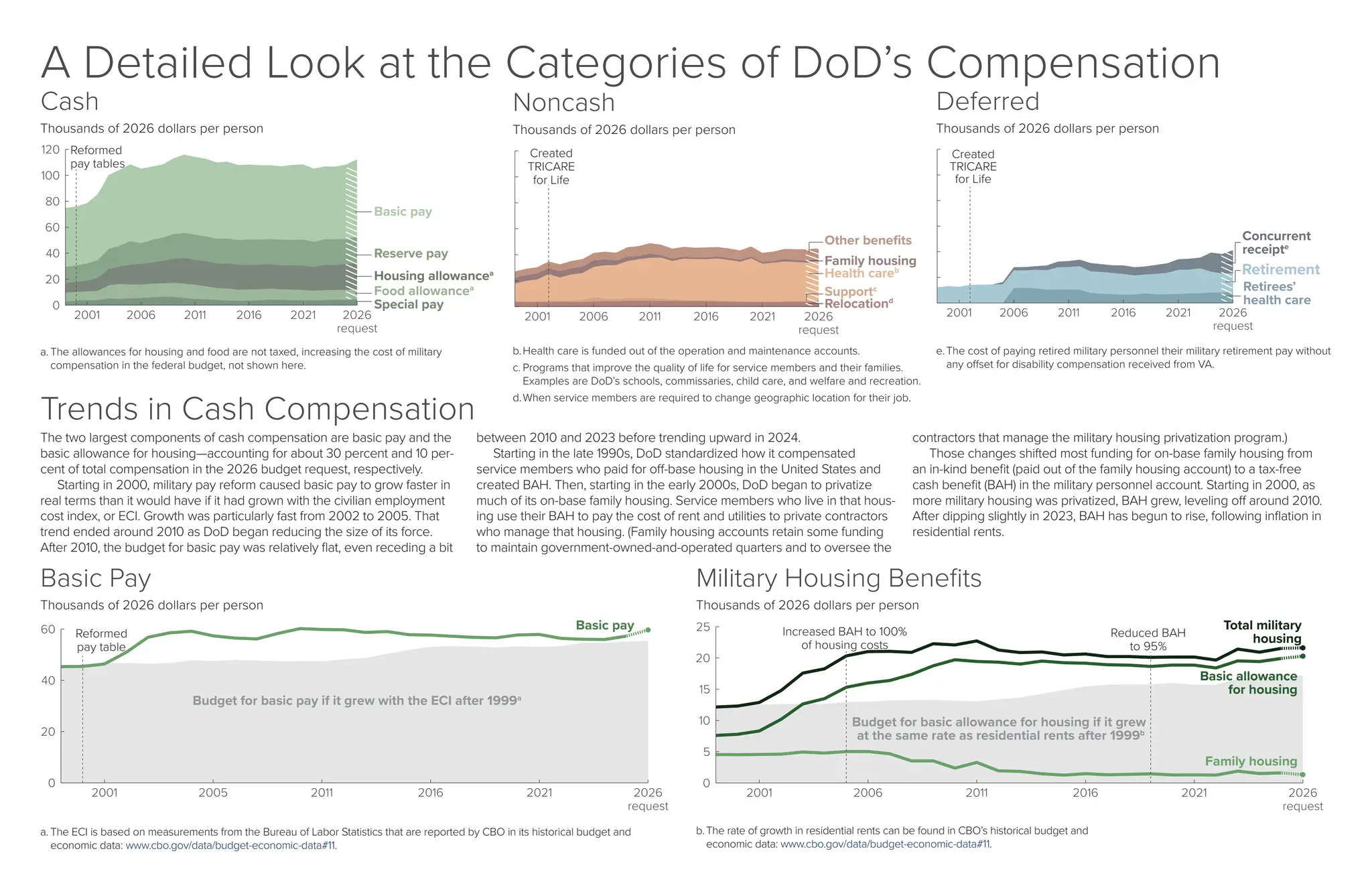
Military basic pay is funded through the Military Personnel (MILPERS) portion of DOD's budget, which also funds other military compensation, such as housing and subsistence allowances, special and incentive pay, travel pay, and military retired pay accrual costs. The President's FY2027 MILPERS request is $205.1 billion, an increase of approximately $8.3 billion from the FY2026 request. Servicemembers also receive benefits that are funded through other accounts, such as health care, reduced-price groceries at military commissaries, tuition assistance, and subsidized child care, among other benefits. Military veterans also may be eligible to receive benefits from the Department of Veterans Affairs under a separate appropriation.
Although basic pay is normally the largest component of the cash compensation a servicemember receives, when comparing military pay to civilian earnings, analysts typically use a measure called Regular Military Compensation (RMC). RMC is a statutorily-defined measure of the cash or in-kind compensation elements which servicemembers receive every payday, and includes basic pay, basic allowance for housing, basic allowance for subsistence, and the federal tax advantage that accrues due to the exemption of allowances from income tax.
Law requires the President to direct annual reviews of the "adequacy of the pays and allowances" for the uniformed services and to conduct a comprehensive review of the compensation system at least once every four years. In its 2025 report, the Fourteenth Quadrennial Review of Military Compensation (QRMC) found military compensation (as measured by RMC) to be "more than adequate" relative to civilian pay. This report noted that pay increases can incentivize applicants and increase the pool of high-quality enlistees. Nevertheless, it also noted, "the costs of [basic] pay raises outweighed the potential benefits, particularly considering the inefficiency of a junior enlisted pay raise relative to other policies that can achieve those potential benefits," and that, "[b]asic pay is a blunt and costly instrument and most prudently deployed only when there are system-wide problems, such as both widespread retention and recruiting shortfalls, which cannot be solved more efficiently with other policy instruments." Some of the other policy instruments identified by the QRMC included targeted enlistment bonuses, performance incentives, and constructive credit for lateral entrants.
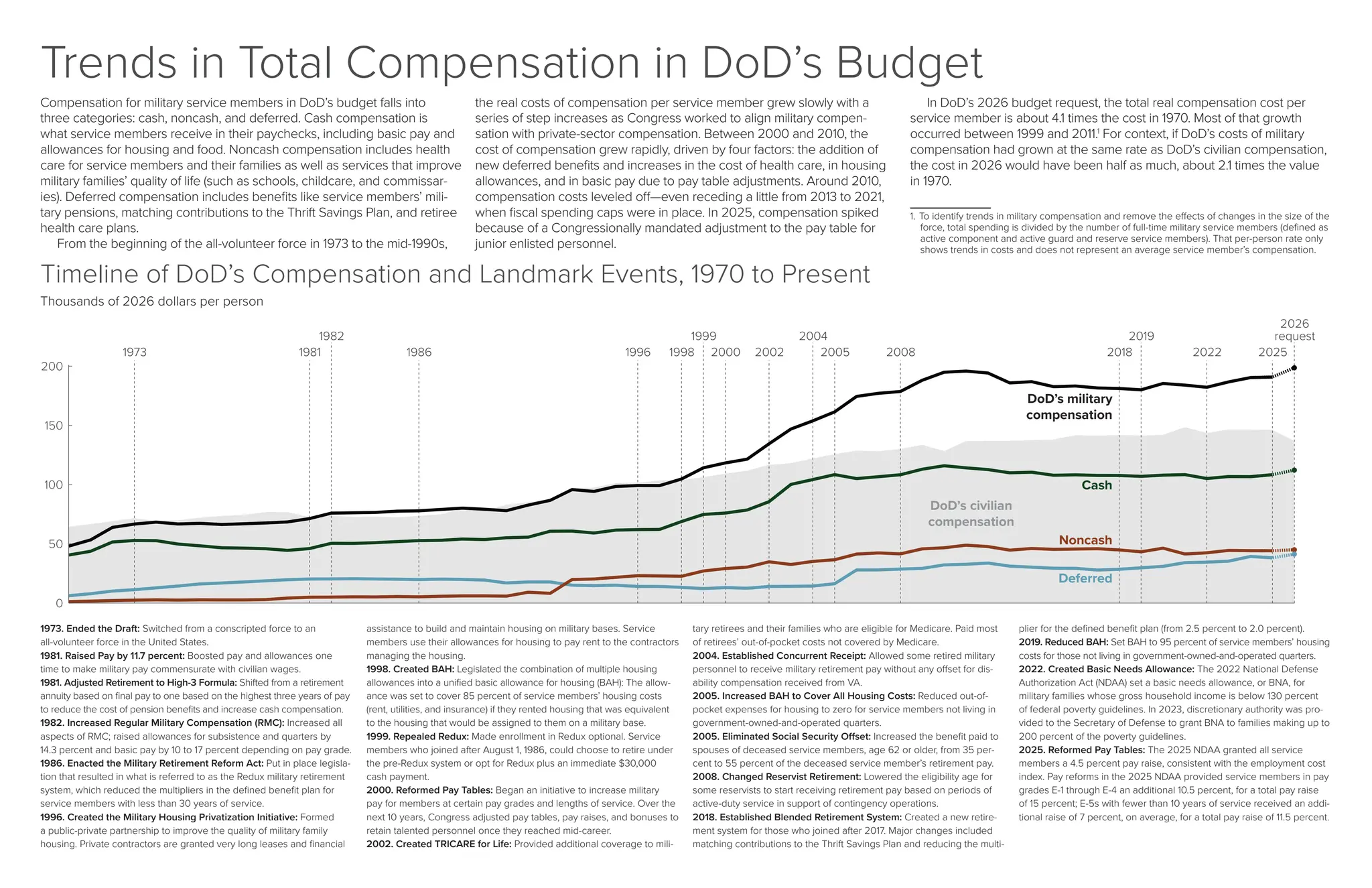
Military compensation costs have grown over time; CBO estimates that the total real cost of compensation per servicemember in the FY2026 budget was 4.1 times the cost in 1970. Congress may evaluate the FY2027 proposed pay increase against recent pay table reforms, current recruiting and retention conditions, other federal spending priorities, and potential changes to other military compensation elements.
DOD is "using a secondary Department of War designation," under Executive Order 14347, dated September 5, 2025.